Mathematics
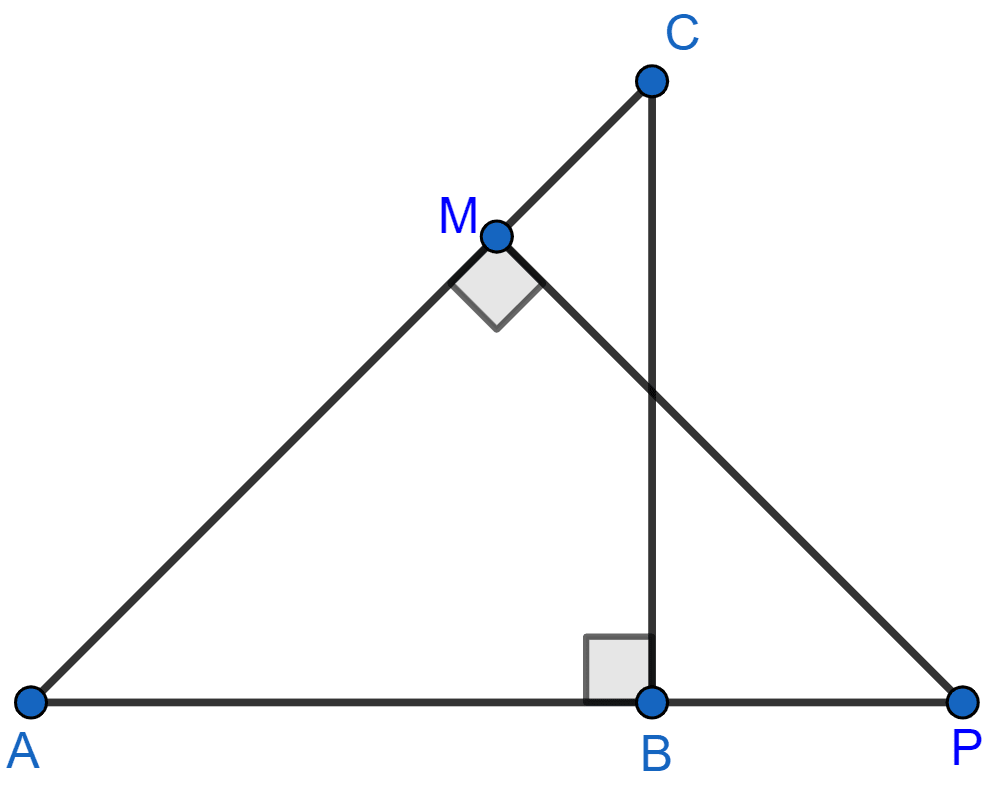
In the given figure, ΔABC and ΔAMP are right angled at B and M respectively.
Given AC = 10 cm, AP = 15 cm and PM = 12 cm.
(i) Prove that : ∆ABC ~ ∆AMP.
(ii) Find AB and BC.
Similarity
27 Likes
Answer
(i) In ∆ABC and ∆AMP, we have
⇒ ∠BAC = ∠PAM [Common]
⇒ ∠ABC = ∠PMA [Each = 90°]
∴ ∆ABC ~ ∆AMP [By AA]
Hence, proved that, ∆ABC ~ ∆AMP.
(ii) In right angle triangle AMP,
By pythagoras theorem,
⇒ AP2 = AM2 + MP2
⇒ AM2 = AP2 - MP2
⇒ AM2 = 152 - 122
⇒ AM2 = 225 - 144
⇒ AM2 = 81
⇒ AM = = 9 cm.
Since, corresponding sides of similar triangles are proportional we have :
Also,
Hence, AB = 6 cm and BC = 8 cm.
Answered By
16 Likes
Related Questions
State, true or false:
(i) Two similar polygons are necessarily congruent.
(ii) Two congruent polygons are necessarily similar.
(iii) All equiangular triangles are similar.
(iv) All isosceles triangles are similar.
(v) Two isosceles-right triangles are similar.
(vi) Two isosceles triangles are similar, if an angle of one is congruent to the corresponding angle of the other.
(vii) The diagonals of a trapezium, divide each other into proportional segments.
D is a point on the side BC of triangle ABC such that angle ADC is equal to angle BAC. Prove that: CA2 = CB x CD.
In the figure, PQRS is a parallelogram with PQ = 16 cm and QR = 10 cm, L is a point on PR such that RL : LP = 2 : 3. QL produced meets RS at M and PS produced at N. Find the lengths of PN and RM.
In the given figure, AB || EF || DC; AB = 67.5 cm, DC = 40.5 cm and AE = 52.5 cm.
(i) Name the three pairs of similar triangles.
(ii) Find the length of EC and EF.