Mathematics
In triangle ABC; M is the mid-point of AB, N is mid-point of AC and D is any point in base BC. Use intercept theorem to show that MN bisects AD.
Answer
Let MN intersects at AD at point X.
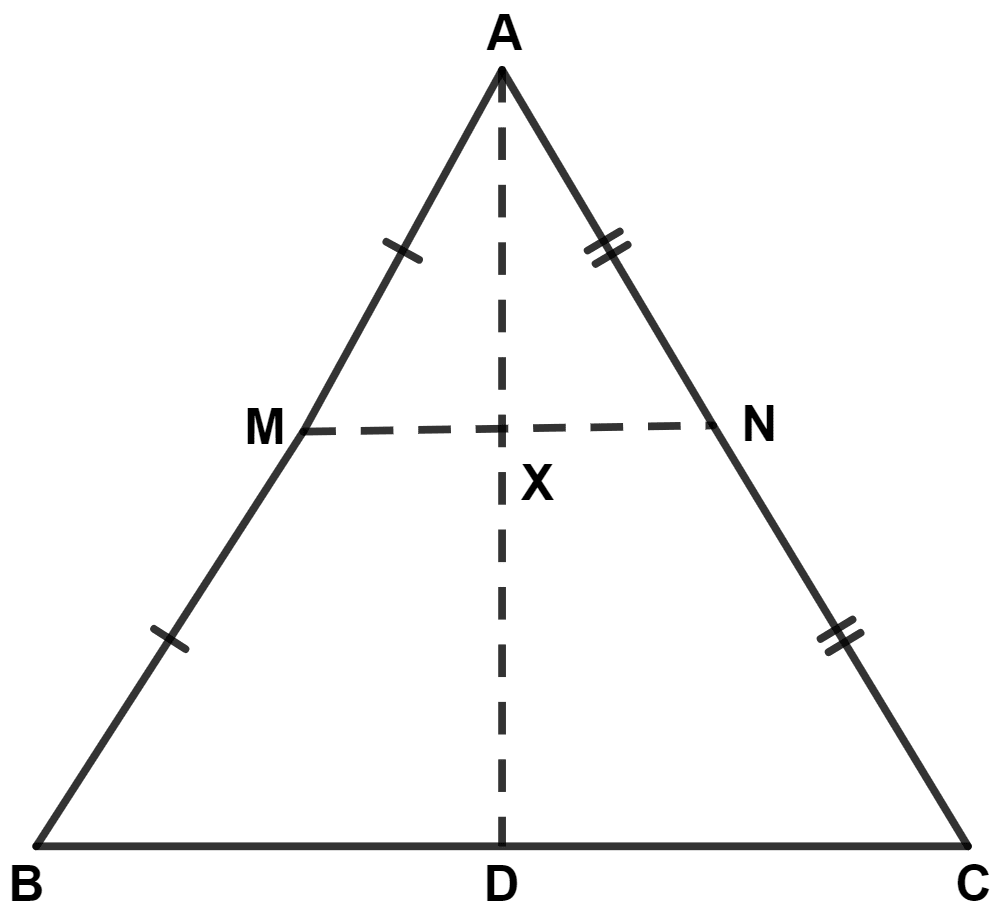
By mid-point theorem,
The line segment joining the mid-points of any two sides of a triangle is parallel to the third side and is equal to half of it.
In △ ABC,
M is mid-point of AB and N is mid-point of AC.
∴ MN || BC (By mid-point theorem)
By equal intercept theorem,
If a transversal makes equal intercepts on three or more parallel lines, then any other line cutting them will also make equal intercepts.
Since,
M is mid-point of AB.
∴ AM = MB
N is mid-point of AC.
∴ AN = CN
From figure,
MN || BC, AM = BM and AN = CN
∴ AX = DX (By equal intercept theorem)
Hence, proved that MN bisects AD.
Related Questions
In parallelogram ABCD, E and F are mid-points of the sides AB and CD respectively. The line segments AF and BF meet the line segments ED and EC at points G and H respectively. Prove that :
(i) triangles HEB and FHC are congruent;
(ii) GEHF is a parallelogram.
In triangle ABC, D and E are points on side AB such that AD = DE = EB. Through D and E, lines are drawn parallel to BC which meet side AC at points F and G respectively. Through F and G, lines are drawn parallel to AB which meet side BC at points M and N respectively. Prove that :
BM = MN = NC.
If the quadrilateral formed by joining the mid-points of the adjacent sides of quadrilateral ABCD is a rectangle, show that the diagonals AC and BD intersect at right angle.
The midpoint of the side of a triangle are joined together to get four triangles. These four triangles are:
not equal to each other
congruent to each other
not congruent to each other
none of these