
Mathematics
Joseph has a recurring deposit account in a bank for 3 years at 10% p.a. simple interest. If he gets ₹ 16,650 as interest at the time of maturity, find his monthly deposit and the maturity value.
Banking
14 Likes
Answer
Let monthly deposit be ₹ P.
Given,
r = 10%
n = 3 years or 36 months
I = ₹ 16,650
By formula,
I =
Substituting values we get :
Sum deposited = ₹ 3,000 × 36 = ₹ 1,08,000.
M.V. = Sum deposited + Interest = ₹ 1,08,000 + ₹ 16,650 = ₹ 1,24,650.
Hence, maturity value = ₹ 1,24,650.
Answered By
3 Likes
Related Questions
For the following frequency distribution :
Marks No. of students below 10 7 below 20 20 below 30 50 below 40 60 below 50 70 Assertion (A) : The modal class is 40-50.
Reason (R) : The modal class is the class of maximum frequency.
A is true, R is true
A is false, R is false
A is true, R is false
A is false, R is true
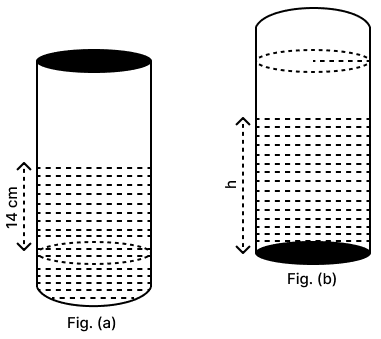
The given figure (fig a) shows a closed liquid container with a cylindrical part and a hemispherical part. It contains liquid upto a height of 14 cm of the cylindrical part. Now this container is inverted as shown in the figure (b), find the height upto which the liquid in figure (b) will stand.
Given, radius of the cylinder is 6 cm and π =
(i) Evaluate :
(ii) Evaluate :
(iii) Prove that : = 2.
If a, b and c are in continued proportion, prove that :
abc(a + b + c)3 = (ab + bc + ca)3.