
Physics
When the magnet as shown in the diagram, is moved towards the coil at a speed of 5 m s-1, the galvanometer shows a certain deflection to the right.
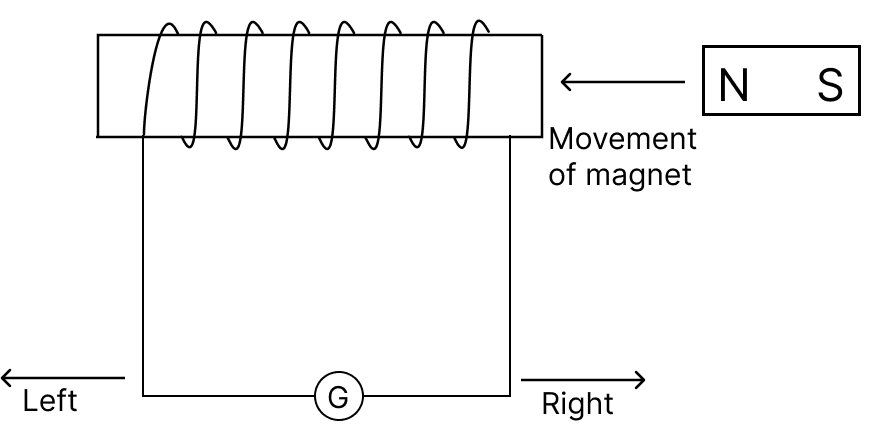
How will the direction and magnitude of deflection change when the coil also moves with a speed of 5 m s-1:
(a) in the direction of the motion of the magnet?
(b) in the opposite direction of the motion of the magnet?
Electro-Magnetism
1 Like
Answer
The deflection of the galvanometer depends on the rate of change of magnetic flux, which depends on the relative motion between the magnet and the coil.
(a) Both the magnet and the coil move in the same direction with the same speed, so there is no relative motion between them and hence, the magnetic flux through the coil does not change.
Therefore, no current is induced and the galvanometer shows no deflection.
(b) Since the magnet and the coil are moving opposite to each other so now the relative speed between them is given by the sum of individual speeds and becomes 10 m s-1 (5 + 5) which increases the rate of change of magnetic flux.
Therefore, the direction of deflection remains the same (to the right), but the magnitude of deflection increases.
Answered By
3 Likes
Related Questions
The reverse side of a three-pin plug with incorrect connection of wires is shown in the diagram below.
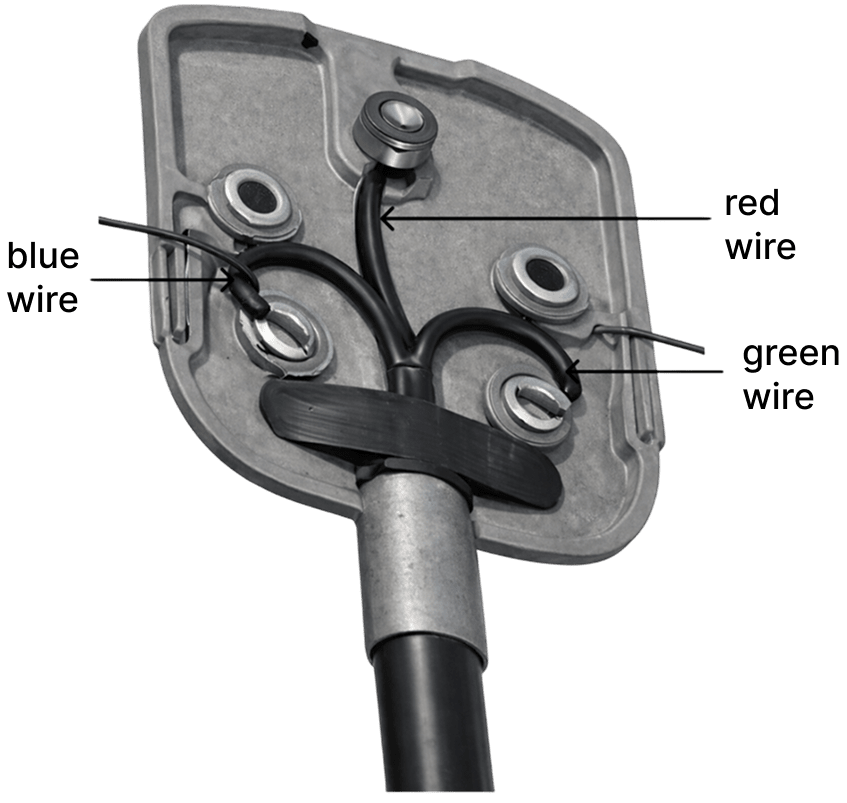
(a) Identify the fault in the above connection.
(b) Mention a risk factor involved, if the user operates the appliance without correcting it.
(c) Will the appliance function in the present situation? (Yes or No)
In the combinations of resistors shown below. calculate:
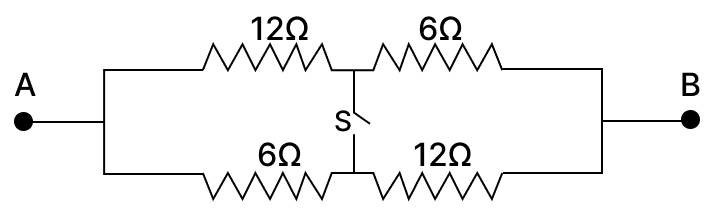
(a) the resistance across AB when the switch S is open.
(b) the resistance across AB when the switch S is closed.
An electric iron rated 1100 W, 220 V is operated for 5 hours.
Calculate:
(a) the minimum rating of the fuse required.
(b) the energy consumed in kWh.
(c) the cost of the energy consumed, if the rate is ₹ 10 per unit.
(a)
- Which element is used in the lining of the special aprons worn by workers in nuclear power plants?
- Why is this element preferred?
(b) emits a nuclear radiation which does not alter the mass number but is deflected by a magnetic field.
- Name the type of nuclear radiation emitted by .
- Write the equation for this radioactive decay.