
Physics
A magnetic compass is present on a small table, very close to the wall in a room. A man enters the room and switches on the Air Conditioner fitted near the ceiling. He observes that the needle in the compass shows immediate deflection. Identify the most probable reason for the deflection.
- Air blowing in the room.
- Current starts flowing through AC wire concealed in the adjacent wall.
- Vibrations are produced when the Man starts talking to his wife in the kitchen.
- Vibrations were produced due to a file in his hand that fell on the ground.
Electro-Magnetism
8 Likes
Answer
Current starts flowing through AC wire concealed in the adjacent wall.
Reason — When the AC is switched on, electric current flows through the concealed wires, generating a magnetic field around them. This magnetic field interacts with the magnetic compass, causing the needle to deflect. Air movement or vibrations don’t affect magnetic fields, so they wouldn’t cause the needle to move.
Answered By
3 Likes
Related Questions
The below diagram shows different copper conductors of diameters d and 2d and lengths, which are multiples of l. The increasing order of their resistances will be:
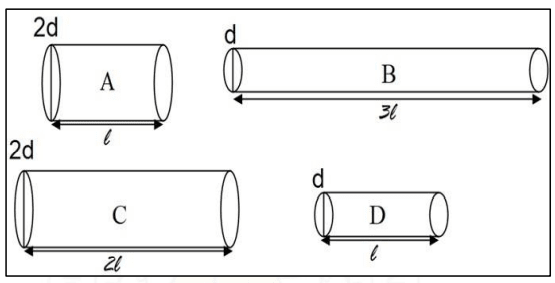
- A < B < C < D
- A < C < D < B
- A < D < C < B
- D < A < C < B
The diagram shows the magnificent dome at Gol Ghumbaz at Bijapur. A boy standing at A whispers, and it is clearly heard at B across the huge dome.
[Speed of sound is 330 ms-1]
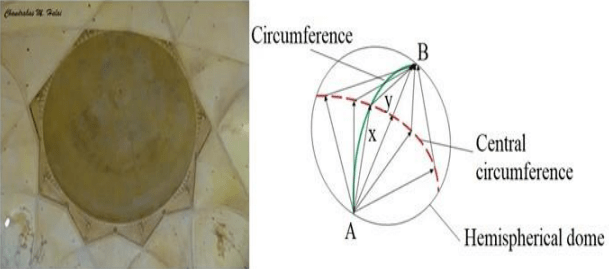
Assertion (A) : The distance travelled by sound waves (x+y) should be < 33 m.
Reason (R) : Sound reflected within 0.1 s is not heard by humans.
- A and R are true, and R is the reason for A.
- A and R are true, and R is not the reason for A.
- A is true, but R is false.
- A is false, but R is true.
Two substances, A and B, have the same mass. Substance A has a higher specific heat capacity than substance B. What consequences would you expect when these substances are subjected to the same amount of heat energy?
- Substance A will experience a smaller temperature change than substance B.
- Substance A will experience a larger temperature change than substance B.
- Both substances will experience the same temperature change.
- Either of them can show a greater change in temperature as the temperature change depends on factors other than specific heat capacity.
A student traces the path of a ray of light through a glass prism for different angles of incidence. He analyses each diagram and draws the following conclusion:
I. On entering the prism, the light ray bends towards its base.
II. Light ray suffers refraction at the point of incidence and at the point of emergence while passing through the prism.
III. An emergent ray bends at a certain angle to the direction of the incident ray.
IV. While emerging from the prism at the second surface, the angle of refraction is less than the angle of incidence at that surface.
Which of the above inferences are correct?
- I, II and III
- I, III and IV
- II, III and IV
- All of these.