
Chemistry
Match the Column A with Column B:
| Column A | Column B |
|---|---|
| (a) N2 + 3H2 ⇌ 2NH3 | 1. Vanadium Pentoxide |
| (b) 4NH3 + 5O2 ⟶ 4NO + 6H2O | 2. Nickel |
| (c) 2SO2 + O2 ⇌ 2SO3 | 3. Iron |
| (d) C2H4 + H2 ⟶ C2H6 | 4. Concentrated Sulphuric acid |
| (e) CuSO4.5H2O ⟶ CuSO4 + 5H2O | 5. Platinum |
Ammonia
16 Likes
Answer
| Column A | Column B |
|---|---|
| (a) N2 + 3H2 ⇌ 2NH3 | 3. Iron |
| (b) 4NH3 + 5O2 ⟶ 4NO + 6H2O | 5. Platinum |
| (c) 2SO2 + O2 ⇌ 2SO3 | 1. Vanadium Pentoxide |
| (d) C2H4 + H2 ⟶ C2H6 | 2. Nickel |
| (e) CuSO4.5H2O ⟶ CuSO4 + 5H2O | 4. Concentrated Sulphuric acid |
Answered By
11 Likes
Related Questions
State the terms for the following:
(a) Undistilled alcohol containing a large amount of methanol.
(b) A salt formed by the partial replacement of the hydroxyl group of a di-acidic or a tri-acidic base by an acid radical.
(c) Organic compounds having the same molecular formula but different structural formula.
(d) The tendency of an atom to attract the shared pair of electrons towards itself when combined in a compound.
(e) The type of covalent bond in which electrons are shared unequally between the combining atoms.
Complete the following sentences by choosing the correct word(s) from the brackets:
(a) …………… solution forms a coloured precipitate with ammonium hydroxide which is soluble in excess of ammonium hydroxide. [Ferrous chloride / Copper nitrate]
(b) Zinc blende is converted to zinc oxide by ……………. [Calcination / Roasting]
(c) …………… conducts electricity by the movement of ions. [Molten iron / Molten sodium chloride]
(d) The reaction that takes place at the anode during the electrolysis of aqueous Sodium argentocyanide with silver electrodes is ……………. [Ag ⟶ Ag+ + e-/ Ag+ + e- ⟶ Ag]
(e) The salt formed when ZnO reacts with hot concentrated NaOH is …………… . [sodium zincate / zinc hydroxide]
(a) Draw the structural diagram for the following organic compounds:
- 2-methyl propene
- butanal
(b) Give IUPAC name for the following organic compounds:
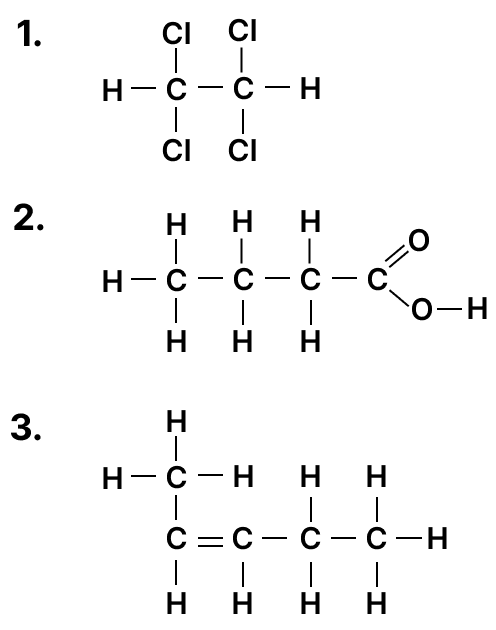
The atomic number of two atoms ‘X’ and ‘Y’ are 14 and 8 respectively.
State:
(a) the period to which ‘X’ belongs.
(b) the formula of the compound formed between ‘X’ and ‘Y’.
(Do not identify X and Y)