
History & Civics
Nationalism refers to the feeling of oneness that emerges when people consider themselves as one nation. With reference to the growth of nationalism, answer the following:
(i) Name the first President of the Congress. Mention any two of its objectives.
(ii) The press played an important role in the growth of Indian Nationalism. Thus, the British saw the need for curbs on the press. Mention any three points to analyse the role of the press in the growth of nationalism.
(iii) Lord Lytton's repressive policies led to the growth of Nationalism. Mention any four policies enforced by him.
Nationalism Growth
4 Likes
Answer
(i) The first President of the Indian National Congress was W.C. Bonnerjee. Two objectives of the Indian National Congress are given below:
- To promote friendly relations between nationalist political workers from different parts of the country.
- To formulate popular demands and present them before the government.
(ii) The press played an important role in the growth of Indian Nationalism in the following ways:
- The press helped spread the ideals of patriotism, modern liberal ideas of liberty, freedom, and equality.
- The Press criticised the British policies, and made the Indians aware of the happenings in the world.
- The Press helped Indians exchange views, and played an important role in the Indian freedom struggle.
(iii) Four repressive policies enforced by Lord Lytton that led to the rise of nationalism were:
- Vernacular Press Act (1878) – This Act banned Indian-language newspapers from publishing anti-British content, curbing freedom of expression. English newspapers were exempt.
- Indian Arms Act (1878) – Indians were prohibited from possessing arms without a licence, while Europeans faced no such restriction, highlighting racial discrimination.
- ICS Age Limit Reduction – The maximum age limit for the Indian Civil Service exam was reduced from 21 to 19. Since the exam was held in London, this move made it harder for Indians to qualify.
- Removal of Cotton Import Duties – Import duties on British cotton textiles were abolished, harming India's textile industry and causing economic distress among Indian weavers.
Answered By
2 Likes
Related Questions
The Supreme Court of India is the supreme judicial authority and the highest court of the Republic of India. It is the final court of appeal for all civil and criminal cases. With reference to the Supreme Court, answer the following questions:
(i) Who appoints the judges of the Supreme Court?
Mention any two qualifications required for a person to be appointed as a judge of the Supreme Court.(ii) Under Article 129, the Supreme Court of India is called a Court of Record. Justify this statement with any three points.
(iii) Explain the following terms:
(a) Revisory Jurisdiction
(b) Advisory JurisdictionThe Indian Rebellion of 1857 was a major uprising against the rule of the British East India Company, which functioned as a sovereign power on behalf of the British Crown. With reference to this, answer the following questions:
(i) The British used many policies of expansion. Mention any three such policies.
(ii) How did the failure of this Revolt impact the Mughals and the Peshwas?
(iii) The India army was reorganised after 1858, to prevent the reoccurrence of another uprising. Analyse this statement by stating any four changes made in the army after the Revolt.
Read the excerpt given below and answer the questions that follow-
The March, which took place in India, was led by Mohandas Gandhi to protest British rule in India. During the march, thousands of Indians followed Gandhi from his religious retreat near Ahmedabad to the Arabian Sea coast, a distance of some 240 miles. The march resulted in the arrest of nearly 60,000 people, including Gandhi himself."
— The Marion (Ohio) Star [Edited]
(i) Name the march being discussed above. Which movement did this march lead to? In which year was that movement launched?
(ii) The movement which began with this march made a considerable impact on the social and political surroundings of the country. Analyse this statement by mentioning any three impacts.
(iii) Mention any four clauses of the Gandhi Irwin Pact.
Look at the picture given and answer the following questions:
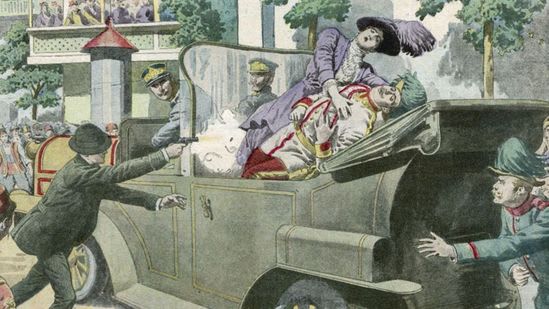
(i) Describe the incident depicted in the cartoon.
(ii) Mention any three points to analyse how Europe was rearranged as a consequence of the war caused by this incident.
(iii) The Germans described the Treaty of Versailles as harsh and humiliating. Give any four reasons that justify this statement.