
History & Civics
Read the excerpt given below and answer the questions that follow-
The March, which took place in India, was led by Mohandas Gandhi to protest British rule in India. During the march, thousands of Indians followed Gandhi from his religious retreat near Ahmedabad to the Arabian Sea coast, a distance of some 240 miles. The march resulted in the arrest of nearly 60,000 people, including Gandhi himself." — The Marion (Ohio) Star [Edited]
(i) Name the march being discussed above. Which movement did this march lead to? In which year was that movement launched?
(ii) The movement which began with this march made a considerable impact on the social and political surroundings of the country. Analyse this statement by mentioning any three impacts.
(iii) Mention any four clauses of the Gandhi Irwin Pact.
Mahatma Gandhi
20 Likes
Answer
(i) The march being discussed in the given excerpt is known as the Dandi March. This march led to the beginning of the Civil Disobedience Movement of 1930.
(ii) The Civil Disobedience Movement made a considerable impact on the social and political surroundings of the country, in the following ways:
- It widened the base of freedom struggle by mobilising various social groups like merchants, peasants, tribals, and workers across the country.
- It inspired the youth to follow Gandhi's path of non-violence in the freedom struggle instead of using violence as a political weapon.
- It marked greater participation of women in politics, inspiring many to step out and join the freedom struggle.
(iii) Four clauses of Gandhi Irwin Pact were:
- The government agreed to release all political prisoners, except those guilty of violence.
- The government agreed to permit the free collection or manufacture of salt by persons near the sea coast.
- The Congress agreed to suspend the Civil Disobedience Movement.
- The Congress agreed to participate in the second session of the Round Table Conference.
Answered By
12 Likes
Related Questions
The Indian Rebellion of 1857 was a major uprising against the rule of the British East India Company, which functioned as a sovereign power on behalf of the British Crown. With reference to this, answer the following questions:
(i) The British used many policies of expansion. Mention any three such policies.
(ii) How did the failure of this Revolt impact the Mughals and the Peshwas?
(iii) The India army was reorganised after 1858, to prevent the reoccurrence of another uprising. Analyse this statement by stating any four changes made in the army after the Revolt.
Nationalism refers to the feeling of oneness that emerges when people consider themselves as one nation. With reference to the growth of nationalism, answer the following:
(i) Name the first President of the Congress. Mention any two of its objectives.
(ii) The press played an important role in the growth of Indian Nationalism. Thus, the British saw the need for curbs on the press. Mention any three points to analyse the role of the press in the growth of nationalism.
(iii) Lord Lytton's repressive policies led to the growth of Nationalism. Mention any four policies enforced by him.
Look at the picture given and answer the following questions:
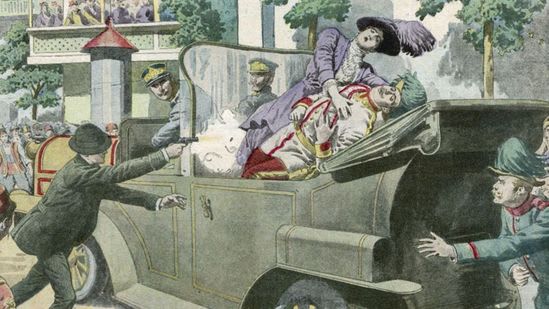
(i) Describe the incident depicted in the cartoon.
(ii) Mention any three points to analyse how Europe was rearranged as a consequence of the war caused by this incident.
(iii) The Germans described the Treaty of Versailles as harsh and humiliating. Give any four reasons that justify this statement.
The United Nations Organisation aims to maintain international peace. With reference to its organs and agencies, answer the following:
(i) What is the composition of the International Court of Justice?
(ii) Mention any three functions of the General Assembly.
(iii) Gujarat's famed garba dance received the intangible heritage tag. Which agency of the United Nations is authorized to give this tag? Mention any three other contributions of that agency in the preservation of culture.