
History & Civics
Look at the picture given and answer the following questions:
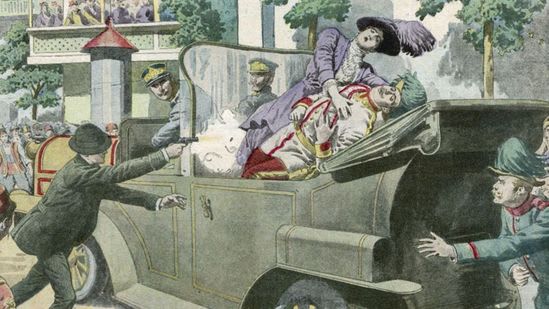
(i) Describe the incident depicted in the cartoon.
(ii) Mention any three points to analyse how Europe was rearranged as a consequence of the war caused by this incident.
(iii) The Germans described the Treaty of Versailles as harsh and humiliating. Give any four reasons that justify this statement.
1ˢᵗ World War
6 Likes
Answer
(i) The incident depicted in the cartoon is known as the Sarjevo Crisis, which was the immediate cause of the World War I.
Archduke Francis Ferdinand was assassinated on June 28, 1914, in Sarajevo by members of the Serbian secret society 'Union of Death'. Austria sent an ultimatum with 11 demands to Serbia; Serbia accepted most but rejected those affecting its sovereignty. Austria declared war on Serbia on July 28, 1914, marking the start of the First World War.
(ii) The World War I gave a serious blow to the autocratic monarchial system and led to the development of democracy in Europe.
Austria and Hungary became separate independent States. Czechoslovakia and Yugoslavia emerged as independent States.
European supremacy came to an end. The United States surpassed Europe economically and militarily. Ruling dynasties of Europe were destroyed, the Hohenzollern in Germany and the Hapsburg in Austria-Hungary.
The political instability and economic crisis in post-war Europe led to the rise of dictatorships in countries like Germany and Italy, where people turned to totalitarian rule for stability and national revival.
(iii) The Treaty of Versailles was signed to prevent Germany from going to war again. So, its terms were extremely harsh and humiliating towards Germany.
- Germany was declared guilty of aggression and had to pay war reparation of 33 billion dollars.
- The Saar coal mines were given to France for 15 years and the area was to be governed by the League of Nations.
- The area of the Rhine valley was demilitarized and the German territory west of Rhine was to be occupied by the Allied troops for 15 years.
- The German Army was restricted to a force of 1,00,000 soldiers and the Navy was limited to 15,000 men and 24 ships. The Air Force and submarines were banned.
Answered By
3 Likes
Related Questions
The Indian Rebellion of 1857 was a major uprising against the rule of the British East India Company, which functioned as a sovereign power on behalf of the British Crown. With reference to this, answer the following questions:
(i) The British used many policies of expansion. Mention any three such policies.
(ii) How did the failure of this Revolt impact the Mughals and the Peshwas?
(iii) The India army was reorganised after 1858, to prevent the reoccurrence of another uprising. Analyse this statement by stating any four changes made in the army after the Revolt.
Nationalism refers to the feeling of oneness that emerges when people consider themselves as one nation. With reference to the growth of nationalism, answer the following:
(i) Name the first President of the Congress. Mention any two of its objectives.
(ii) The press played an important role in the growth of Indian Nationalism. Thus, the British saw the need for curbs on the press. Mention any three points to analyse the role of the press in the growth of nationalism.
(iii) Lord Lytton's repressive policies led to the growth of Nationalism. Mention any four policies enforced by him.
Read the excerpt given below and answer the questions that follow-
The March, which took place in India, was led by Mohandas Gandhi to protest British rule in India. During the march, thousands of Indians followed Gandhi from his religious retreat near Ahmedabad to the Arabian Sea coast, a distance of some 240 miles. The march resulted in the arrest of nearly 60,000 people, including Gandhi himself."
— The Marion (Ohio) Star [Edited]
(i) Name the march being discussed above. Which movement did this march lead to? In which year was that movement launched?
(ii) The movement which began with this march made a considerable impact on the social and political surroundings of the country. Analyse this statement by mentioning any three impacts.
(iii) Mention any four clauses of the Gandhi Irwin Pact.
The United Nations Organisation aims to maintain international peace. With reference to its organs and agencies, answer the following:
(i) What is the composition of the International Court of Justice?
(ii) Mention any three functions of the General Assembly.
(iii) Gujarat's famed garba dance received the intangible heritage tag. Which agency of the United Nations is authorized to give this tag? Mention any three other contributions of that agency in the preservation of culture.