
Mathematics
In a pentagon ABCDE, DP is drawn perpendicular to AB and is perpendicular to CE also at point Q. If AP = BP = 12 cm, EQ = CQ = 8 cm, DE = DC = 10 cm and DP = 18 cm, find the area of the pentagon ABCDE.
Mensuration
3 Likes
Answer
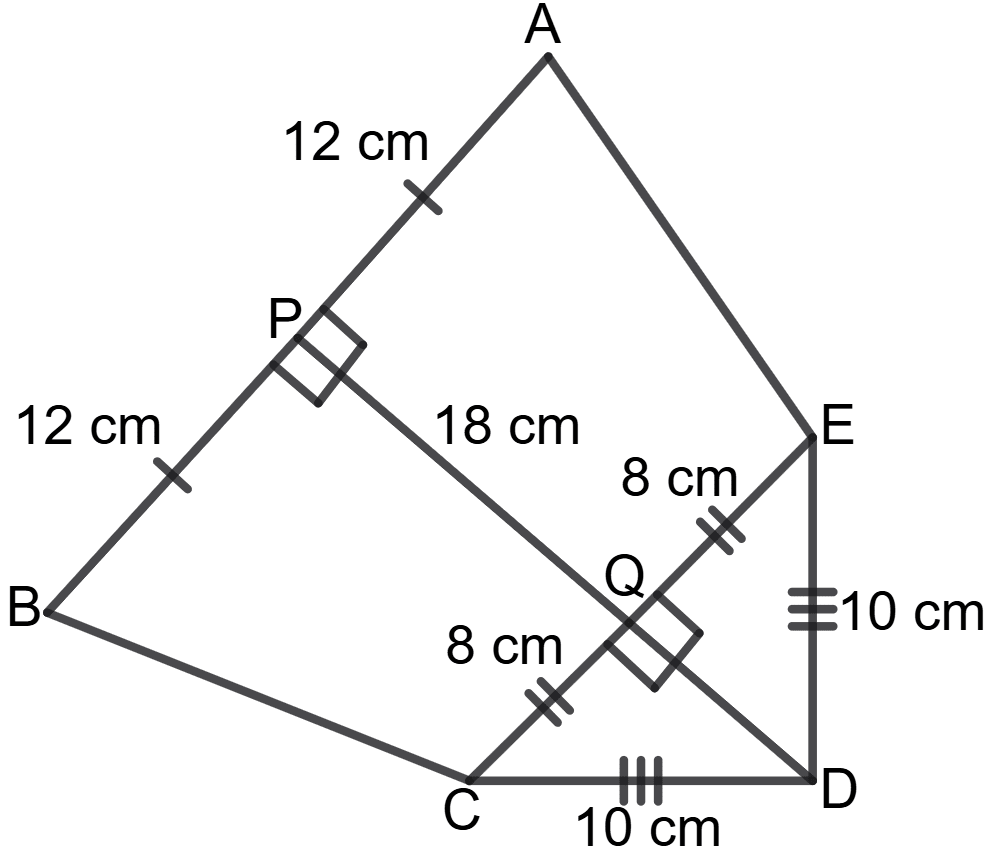
Given: DP ⊥ AB at point P, with AP = BP = 12 cm, so AB = 24 cm.
DP ⊥ CE at point Q, with EQ = CQ = 8 cm, so CE = 16 cm.
DE = DC = 10 cm
DP = 18 cm
In triangle DEQ, using pythagoras theorem,
⇒ DE2 = EQ2 + DQ2
⇒ 102 = 82 + h2
⇒ h2 = 100 - 64
⇒ h2 = 36
⇒ h =
⇒ h = 6
Since height cannot be negative, QD = 6 cm.
PQ = PD - QD = 18 - 6 = 12 cm
From the figure, the pentagon ABCDE is composed of: trapezium ABCE and triangle CDE.
Area of trapezium ABCE = × (Sum of parallel sides) × height
= × (AB + CE) × PQ
= × (24 + 16) × 12
= 40 x 6
= 240 cm2
Area of △ CDE = × base × height
= × 16 × 6
= 8 × 6
= 48 cm2
Total Area of Pentagon ABCDE = Area trapezium ABCE + Area △ CDE = 240 + 48 = 288 cm2
Hence, the area of pentagon ABCDE = 288 cm2.
Answered By
1 Like
Related Questions
Find the area and the perimeter of the following figure.
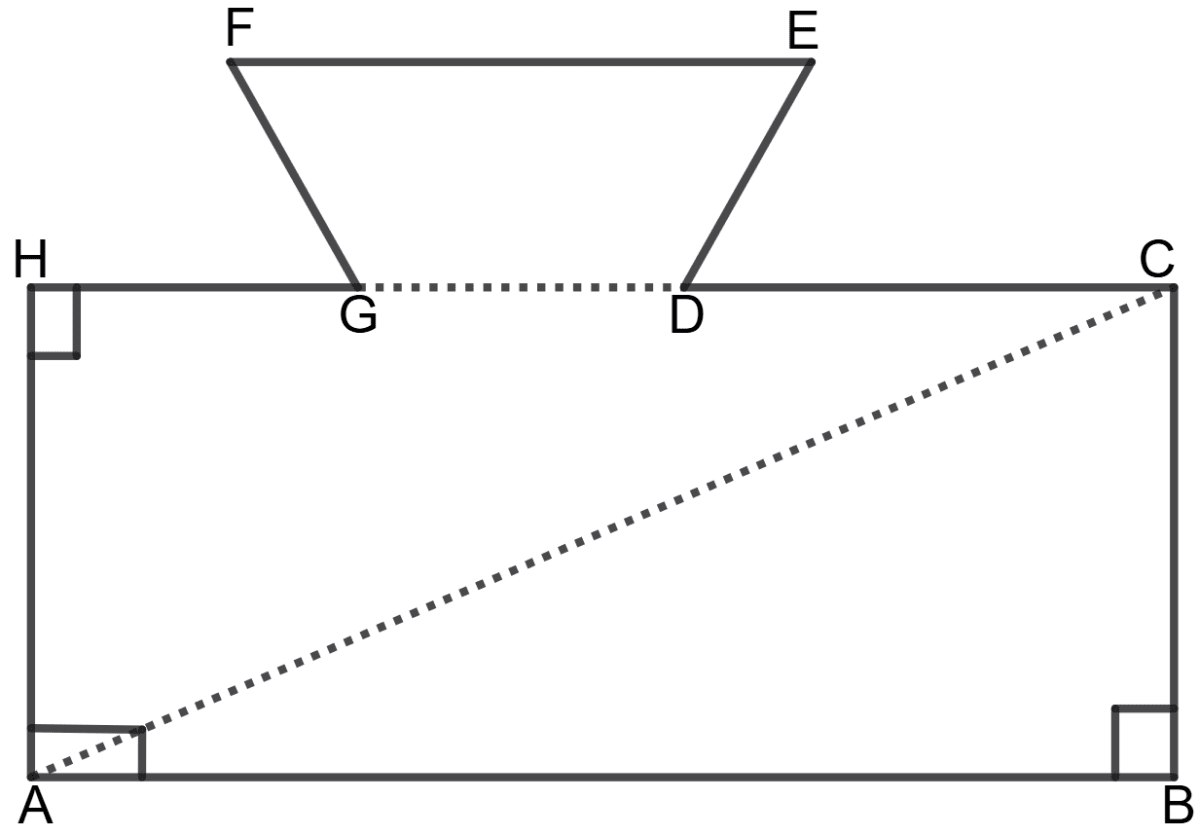
Given : AB = 12 cm, AC = 13 cm, DE = FG = 5 cm, EF = 10 cm and GD = 4 cm.
Each side of a square ABCD is 12 cm. A point P lies on side DC such that area of △ ADP : area of trapezium ABCP = 2 : 3. Find DP.
A rectangular park has dimensions 240 m by 200 m. A circular lawn is made inside the park. If the area of the park excluding the lawn is 32600 sq m, find the circumference of the lawn.
How many circular discs, each of 4 cm radius, can be cut from the rectangular metal sheet with dimensions :
(i) 75 cm and 48 cm
(ii) 64 cm and 60 cm