
Mathematics
The perimeter of a rhombus is 52 cm. If one of its diagonals is 24 cm long, find:
(i) the length of the other diagonal,
(ii) the area of the rhombus.
Mensuration
2 Likes
Answer
(i) Let ABCD be a rhombus.
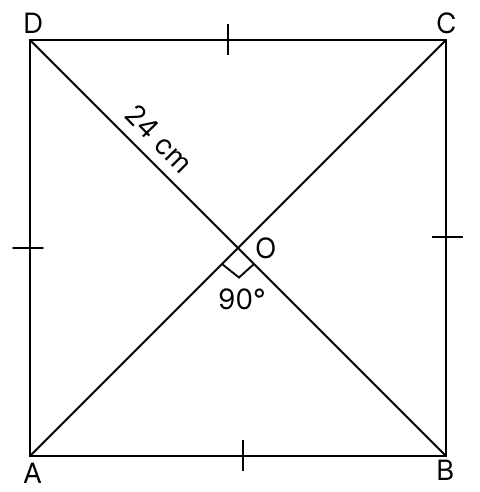
Perimeter of the rhombus = 52 cm
One diagonal BD = 24 cm
Let a be the length of a side of the rhombus.
Perimeter of a rhombus = 4 x Side
⇒ 4 x a = 52
⇒ a =
⇒ a = 13 cm.
BD = 24 cm
Since the diagonals of a rhombus bisect at 90°.
Then, OB = OD = = 12 cm.
Applying pythagoras theorem for △AOB, we get:
⇒ AB2 = OA2 + OB2
⇒ (13)2 = OA2 + (12)2
⇒ 169 = OA2 + 144
⇒ OA2 = 169 - 144
⇒ OA2 = 25
⇒ OA =
⇒ OA = 5 cm.
⇒ AC = 2 x OA = 2 x 5 cm = 10 cm.
Hence, the length of the other diagonal = 10 cm.
(ii) By formula,
Area of rhombus = x product of diagonals
= x 24 x 10
= 12 x 10 = 120 cm2.
Hence, area of the rhombus = 120 cm2.
Answered By
3 Likes
Related Questions
Find the area of a rhombus one side of which measures 20 cm and the one of whose diagonals is 24 cm.
The two parallel sides of a trapezium are 58 m and 42 m long. The other two sides are equal, each being 17 m. Find its area.
The area of a rhombus is 216 cm2 and one of its diagonals measures 24 cm. Find:
(i) the length of the other diagonal,
(ii) the length of each of its sides,
(iii) its perimeter.
Two adjacent sides of a parallelogram are 36 cm and 25 cm. If the distance between longer sides is 15 cm, find the distance between the shorter sides.