
Physics
The below picture shows three cylinders filled with water to a different extent. The tuning forks L, M and N in vibration produce louder sound when held above the mouth of the cylinders. Which combination is correct for hearing a louder sound of the tuning fork?
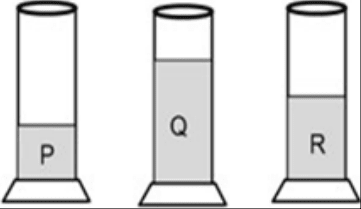
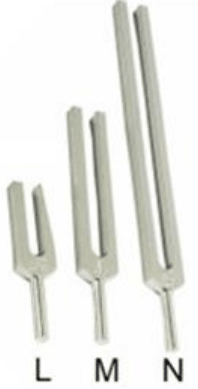
- L – R, M – Q, N – P
- L – P, M – Q, N – R
- L – R, M – P, N – Q
- L – Q, M – R, N – P
Sound
19 Likes
Answer
L – Q, M – R, N – P
Reason — The frequency of a tuning fork is inversely proportional to the square of the length of its prongs i.e.,
So, tunning fork L has highest frequency, N has lowest frequency and M has medium frequency
Frequency is inversely proportional to the length of the air column i.e.,
So, air column Q has highest frequency, P has lowest frequency and R has medium frequency
Highest frequency tuning fork (L) should match with the highest frequency air column (Q).
So, L-Q combination will resonate.
Medium frequency tuning fork (M) should match with the medium frequency air column (R).
So, M-R combination will resonate.
Lowest frequency tuning fork (N) should match with the lowest frequency air column (P).
So, N-P combination will resonate.
Answered By
11 Likes
Related Questions
The given rods will attract each other when:
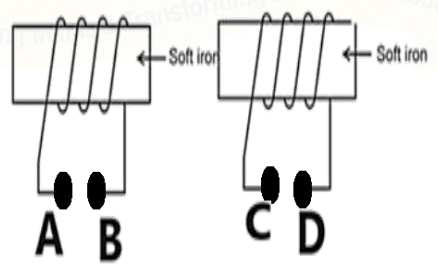
- A and C are connected to positive terminal of the battery.
- B and C are connected to the positive terminal of the battery.
- A and D are connected to the positive terminal of the battery.
- A and D are connected to the negative terminal of the battery.
Which of the following equations are correctly balanced?
- Only D
- Only C
- Both A & B
- Both C & D
Three metals, A, B and C, are supplied with the same quantity of heat. Their masses are in the ratio 2 : 3 : 4. If they show the same rise in the temperature, then the ratio of their thermal capacities will be:
- 1:1:1
- 4:3:2
- 2:3:4
- 2:3:1
The below diagram shows different copper conductors of diameters d and 2d and lengths, which are multiples of l. The increasing order of their resistances will be:
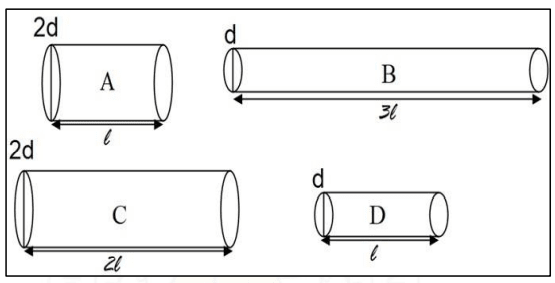
- A < B < C < D
- A < C < D < B
- A < D < C < B
- D < A < C < B