Mathematics
PQRS is a parallelogram whose diagonals intersect at M.
If ∠PMS = 54°, ∠QSR = 25° and ∠SQR = 30°, find :
(i) ∠RPS
(ii) ∠PRS
(iii) ∠PSR.
Answer
(i) PQRS is a parallelogram which means opposite sides are parallel.
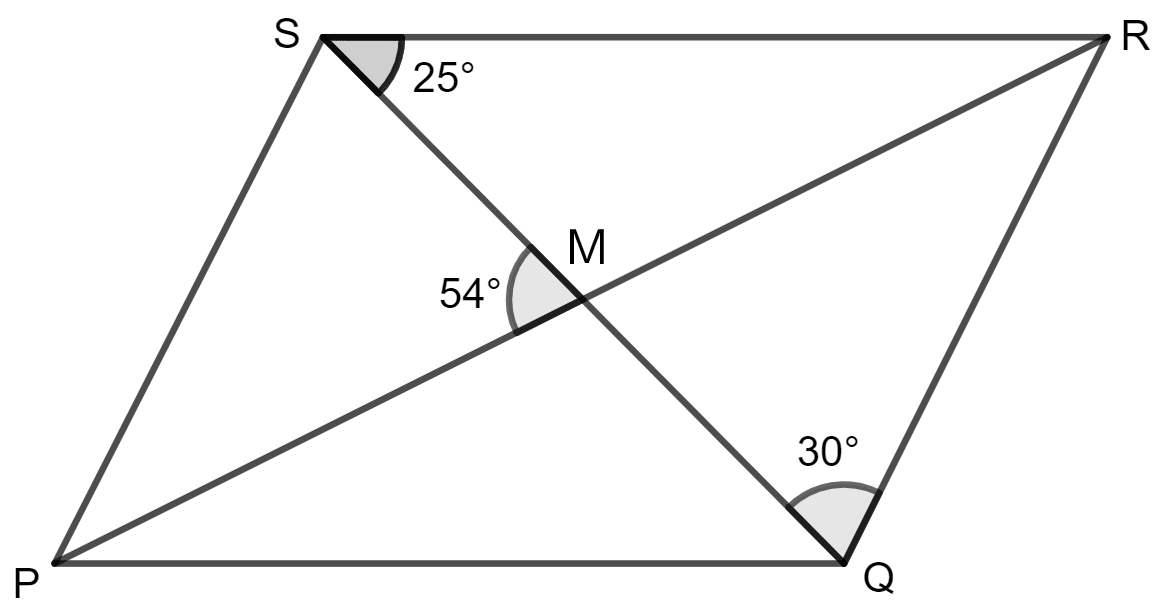
When QR is parallel to PS.
⇒ ∠PSQ = ∠SQR (alternate angles)
It is given that ∠PMS = 54°, ∠QSR = 25° and ∠SQR = 30°
So, ∠PSQ = ∠SQR = 30°
In triangle SMP, sum of all the angles of triangle is = 180°
⇒ ∠PMS + ∠PSM + ∠MPS = 180°
(As we know , ∠MPS = ∠RPS)
⇒ 54° + 30° + ∠RPS = 180°
⇒ 84° + ∠RPS = 180°
⇒ ∠RPS = 180° - 84°
⇒ ∠RPS = 96°
Hence, the value of ∠RPS is 96°.
(ii) Now, consider triangle MSR, according to exterior angle property, exterior angle is equals to sum of two opposite interior angles.
∠MRS + ∠RSM = ∠PMS
⇒ ∠PRS + 25° = 54°
⇒ ∠PRS = 54° - 25°
⇒ ∠PRS = 29°
Hence, the value of ∠PRS is 29°.
(iii) ∠PSR is divided into two angles ∠PSQ and ∠RSQ. So,
∠PSR = ∠PSQ + ∠RSQ
= 30° + 25°
= 55°
Hence, the value of ∠PSR is 55°.