
Chemistry
Select the correct statement(s) for the diagram shown below.
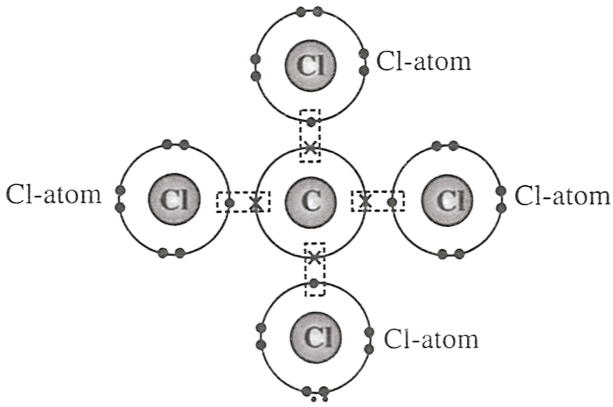
P — One atom of carbon transfers one electron to each chlorine atom.
Q — One atom of carbon shares four electron pairs, one with each of the four atoms of chlorine.
R — Carbon atom attains neon configuration and chlorine attains argon configuration after the combination.
- Only P
- Only Q
- Only R
- Both Q and R
Atomic Structure
6 Likes
Answer
Both Q and R
Reason — Carbon has the electronic configuration of [2, 4] and Chlorine has 7 electrons in the third orbit so its electronic configuration is [2, 8, 7]. Carbon forms covalent bond by sharing four electron pairs, one with each of the four atoms of chlorine. After sharing of electrons in order to obtain stable octate configuration, carbon attains electronic configuration of neon as [2, 8] and chlorine attains electronic configuration of argon as [2, 8, 8].
Answered By
4 Likes
Related Questions
An atom is electrically neutral because :
P — Electrons, protons and neutrons are equal in number.
Q — Protons are equal to neutrons.
R — Protons are equal to electrons.
- Only P
- Only Q
- Only R
- Both Q and R
Select the correct statement(s) for the diagram shown below.
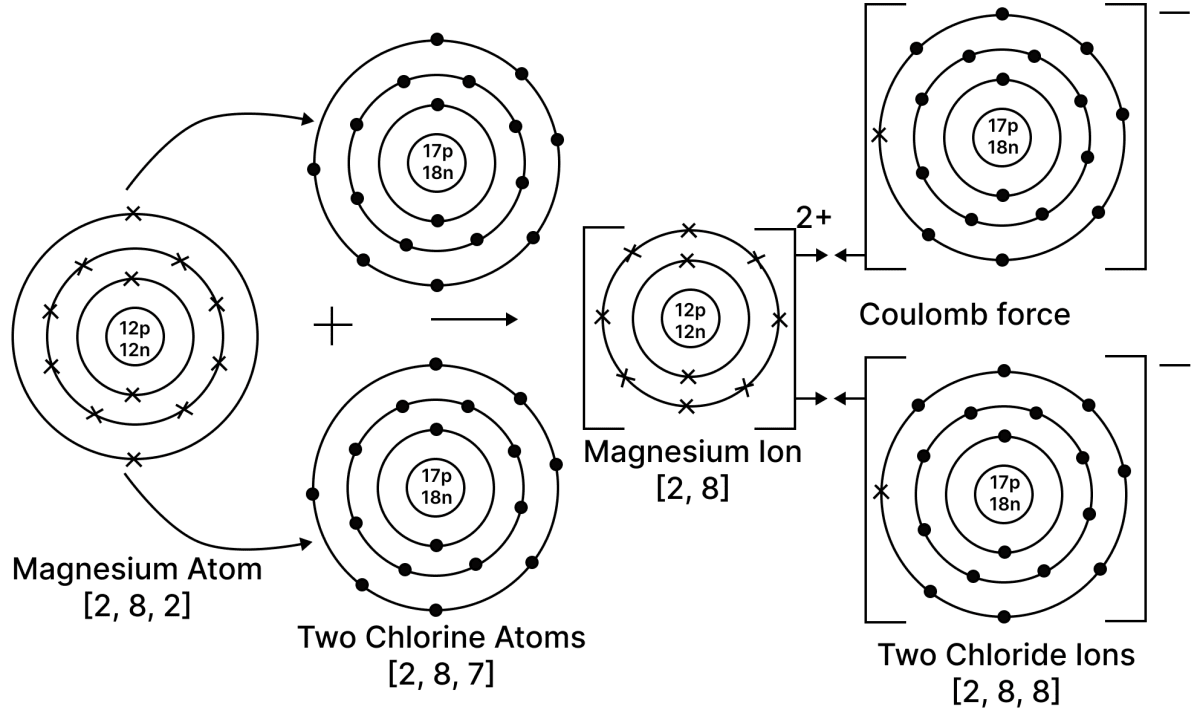
P — Mg loses electrons and undergoes reduction.
Q — Cl gains electrons and undergoes reduction.
R — Mg loses electrons and undergoes oxidation.
- Only P
- Only Q
- Only R
- Both Q and R
Match the atomic numbers 4, 8, 10, 15 and 19 with each of the following:
(a) Element which can form trivalent ion.
(b) An element with 4 shells.
(c) Element with 6 valence electrons.
(d) Element which does not form an ion.
Identify the following reactions as either oxidation or reduction:
(i) O + 2e- ⟶ O2-
(ii) K - e- ⟶ K+
(iii) Fe3+ + e- ⟶ Fe2+
(iv) Zn ⟶ Zn2+ + 2e-