
Mathematics
Solve the following system of equations by using the method of cross multiplication:
(x ≠ 0, y ≠ 0)
Linear Equations
2 Likes
Answer
Substituting in , we get :
⇒ a + b = 7
⇒ a + b - 7 = 0 ………(1)
Substituting in , we get :
⇒ 2a + 3b = 17
⇒ 2a + 3b - 17 = 0 ………(2)
Applying cross-multiplication method for solving equations (1) and (2), we get :
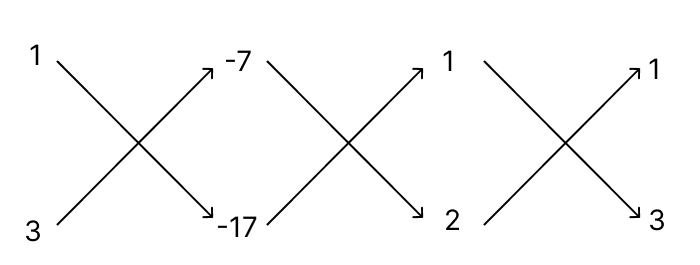
Now we have a = 4 and b = 3,
Hence, and .
Answered By
1 Like
Related Questions
Solve the following system of equations by using the method of cross multiplication:
3x + 2y + 25 = 0, 2x + y + 10 = 0
Solve the following system of equations by using the method of cross multiplication:
, (x ≠ 0, y ≠ 0)
Solve the following system of equations by using the method of cross multiplication:
, where x ≠ -y and x ≠ y
Solve the following system of equations by using the method of cross multiplication:
, where x ≠ -1 and x ≠ 1.