KnowledgeBoat Logo
|

Mathematics

Solve the following system of equations by using the method of cross multiplication:

10x+y+2xy=4,15x+y5xy+2=0\dfrac{10}{x + y} + \dfrac{2}{x - y} = 4, \dfrac{15}{x + y} - \dfrac{5}{x - y} + 2 = 0, where x ≠ -y and x ≠ y

Linear Equations

1 Like

Answer

Substituting 1x+y=a,1xy=b\dfrac{1}{x + y}= a, \dfrac{1}{x - y} = b in 10x+y+2xy=4\dfrac{10}{x + y} + \dfrac{2}{x - y} = 4, we get:

⇒ 10a + 2b = 4

⇒ 10a + 2b - 4 = 0     …..(1)

Substituting 1x+y=a,1xy=b\dfrac{1}{x + y}= a, \dfrac{1}{x - y} = b in 15x+y5xy+2=0\dfrac{15}{x + y} - \dfrac{5}{x - y} + 2 = 0, we get:

⇒ 15a - 5b + 2 = 0     ….(2)

Applying cross-multiplication method for solving equations (1) and (2), we get :
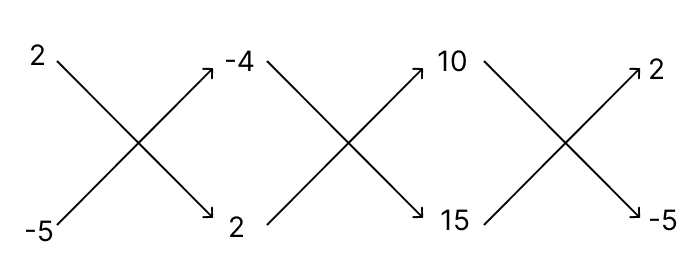
Solve the following system of equations by using the method of cross multiplication: R.S. Aggarwal Mathematics Solutions ICSE Class 9.

a(2)×(2)(5)×(4)=b(4)×(15)(2)×(10)=1(10)×(5)(15)×(2)a(4)20=b6020=15030a16=b80=180a16=180 and b80=180a=1680 and b=8080a=15 and b=1.\Rightarrow \dfrac{a}{(2) \times (2) - (-5) \times (-4)} = \dfrac{b}{(-4) \times (15) - (2) \times (10)} = \dfrac{1}{(10) \times (-5) - (15) \times (2)} \\[1em] \Rightarrow \dfrac{a}{(4) - 20} = \dfrac{b}{-60 - 20} = \dfrac{1}{-50 - 30} \\[1em] \Rightarrow \dfrac{a}{-16} = \dfrac{b}{-80} = \dfrac{1}{-80} \\[1em] \Rightarrow \dfrac{a}{-16} = \dfrac{1}{-80} \text{ and } \dfrac{b}{-80} = \dfrac{1}{-80} \\[1em] \Rightarrow a = \dfrac{-16}{-80} \text{ and } b = \dfrac{-80}{-80} \\[1em] \Rightarrow a = \dfrac{1}{5} \text{ and } b = 1.

Now we have a = 15\dfrac{1}{5} and b = 1,

1x+y=a1x+y=15x+y=5 ……….(3)1xy=b1xy=1xy=1 ……..(4)\Rightarrow \dfrac{1}{x + y} = a \\[1em] \Rightarrow \dfrac{1}{x + y} = \dfrac{1}{5} \\[1em] \Rightarrow x + y = 5 \text{ ……….(3)} \\[1em] \Rightarrow \dfrac{1}{x - y} = b \\[1em] \Rightarrow \dfrac{1}{x - y} = 1 \\[1em] \Rightarrow x - y = 1 \text{ ……..(4)}

On adding equations (3) and (4) we get,

⇒ (x + y) + (x - y) = 5 + 1

⇒ 2x = 6

⇒ x = 62=3\dfrac{6}{2} = 3.

Substituting value of x in equation (4) we get,

⇒ x - y = 1

⇒ 3 - y = 1

⇒ y = 3 - 1 = 2.

Hence, x = 3, y = 2.

Answered By

2 Likes


Related Questions