Biology
During Sports Day, Arnav ran a 200-meter race. After finishing, his breathing became fast and deep. A few minutes later, his breathing returned to normal even without him consciously trying. His teacher explained that this automatic adjustment was managed by a particular nervous system in the body.
(a) Name the specific division of the nervous system involved in this automatic control.
(b) State the two parts of this division.
(c) Write one important role of each part.
(d) Arnav's heartbeat and breathing rate increased during the race. Which gas was deficient in his blood at that moment?
(e) Mention the exact location of this nervous system within the body.
Answer
(a) The specific division of the nervous system involved in this automatic control is the Autonomic Nervous System (ANS).
(b) Sympathetic nervous system and Parasympathetic nervous system are the two parts of nervous system division.
(c) Sympathetic nervous system prepares the body for action during stress or exercise by increasing heart rate and breathing rate (fight-or-flight response).
Parasympathetic nervous system helps the body return to normal by slowing down heart rate and breathing rate (rest-and-digest response).
(d) The gas deficient in Arnav’s blood at that moment was oxygen.
(e) Autonomic Nervous System consists of a pair of chains of ganglia (a mass of cytons of nerve cells) and nerves found on either side of the spinal cord.
Related Questions
Draw a neat and labelled diagram of a nerve cell.
Given alongside is the figure of a median section of an organ. Study the same and answer the following questions :
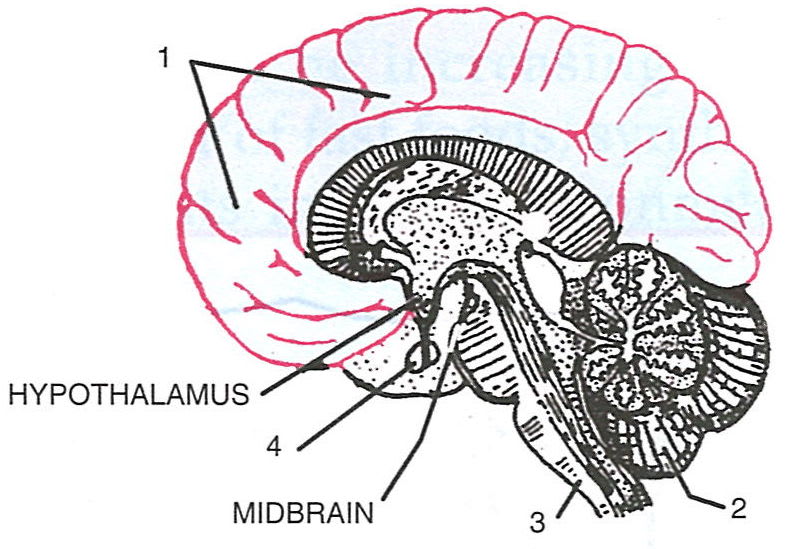
- Name the organ and write its location in our body.
- Label the guidelines 1 to 4.
- Write one important function of hypothalamus.
- Which of the structures from 1 to 4 is considered as the master gland of the body ?
- Mention the basic structural unit of the organ shown in the figure and the organ system to which it belongs.
A part of our nervous system is shown alongside. Study the same and answer the following questions :
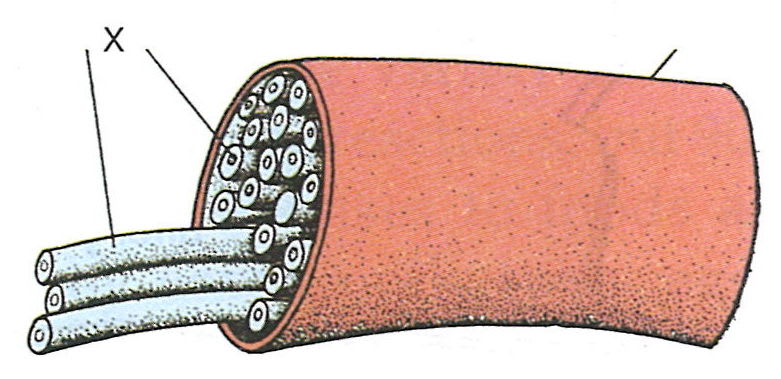
- Identify the figure and name it.
- Define the structure shown.
- Label the part shown as X.
- Write the name of the protective, tubular covering of the structure shown.
- Mention the names of the three kinds of the structure that is shown in the figure.
Briefly describe the structure of the cerebrum in human brain and mention its functions.