Mathematics
State which of the following statements are true and which are false:
(i) A triangle can have two right angles.
(ii) A triangle cannot have more than one obtuse angle.
(iii) A triangle has at least two acute angles.
(iv) If all the three sides of a triangle are equal, it is called a scalene triangle.
(v) A triangle has four sides.
(vi) An isosceles triangle is an equilateral triangle also.
(vii) An equilateral triangle is an isosceles triangle also.
(viii) A scalene triangle has all its angles equal.
Answer
(i) False
Reason — The sum of angles of a triangle is 180°. If a triangle had two right angles, their sum alone would be 180°, leaving 0° for the third angle, which is not possible.
(ii) True
Reason — If a triangle had two obtuse angles (each greater than 90°), their sum alone would exceed 180°, which violates the angle sum property.
(iii) True
Reason — Since the sum of angles of a triangle is 180°, a triangle can have at most one angle that is right or obtuse. So at least two angles must be acute.
(iv) False
Reason — If all three sides of a triangle are equal, it is called an equilateral triangle, not a scalene triangle.
(v) False
Reason — A triangle has three sides, not four.
(vi) False
Reason — An isosceles triangle has only two sides equal, so it is not necessarily an equilateral triangle (which has all three sides equal).
(vii) True
Reason — An equilateral triangle has all three sides equal, which means it has at least two equal sides. So it is also an isosceles triangle.
(viii) False
Reason — A scalene triangle has all sides of different lengths, so all its angles are also different (not equal).
Related Questions
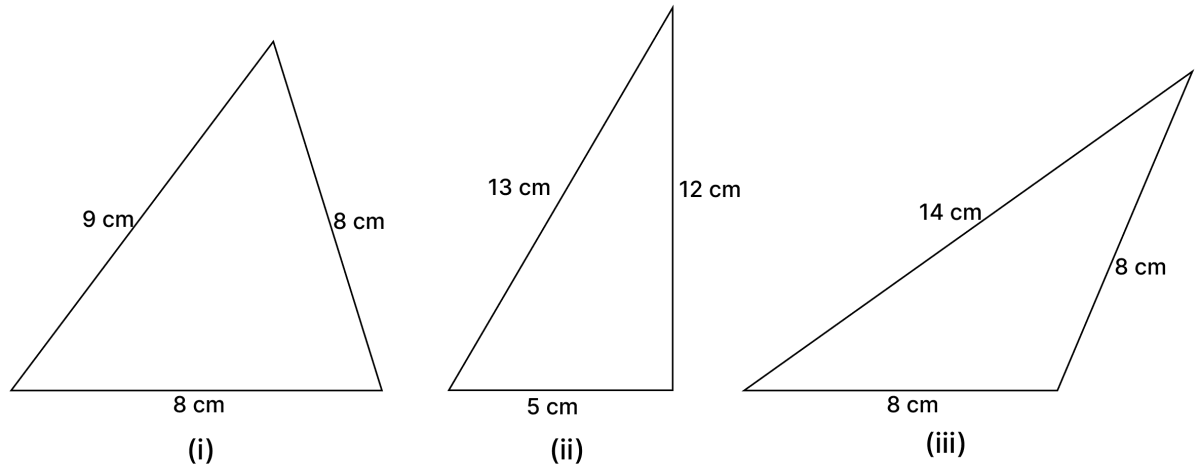
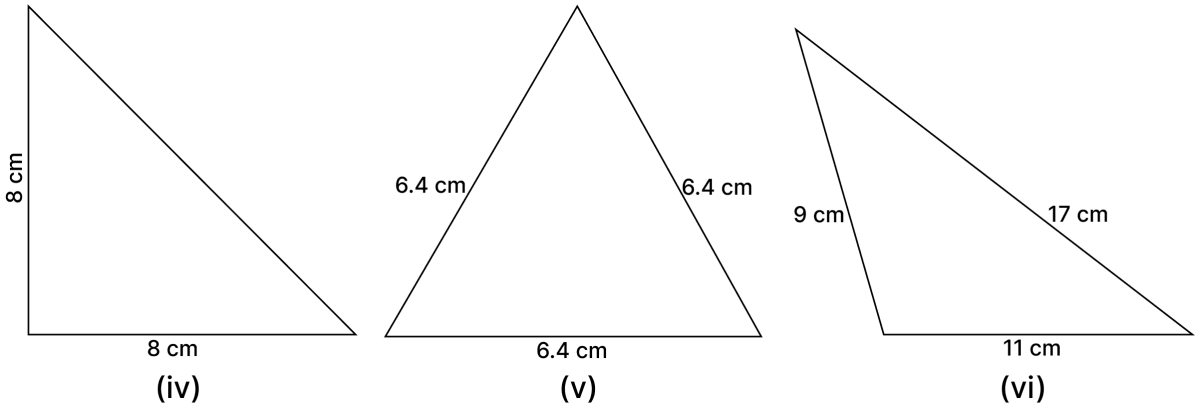
Name each of the following triangles in two different ways (you may judge the nature of the angle by observation):
Match the following:
Measures of triangles Types of triangles (i) 3 sides of equal length (a) Scalene (ii) 2 sides of equal length (b) Isosceles right-angled (iii) all sides of different length (c) Obtuse-angled (iv) 3 acute angles (d) Right-angled (v) 1 right angle (e) Equilateral (vi) 1 obtuse angle (f) Acute-angled (vii) 1 right angle with two sides of equal length (g) Isosceles State whether the following statements are true (T) or false (F):
(i) Each angle of a rectangle is a right angle.
(ii) The opposite sides of a rectangle are equal in length.
(iii) The diagonals of a square are perpendicular to one another.
(iv) All sides of a rhombus are equal in length.
(v) All sides of a parallelogram are equal in length.
(vi) The opposite sides of a trapezium are parallel.
(vii) The diagonals of a parallelogram are equal.
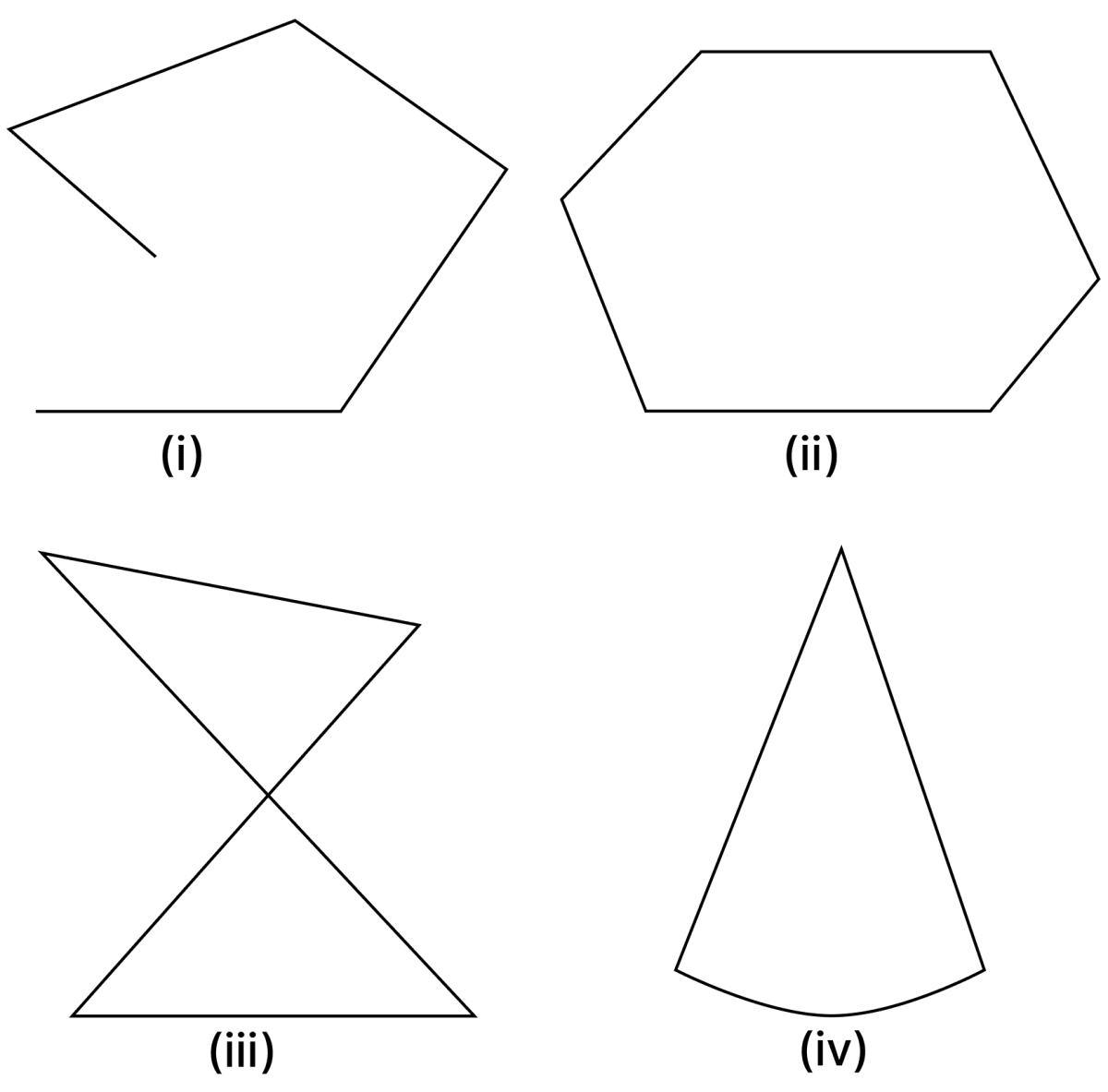
Examine whether the following figures are polygons. Give reasons.