
Physics
(a) State the principle of calorimetry.
(b) Why should the surface of the calorimeter be polished?
(c) Why should the calorimeter be made of a material of low specific heat capacity?
Calorimetry
6 Likes
Answer
(a) The principle of calorimetry states that when a hot body is brought in contact with a cold body, then heat lost by the hot body is equal to the heat gained by the cold body, provided there is no heat loss in the environment.
Heat energy lost by the hot body = Heat energy gained by the cold body
(b) The outer and inner surface of the calorimeter should be polished so as to reduce the loss of heat due to radiation.
(c) The calorimeter should be made of a material of low specific heat capacity so that the amount of heat energy taken by the calorimeter from the contents to acquire it's temperature, is very small.
Answered By
5 Likes
Related Questions
Study the diagram and answer the questions that follow:
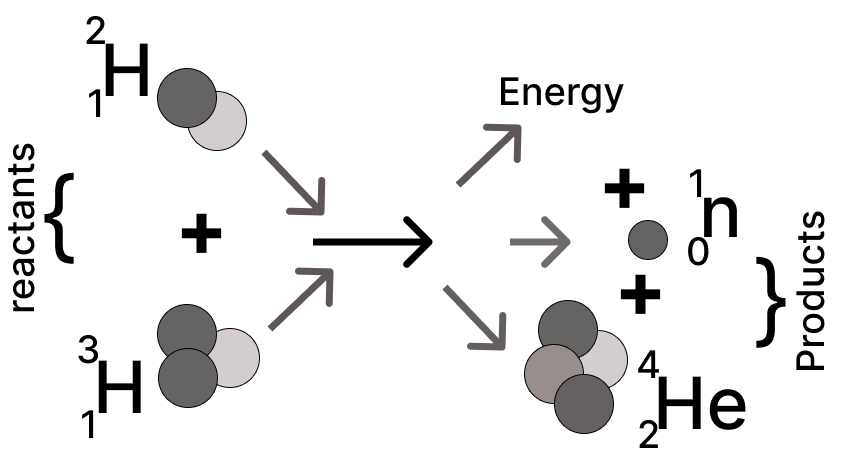
(a) Name the nuclear process displayed in the diagram.
(b) Is it possible to conduct this process at room temperature?
(c) Mass of reactants …………… mass of the products.
[Fill in the blank using <, > or =]
A cell of e.m.f 1.5 V and internal resistance 1 Ω is connected to two resistors of resistances 6 Ω and 3 Ω in parallel and a resistor of resistance 2 Ω in series as shown in the diagram.
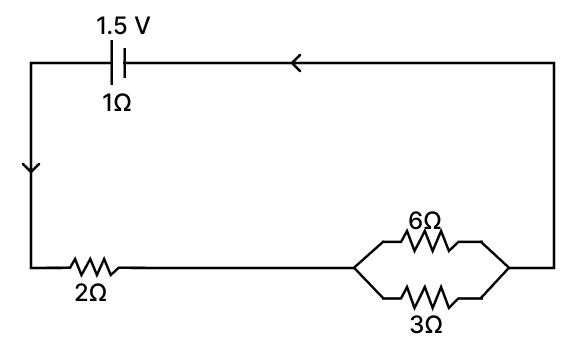
Calculate the current through:
(a) 2 Ω resistor
(b) 6 Ω resistor
A spirit lamp supplying heat at a rate of 50 W is used to melt 0.025 kg of ice at 0 °C taken in a container. If all the ice in the container is melted in 168 s, then what is the specific latent heat of fusion of ice?
(The heat capacity of the container is negligible.)
A student wants to design a device to connect a bulb rated 10 W, 22 V, to the mains 220 V, so that the bulb operates at its rated voltage.
(a) Name the device he uses.
(b) State the principle involved in the working of this device.
(c) When the bulb is connected to the output of the device, calculate:
- Current drawn
- Resistance of the bulb