
Chemistry
X, Y and Z are three crystalline solids which are soluble in water and have a common anion.
To help you to identify X, Y and Z, you are provided with the following experimental observations. Copy and complete the corresponding inferences in (a) to (e).
(a) A reddish-brown gas is obtained when X, Y and Z are separately warmed with concentrated sulphuric acid and copper turning added to the mixture.
INFERENCE 1: The common anion is the …………… ion.
(b) When X is heated, it melts and gives off only one gas which re-lights a glowing splint.
INFERENCE 2: The cation in X is either …………… or ……………
(c) The action of heat on Y produces a reddish-brown gas and a yellow residue which fuses with the glass of the test tube.
INFERENCE 3: The metal ion present in Y is the …………… ion.
(d) When Z is heated, it leaves no residue. Warming Z with sodium hydroxide solution liberates a gas which turns moist red litmus paper blue.
INFERENCE 4: Z contains the …………… cation.
(e) Write the equations for the following reactions.
- X and concentrated sulphuric acid (below 200° C). (One equation only for either of the cations given in INFERENCE 2).
- Action of heat on Y.
- Concentrated nitric acid is added to copper turnings kept in a beaker.
Nitric Acid
38 Likes
Answer
(a) The common anion is the nitrate ion.
(b) The cation in X is either sodium or potassium
(c) The metal ion present in Y is the lead ion.
(d) Z contains the ammonium ion
(e) The balanced equations are:
- Reaction between Potassium nitrate and concentrated sulphuric acid (below 200° C):
2Pb(NO3)2 2PbO + 4NO2 + O2
Cu + 4HNO3 (conc.) ⟶ Cu(NO3)2 + 2H2O + 2NO2.
Explanation
(a) On adding copper to acidified nitrates and heating, dense reddish brown fumes of nitrogen dioxide [NO2] are evolved.
(b) The alkali metal nitrates such as sodium or potassium nitrates when heated melts into colourless liquids which decompose on heating to give oxygen gas.
(c) Lead nitrate decomposes on heating to give nitrogen dioxide, oxygen gas and yellow residue of lead oxide which fuses with the glass of the test tube.
2Pb(NO3)2 2PbO + 4NO2 + O2
(d) Ammonium nitrate decomposes explosively on heating leaving behind no residue.
NH4NO3 N2O + 2H2O
Ammonium nitrate reacts with sodium hydroxide to give sodium nitrate, ammonia, and water. Ammonia gas turns moist red litmus paper blue.
NH4NO3 + NaOH ⟶ NaNO3 + NH3 + H2O
Answered By
17 Likes
Related Questions
State one observation :
(a) Concentrated nitric acid is reacted with sulphur.
(b) Lead nitrate is heated strongly in a test tube.
(c) Zinc nitrate crystals are strongly heated.
(d) Copper nitrate crystals are heated in a test tube.
Give balanced equation for the following :
(a) dilute nitric acid and copper carbonate.
(b) oxidation of carbon with conc. HNO3.
(c) Laboratory preparation of nitric acid.
(d) Action of heat on a mixture of copper and concentrated nitric acid.
The diagram given below is a representation of the Industrial preparation of Nitric acid by Ostwald's process. With respect to the process, answer the following questions :
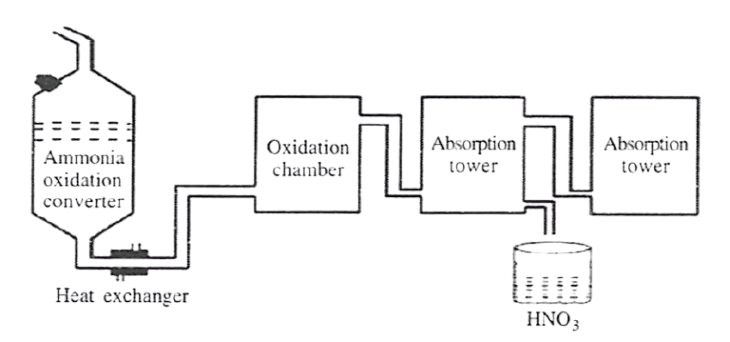
(a) Write the temperature and the catalyst required during the catalytic oxidation of ammonia.
(b) Give balanced chemical equation for the reaction occurring during the conversion of nitrogen dioxide to nitric acid.
(a) Mention three important uses of nitric acid. Give the property of nitric acid involved in the use.
(b) Explain with the help of a balanced equation, the brown ring test for nitric acid.
(c) Why is freshly prepared ferrous sulphate solution used for testing the nitrate radical in the brown ring test