
Science
Zarina worked as an apprentice in a factory where flashlights and solar cookers are made. She learnt to make the circuits, the design of the light-box and light concentrators of the solar cookers as well. She learnt the uses of lenses in making all those tools. Based on your understanding of lenses, answer the following questions.
(a) What kind of lenses are used in the flashlight and light concentrator of the solar-cooker?
(b) Give reasons for your choices in your answer for part A.
Attempt either subpart C or D.
(c) An object is placed 40 cm away from a lens which is normally used in a solar-cooker. The image formed is twice the size of the object. Calculate the focal length of the lens.
OR
(d) An object is placed 20 cm in front of a lens which is used in a flashlight, and the image is formed 10 cm away from the lens on the same side as the object. Calculate the focal length of the lens.
Refraction Lens
1 Like
Answer
(a) Concave Lens for Flashlight and Convex Lens for solar cooker.
(b) Concave lens diverges the light rays which is needed for a wider reach of the flashlight and convex lens converges the rays which helps to raise the temperature of the place where rays converge.
(c) Given,
- Object distance () = -40 cm
- Size of the image () = -2 x Size of the object ()
Here, negative sign indicates that the object is in front of the lens and the image is inverted.
As, magnification () of a lens is given by,
Let, image distance be ''.
Then,
Let, focal length of the lens be ''.
Then, by using the lens formula,
Hence, the focal length of the lens is approximately 26.67 cm.
(d) Given,
- Object distance () = -20 cm
- Image distance () = -10 cm
Here, negative sign indicates that both the object and the image are in front of the lens.
Let, focal length of the lens be ''.
Then, by using the lens formula,
Hence, the focal length of the lens is -20 cm, indicating it is a diverging lens (concave lens).
Answered By
1 Like
Related Questions
Magnetic field lines are shown in the given diagram. A student makes a statement that the magnetic field at X is stronger than at Y.

(a) Explain with reason if the student’s claim is correct.
(b) Also redraw the diagram and mark the direction of magnetic field lines.
The below image is that of a Digital Single Lense Reflector (DSLR) Camera which are used to take high resolution photographs by professional photographers. The second image of the below two is a schematic diagram of how an image is formed on the sensor of the camera. Based on your understanding of the lenses, answer the following questions.
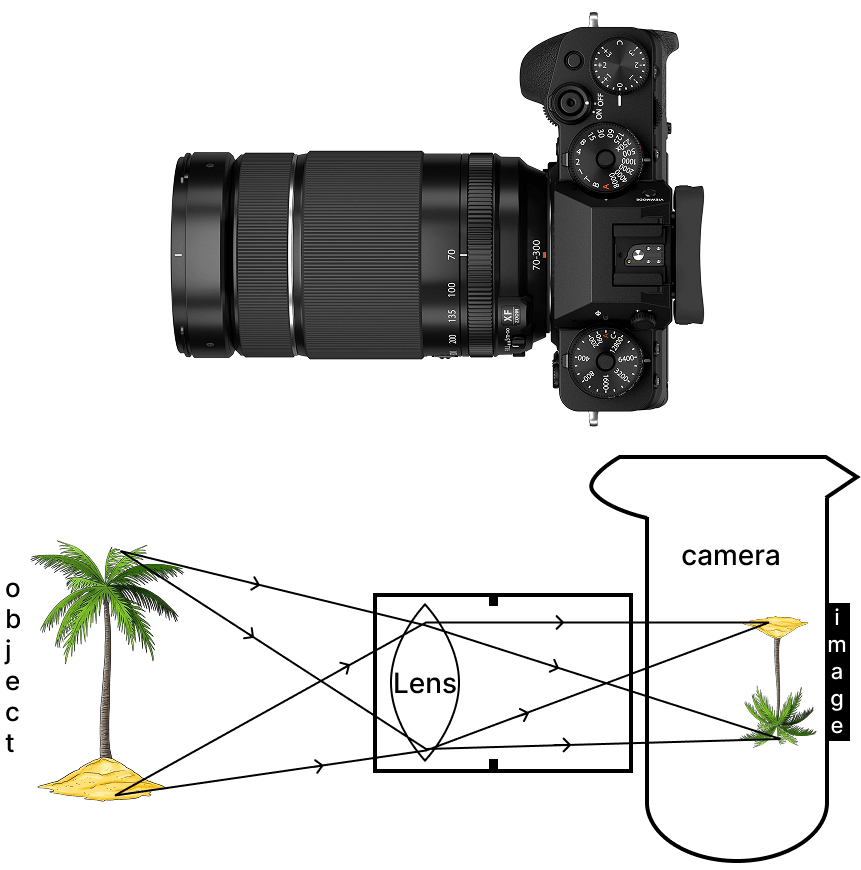
(a) What type of lens is used in the DSLR camera shown in the image?
(b) What type of image is formed on the sensor?
Attempt either subpart C or D.
(c) A photographer is using a DSLR camera with a lens of focal length f = 50 mm to take a close-up photograph of a small object. The lens projects an image onto the camera sensor that is located 60 mm behind the lens. Calculate the object distance (i.e., the distance between the object and the lens).
OR
(d) A photographer is using a DSLR camera to take a picture of a flower. The flower is positioned 150 mm away from the camera lens. The actual height of the flower is 80 mm, and the image height formed on the camera’s sensor is measured to be 20 mm. Calculate the focal length of the camera lens.
The arrangement of resistors shown in the below figure is connected to a battery.

The power dissipation in the 100 Ω resistor is 81 W. Calculate
(a) the current in the circuit
(b) the reading in the voltmeter V2
(c) the reading in the voltmeter V1
An electric heater consists of three similar heating elements A, B and C, connected as shown in the figure below. Each heating element is rated as 1.2 kW, 240 V and has constant resistance. S1, S2 and S3 are respective switches.
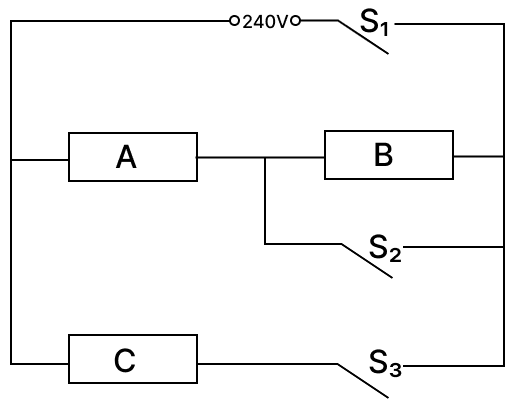
The circuit is connected to a 240 V supply.
(a) Calculate the resistance of one heating element.
(b) Calculate the current in each resistor when only S1 and S3 are closed.
(c) Calculate the power dissipated across A when S1, S2 and S3 are closed.