
Construct a quadrilateral PQRS in which PQ = 4 cm, ∠P = 90°, QR = 4.3 cm, RS = 3.6 cm and SP = 3.2 cm.
Answer
Steps of constructions :
Draw PQ = 4 cm.
Draw ∠QPX = 90°.
With P as centre and radius = 3.2 cm, draw an arc, cutting PX at S.
With Q as centre and radius = 4.3 cm, draw an arc.
With S as centre and radius = 3.6 cm, draw another arc, cutting the previous arc at R.
Join QR and RS.
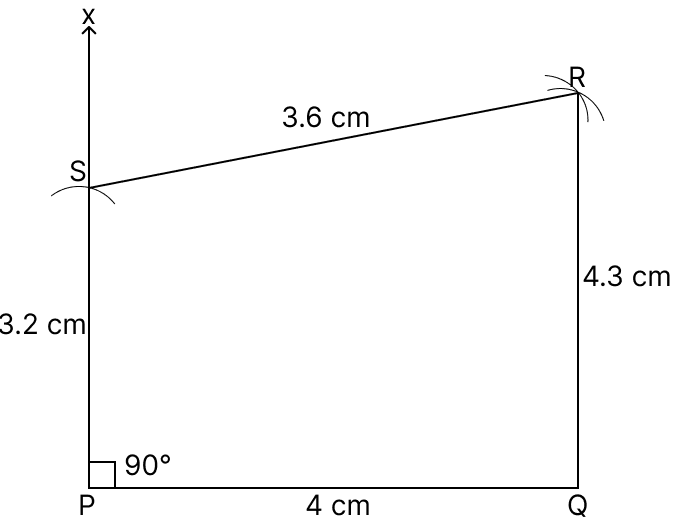
Hence, PQRS is the required quadrilateral.
Construct a quadrilateral ABCD in which AB = 4.5 cm, BC = 5.2 cm, CD = 5 cm, DA = 4.7 cm and ∠ABC = 75°.
Answer
Steps of constructions:
Draw AB = 4.5 cm.
Draw ∠ABX = 75°.
With B as centre and radius = 5.2 cm, draw an arc, cutting BX at C.
With A as centre and radius = 4.7 cm, draw an arc.
With C as centre and radius = 5 cm, draw another arc, cutting the previous arc at D.
Join DC and DA.
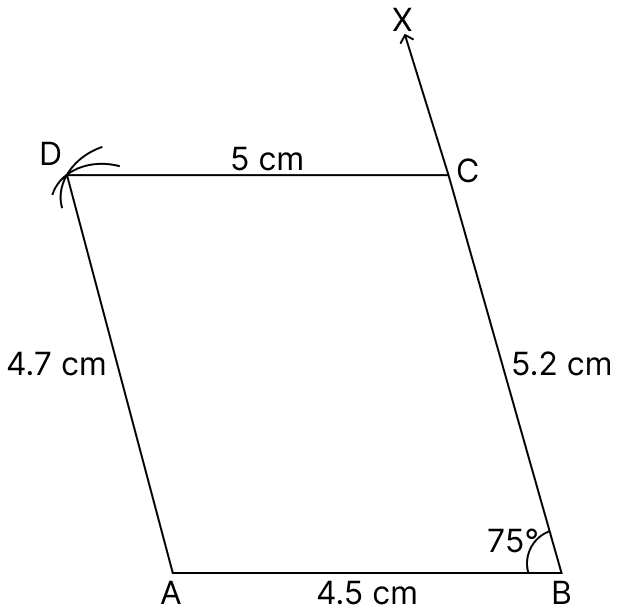
Hence, ABCD is the required quadrilateral.
Construct a quadrilateral ABCD in which AB = CD = 5.1 cm, BC = 4.7 cm, DA = 4.2 cm and ∠BCD = 60°.
Answer
Steps of constructions :
Draw CD = 5.1 cm.
Draw ∠DCX = 60°.
With C as centre and radius = 4.7 cm, draw an arc, cutting CX at B.
With D as centre and radius = 4.2 cm, draw an arc.
With B as centre and radius = 5.1 cm, draw another arc, cutting the previous arc at A.
Join DA and BA.
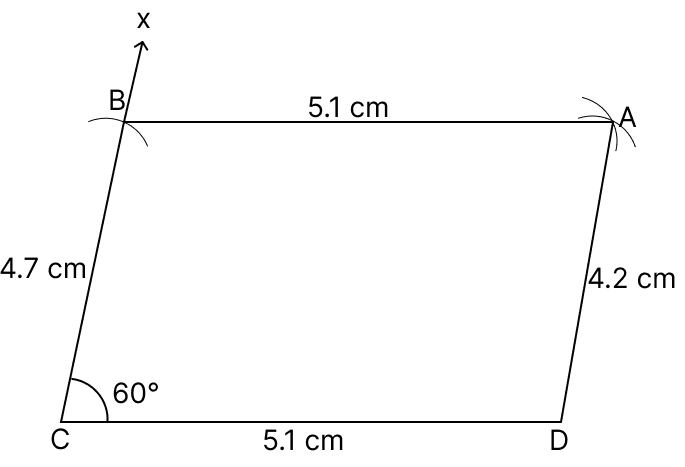
Hence, ABCD is the required quadrilateral.
Construct a quadrilateral UVWZ in which UV = 6 cm, VW = 5.3 cm, UZ = 5 cm, ∠U = 60° and ∠V = 75°.
Answer
Steps of construction:
Draw UV = 6 cm.
Construct ∠VUX = 60°.
With U as centre and radius = 5 cm, draw an arc, cutting UX at Z.
Construct ∠UVY = 75°.
With V as centre and radius = 5.3 cm,draw an arc, cutting arc VY at W.
Join VW and ZW.
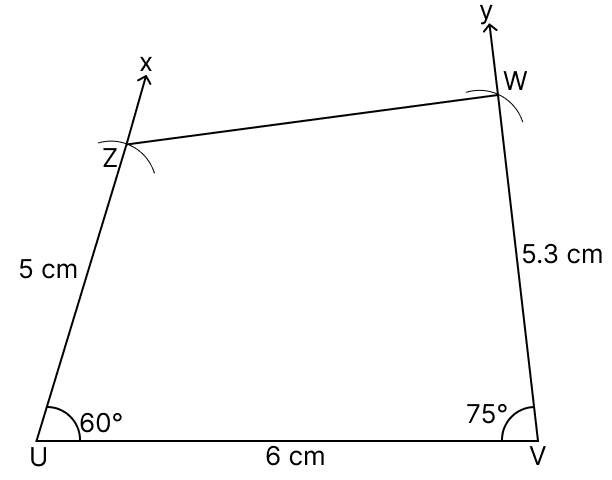
Hence, UVWZ is required quadrilateral.
Construct a quadrilateral PQRS in which PQ = 4.5 cm, QR = 5.6 cm, RS = 4.1 cm, ∠Q = 60° and ∠R = 120°.
Answer
Steps of construction:
Draw QR = 5.6 cm.
Construct ∠RQX = 60°.
With Q as centre and radius = 4.5 cm, draw an arc, cutting QX at P.
Construct ∠QRY = 120°.
With R as centre and radius = 4.1 cm, draw an arc, cutting arc RY at S.
Join SP.
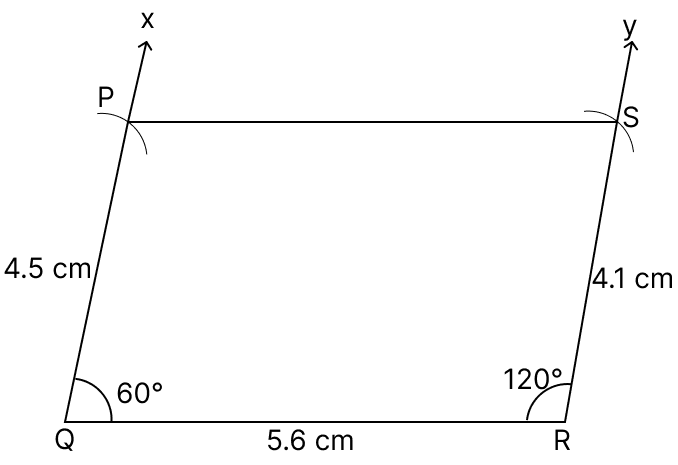
Hence, PQRS is required quadrilateral.
Construct a quadrilateral ABCD in which AB = AD = 5.3 cm, BC = CD = 5 cm and diagonal BD = 6.4 cm.
Answer
Steps of construction :
Draw AB = 5.3 cm.
Taking A as center, draw an arc of radius 5.3 cm (= AD) and taking B as center, draw one more arc of radius 6.4 cm (= diagonal BD). Let the two arcs intersect at point D.
Taking D as center, draw an arc of radius 5 cm (= CD) and taking B as center, draw one more arc of radius 5cm (= BC). Let the two arcs intersect at point C.
Join DC and BC.
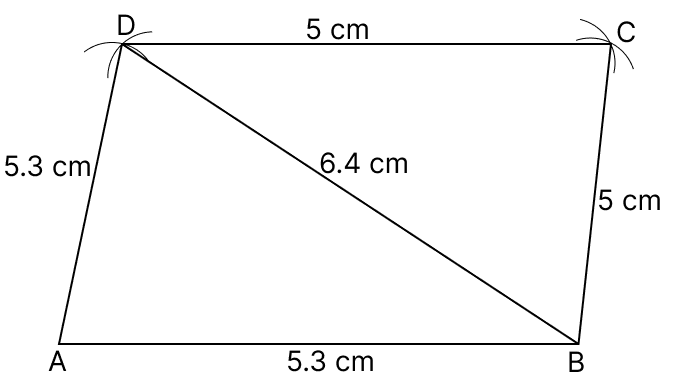
Hence, ABCD is the required quadrilateral.
Construct a quadrilateral XYZT in which XY = XZ = 5.7 cm, YZ = 4.5 cm, ZT = 4.6 cm and XT = 5 cm.
Answer
Steps of construction:
Draw YZ = 4.5 cm.
With Y as centre and radius 5.7 cm draw an arc.
With Z as centre and radius 5.7 cm draw another arc, cutting previous arc at X.
With X as centre and radius 5 cm, draw an arc.
With Z as centre and radius 4.6 cm draw another arc, cutting previous arc at T.
Join XT and ZT.
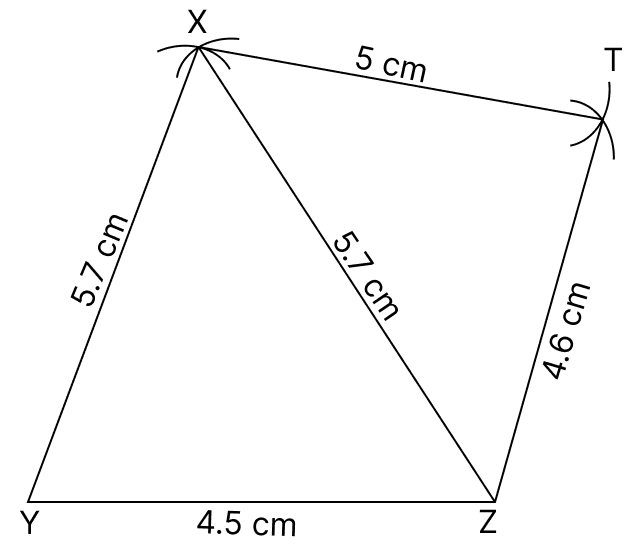
Hence, XYZT is required quadrilateral.
Construct a parallelogram ABCD in which BC = 6 cm, CD = 4 cm and ∠C = 60°.
Answer
Steps of construction:
Draw BC = 6 cm.
Construct ∠BCX = 60°.
With C as centre and radius = 4 cm, draw an arc, cutting CX at D.
With D as centre and radius = 6 cm, draw an arc.
With B as centre and radius = 4 cm, draw another arc,cutting the previous arc at A.
Join AB and DA.
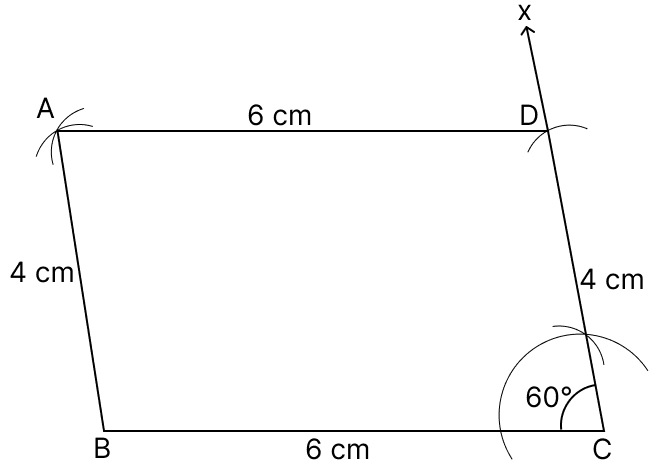
Hence, ABCD is the required parallelogram.
Construct a parallelogram PQRS in which QR = 4.7 cm, ∠Q = 120° and PQ = 2.8 cm.
Answer
Steps of construction :
Draw QR = 4.7 cm.
Construct ∠RQX = 120°.
With Q as centre and radius = 2.8 cm, draw an arc,cutting QX at P.
With P as centre and radius = 4.7 cm, draw an arc.
With R as centre and radius = 2.8 cm, draw another arc, cutting the previous arc at S.
Join RS and PS.
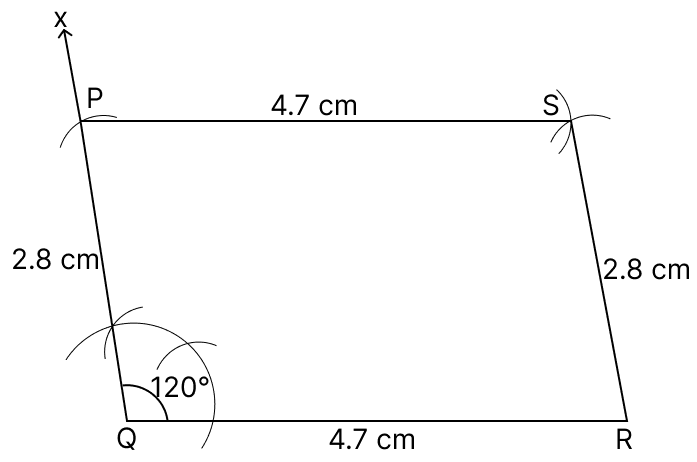
Hence, PQRS is the required parallelogram.
Construct a parallelogram ABCD in which BC = 5 cm, CD = 3 cm and diagonal BD = 6 cm.
Answer
Steps of construction:
Draw BC = 5 cm.
With B as centre and radius = 6 cm, draw an arc.
With C as centre and radius = 3 cm, draw another arc, cutting previous arc at D.
Join BD and CD.
With B as centre and radius = 3 cm draw an arc.
With D as centre and radius = 5 cm, draw another arc,cutting previous arc at A.
Join AD and AB.
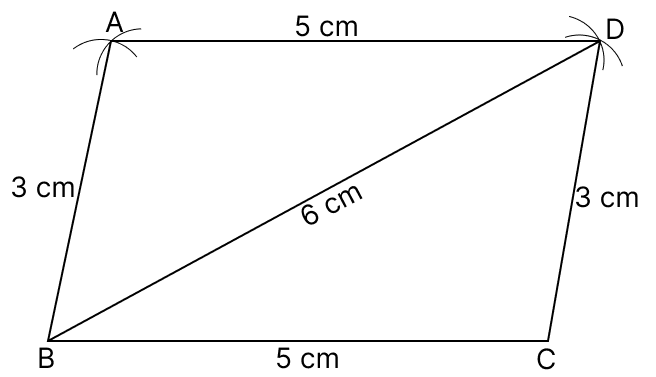
Hence, ABCD is the required parallelogram.
Construct a parallelogram ABCD in which AB = 4.8 cm, BC = 3.5 cm and diagonal AC = 5.4 cm.
Answer
Steps of construction :
Draw AB = 4.8 cm.
With A as centre and radius = 5.4 cm, draw an arc.
With B as centre and radius = 3.5 cm, draw another arc, cutting previous arc at C.
Join BC and AC.
With A as centre and radius = 3.5 cm draw an arc.
With C as centre and radius = 4.8 cm, draw another arc,cutting previous arc at D.
Join AD and CD.
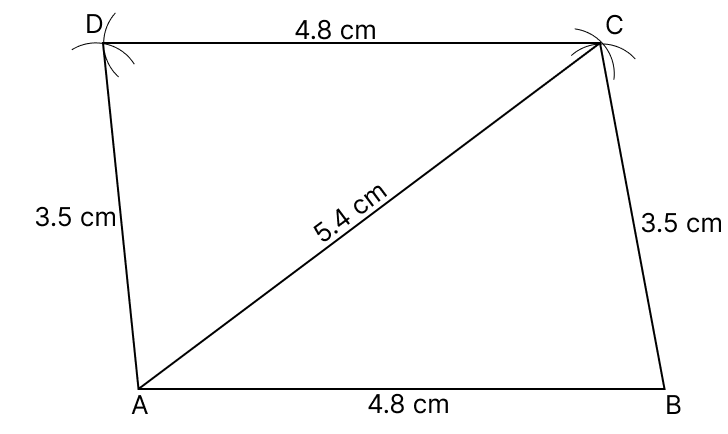
Hence, ABCD is the required parallelogram.
Construct a parallelogram ABCD in which diagonal AC = 5.6 cm, diagonal BD = 6.2 cm and angle between them is 60°.
Answer
Steps of construction:
Draw AC = 5.6 cm.
Find mid-point of AC.
Construct ∠AOX = 60°, produce XO to Y.
With O as centre and radii = (6.2) = 3.1 cm, draw arcs, cutting OX at D and OY at B.
Join AB, BC, CD and DA.
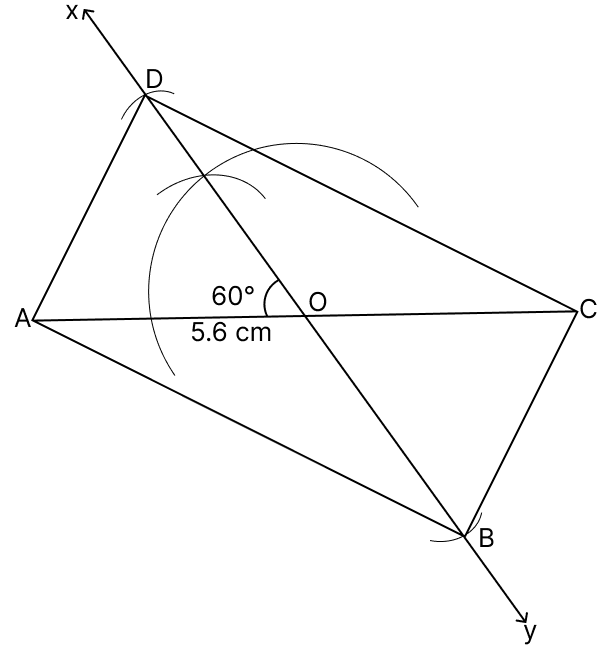
Hence, ABCD is required parallelogram.
Construct a rectangle whose adjacent sides are 4.7 cm and 3.2 cm.
Answer
Steps of construction :
Draw AB = 4.7 cm.
Construct ∠ABX = 90°.
With B as centre and radius equal to 3.2 cm, draw an arc, cutting BX at C.
With A as centre and radius = 3.2 cm, draw an arc.
With C as centre and radius = 4.7 cm, draw an arc, cutting previous arc at D.
Join DC and DA.
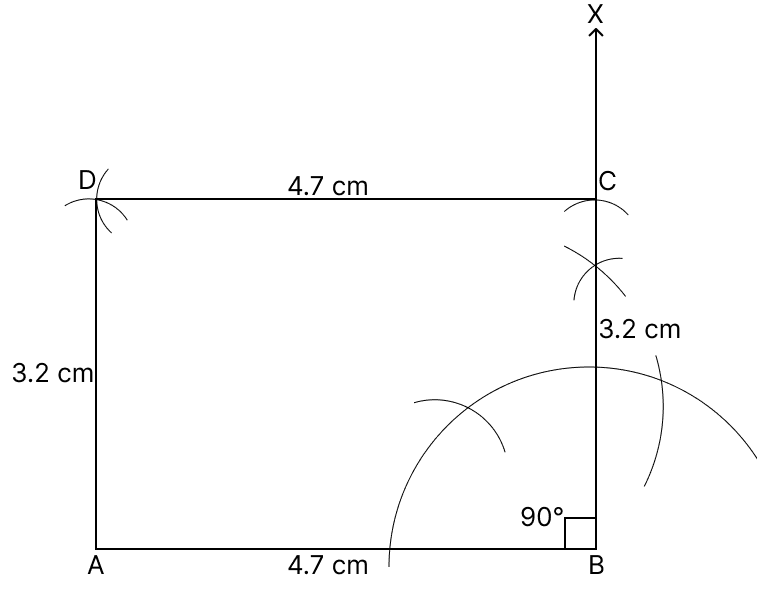
Hence, ABCD is required rectangle.
Construct a rectangle ABCD in which AB = 4.5 cm and diagonal AC = 6 cm.
Answer
Steps of construction :
Draw AB = 4.5 cm.
Construct ∠ABX = 90°.
With A as centre and radius equal to 6 cm, draw an arc, cutting BX at C. Join BC
With C as centre and radius = 4.5 cm, draw an arc.
With A as centre and radius = BC, draw an arc, cutting previous arc at D.
Join DC and DA.
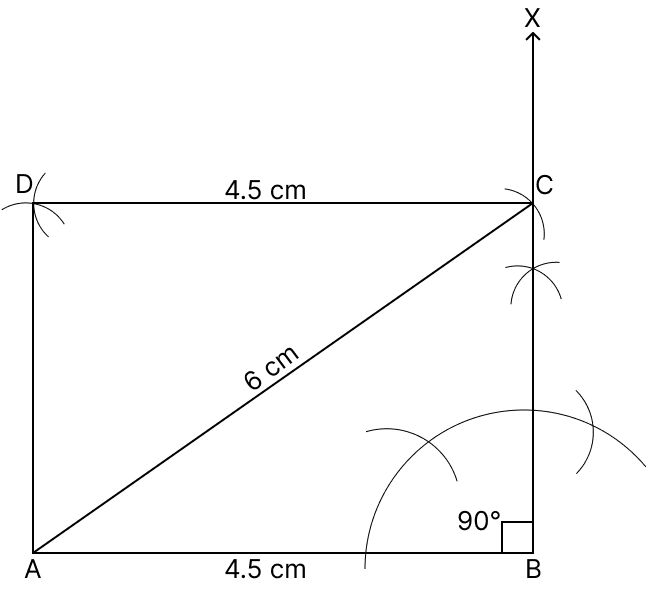
Hence, ABCD is required rectangle.
Construct a rectangle ABCD in which diagonal AC = 6.3 cm and the angle between the two diagonals is 50°.
Answer
Steps of construction :
Draw AC = 6.3 cm.
Find mid-point O of AC.
Construct ∠AOX = 50°.
Produce XO to Y.
Set off OB = 3.15 cm and OD = 3.15 cm.
Join AB, BC, CD and DA.
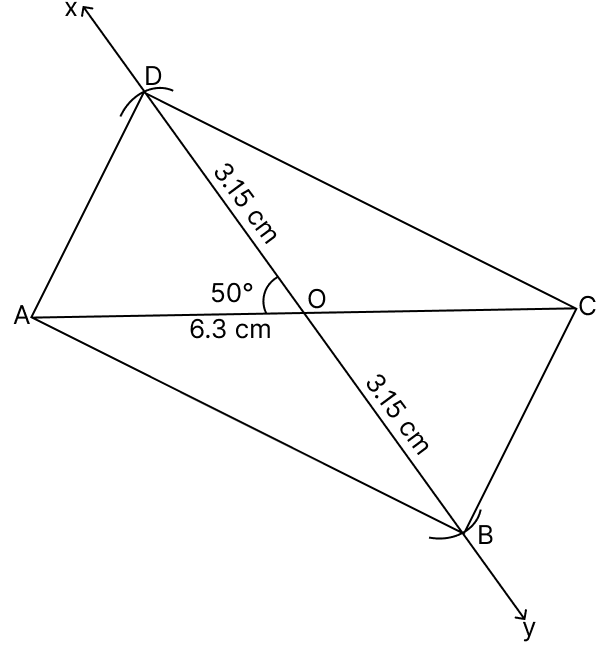
Hence, ABCD is required rectangle.
Construct a square one of whose diagonals measures 6 cm.
Answer
Steps of construction:
Draw AC = 6 cm.
Draw a perpendicular bisector XY of AC, meeting AC at O.
On XY, setoff OD = 3 cm and OB = 3 cm.
Join AD, CD, AB and BC.
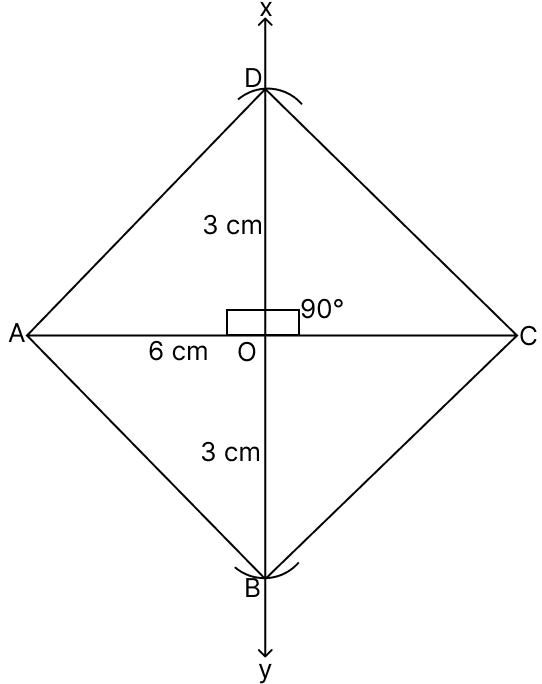
Hence, ABCD is the required square.
Construct a rhombus ABCD in which AB = 4.3 cm and ∠A = 45°.
Answer
Steps of construction :
Draw AB = 4.3 cm.
Construct ∠BAX = 45°.
On AX, cut off AD = 4.3 cm.
With B as centre and radius = 4.3 cm, draw an arc.
With D as centre and radius = 4.3 cm, draw another arc, cutting the previous arc at C.
Join CB and CD.
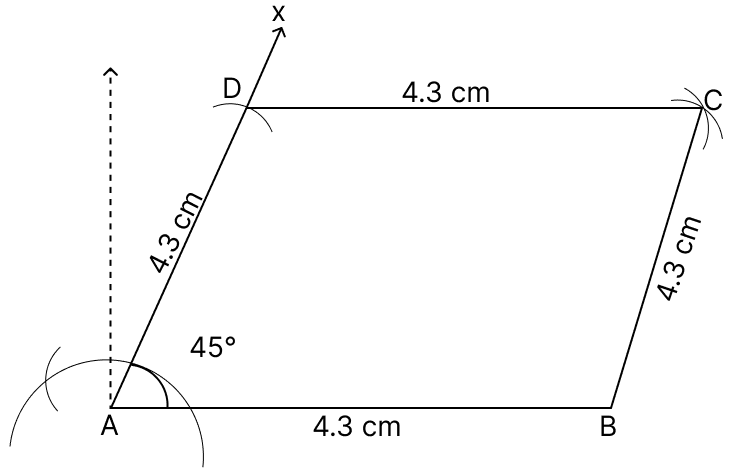
Hence, ABCD is the required rhombus.
Construct a rhombus ABCD in which AB = 5 cm and diagonal AC = 6.8 cm.
Answer
Steps of construction:
Draw AB = 5 cm.
With A as centre and radius = 6.8 cm, draw an arc.
With B as centre and radius = 5 cm, draw another arc, cutting the previous arc at C.
Join BC and AC.
With A as centre and radius = 5 cm, draw an arc.
With C as centre and radius = 5 cm, draw another arc,cutting the previous arc at D.
Join CD and DA.
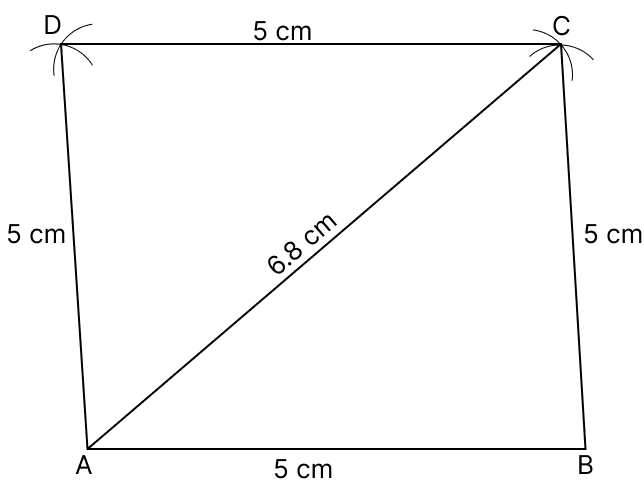
Hence, ABCD is required rhombus.
Construct a rhombus ABCD in which diagonal AC = 5.8 cm and diagonal BD = 6.4 cm.
Answer
Steps of construction :
Draw AC = 5.8 cm.
Draw the perpendicular bisector XOY of AC.
Set off OB = 3.2 cm on OY and OD = 3.2 cm on OX.
Join AB, BC, CD and DA.
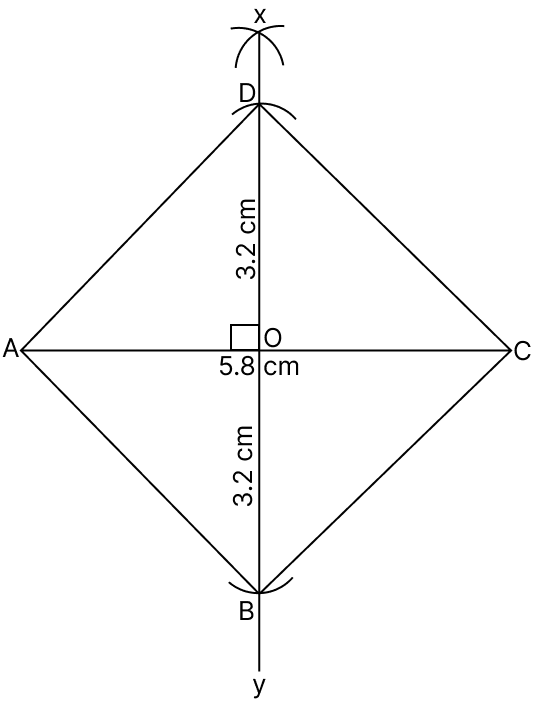
Hence, ABCD is the required rhombus.
Construct a square one of whose diagonals is 5.6 cm.
Answer
Steps of construction :
Draw AC = 5.6 cm.
Draw a perpendicular bisector XY of AC, meeting AC at O.
On XY, setoff OD = 2.8 cm and OB = 2.8 cm.
Join AD, CD, AB and BC.
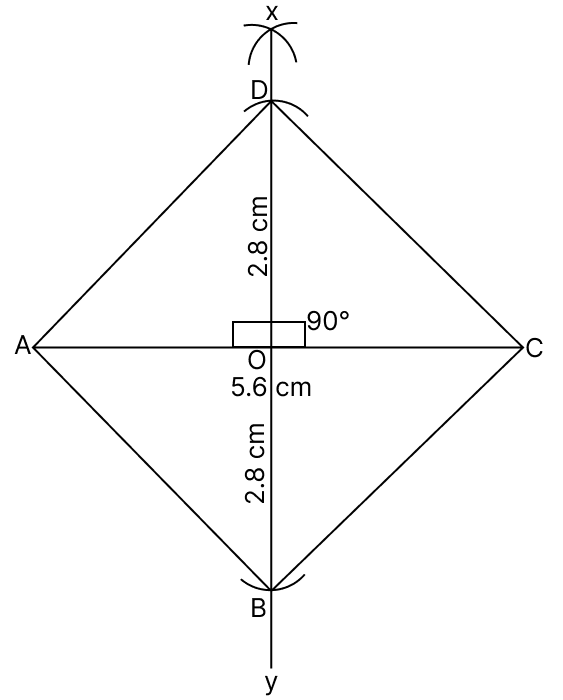
Hence, ABCD is the required square.
Construct a regular hexagon of side 2 cm, using ruler and compasses only.
Answer
We know that each angle in a regular hexagon = 120°.
Steps of construction :
Draw a line segment AB = 2 cm.
At A and B, draw ∠ABC = 120° each and cut off AF = BC = 2 cm.
At F and C, draw rays making angle of 120° each and cut off EF = CD = 2 cm.
Join ED. Hence, ABCDEF is the required hexagon.
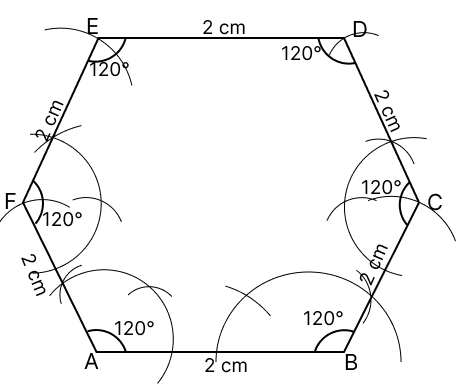
Hence, ABCDEF is required regular hexagon.
Construct a regular hexagon of side 3.5 cm, using ruler and compasses only.
Answer
We know that each angle in a regular hexagon = 120°.
Steps of construction :
Draw a line segment AB = 3.5 cm.
At A and B, draw ∠ABC = 120° each and cut off AF = BC = 3.5 cm.
At F and C, draw rays making angle of 120° each and cut off EF = CD = 3.5 cm.
Join ED. Hence, ABCDEF is the required hexagon.
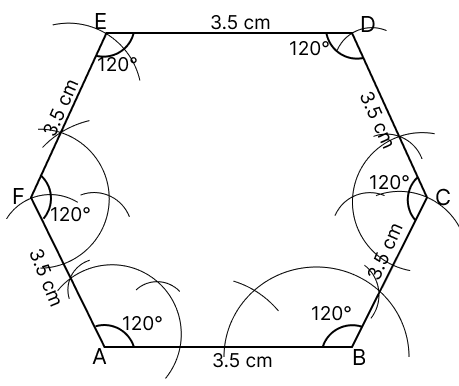
Hence, ABCDEF is required regular hexagon.