
Three angles of a quadrilateral measure 56°, 115° and 84°. Measure of the fourth angle is :
100°
105°
95°
110°
Answer
Let the fourth angle be x.
Given the three angles are 56°, 115° and 84°:
The sum of the angles of a quadrilateral is 360°
56°+ 115° + 84° + x = 360°
255° + x = 360°
x = 360° - 255°
x = 105°
Hence, option 2 is the correct option.
The angles of a quadrilateral are in the ratio 2 : 4 : 5 : 7. The angles of given quadrilateral are :
40°, 60°, 100°, 140°
40°, 80°, 120°, 120°
40°, 80°, 100°, 140°
40°, 60°, 100°, 160°
Answer
We know that,
The sum of the angles of a quadrilateral is 360°
Given the ratio of the angles is 2 : 4 : 5 : 7.
Let the angles be 2x, 4x, 5x, and 7x.
2x + 4x + 5x + 7x = 360°
18x = 360°
x = 20°
2x = 40°
4x = 80°
5x = 100°
7x = 140°
Hence, option 3 is the correct option.
ABCD is a parallelogram in which ∠A = 72°. Measures of ∠B, ∠C and ∠D respectively will be :
72°, 108°, 108°
108°, 108°, 72°
108°, 72°, 108°
none of these
Answer
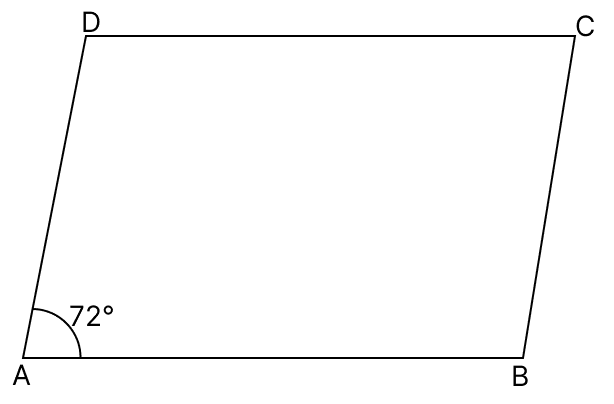
In a parallelogram, consecutive angles are supplementary and opposite angles are equal.
∠A + ∠B = 180°
72° + ∠B = 180°
∠B = 180° - 72°
∠B = 108°
∠A = ∠C = 72° (Opposite angles of parallelogram are equal.)
∠D = ∠B = 108° (Opposite angles of parallelogram are equal.)
Hence, option 3 is the correct option.
In parallelogram ABCD, if ∠A = 2x + 25° and ∠B = 3x − 5°, then value of x will be :
x = 13°
x = 23°
x = 33°
x = 32°
Answer
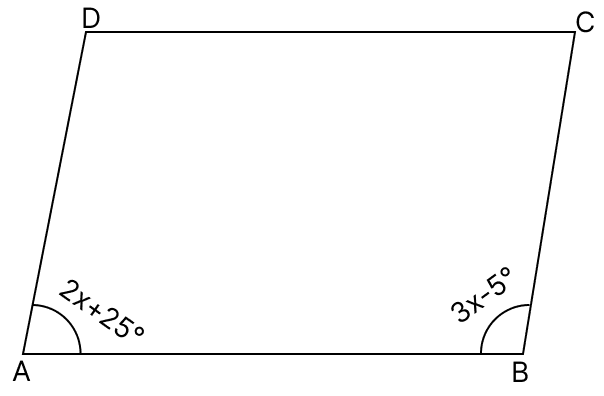
In a parallelogram, consecutive angles are supplementary and opposite angles are equal.
∠A = 2x + 25° and ∠B = 3x − 5°
∠A + ∠B = 180°
2x + 25° + 3x − 5° = 180°
5x + 20° = 180°
5x = 180° - 20°
5x = 160°
x = 32°.
Hence, option 4 is the correct option.
If one angle of a parallelogram is 30° less than twice the smallest angle, then measure of each angle will be :
60°, 80°, 80°, 140°
70°, 110°, 70°, 110°
60°, 120°, 60°, 120°
75°, 105°, 75°, 105°
Answer
Let the smallest angle of the parallelogram be denoted as x.
Given,
One angle of a parallelogram is 30° less than twice the smallest angle = 2x - 30°.
In a parallelogram, consecutive angles are supplementary and opposite angles are equal.
x + 2x - 30° = 180°
3x - 30° = 180°
3x = 180° + 30°
3x = 210°
x = 70°.
The two smaller angles are both 70°.
The two larger angles are both 2(70°) - 30° = 110°.
Hence, option 2 is the correct option.
ABCD is a parallelogram in which AB = 9.5 cm and its perimeter is 30 cm. Length of each side of parallelogram ABCD is :
AB = 9.5 cm, DC = 9.5 cm, BC = 5.5 cm, DA = 5.5 cm
AB = 9.5 cm, BC = 9.5 cm, DC = 5.5 cm, DA = 5.5 cm
DC = 5.5 cm, BC = 5.5 cm, AB = 9.5 cm, AD = 9.5 cm
none of these
Answer
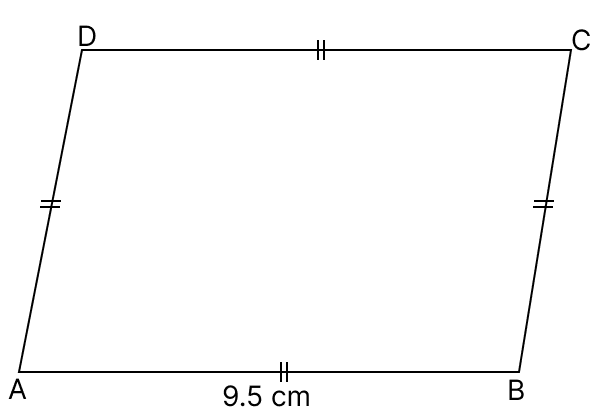
In a parallelogram, opposite sides are equal in length.
AB = CD
BC = DA
Perimeter = 30 cm
We know that,
Perimeter of Parallelogram = 2(Length + Breadth)
30 = 2(9.5 + BC)
15 = (9.5 + BC)
BC = 15 - 9.5
BC = 5.5 cm
BC = AD = 5.5 cm.
AB = CD = 9.5 cm
Hence, option 1 is the correct option.
Each side of a rhombus is 10 cm and one of its diagonals is 16 cm, length of other diagonal will be :
11 cm
12 cm
13 cm
15 cm
Answer
Let ABCD be the rhombus and the diagonals intersect at point O.
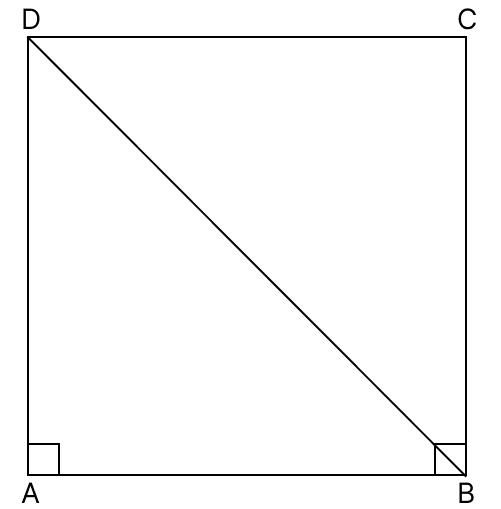
Let diagonal AC = 16 cm.
We know that,
Diagonals of rhombus bisect each other at right angles.
∴ AO = OC = = 8 cm and BO = OD = x cm (let).
In right angle triangle AOB,
By pythagoras theorem,
⇒ (Hypotenuse)2 = (Perpendicular)2 + Base2
⇒ AB2 = AO2 + OB2
⇒ 102 = 82 + x2
⇒ 100 = 64 + x2
⇒ x2 = 100 - 64
⇒ x2 = 36
⇒ x = = 6 cm.
From figure,
⇒ BD = BO + OD = 6 + 6 = 12 cm.
Hence, option 2 is the correct option.
ABCD is a rhombus. If ∠A = 70°, then ∠CDB will be :
45°
65°
55°
75°
Answer
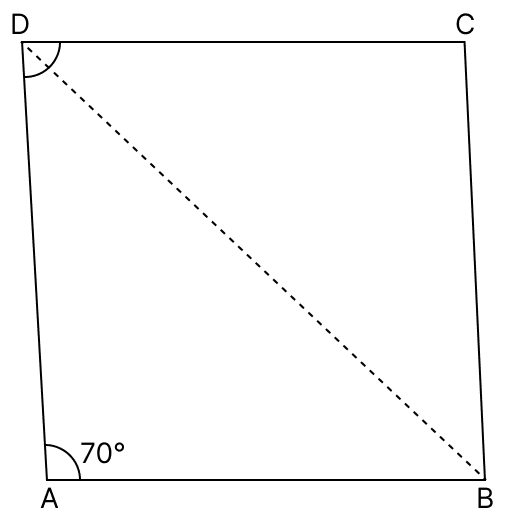
The sum of consecutive angles in a rhombus is 180°.
∠A + ∠D = 180°
70° + ∠D = 180°
∠D = 180° - 70°
∠D = 110°.
The diagonal BD bisects ∠D.
∠CDB =
∠CDB =
∠CDB = 55°.
Hence, option 3 is the correct option.
In a parallelogram, an angle is th of its adjacent angle, then angles of the parallelogram are :
80°, 100°, 80°, 100°
70°, 110°, 70°, 110°
60°, 120°, 60°, 120°
none of these
Answer
In a parallelogram, adjacent angles are supplementary.
Let one of the angle of parallelogram be x.
The adjacent angle is given as .
The adjacent angle = = 80°.
The angles opposite to 100° is also 100°.
The angle opposite to 80° is also 80°.
Hence, option 1 is the correct option.
The lengths of diagonals of a rhombus are 24 cm and 18 cm respectively, length of each side of the rhombus is :
25 cm
15 cm
35 cm
45 cm
Answer
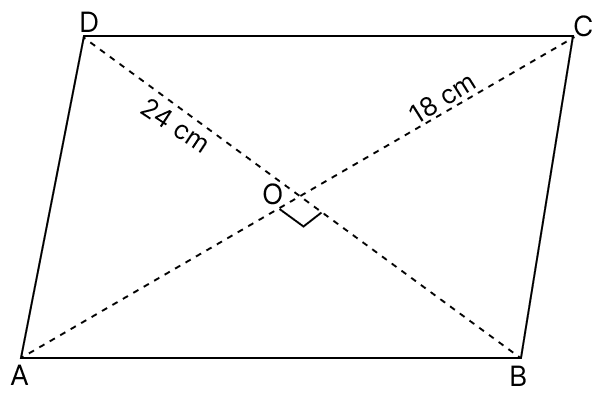
The diagonals of a rhombus are 18 cm and 24 cm.
AC = 18 cm
Then, OA = OC = = 9 cm.
And, BD = 24 cm
Then, OB = OD = = 12 cm.
Since the diagonals of a rhombus bisect at 90°.
Applying pythagoras theorem in triangle AOB, we get :
⇒ AB2 = OA2 + OB2
⇒ AB2 = (9)2 + (12)2
⇒ AB2 = 81 + 144
⇒ AB2 = 225
⇒ AB =
⇒ AB = 15 cm.
Hence, option 2 is the correct option.
ABCD is a parallelogram in which ∠BAD = 60° and ∠BAC = 30°, then ∠CBD =
45°
60°
70°
80°
Answer
Given,
∠BAD = 60° and ∠BAC = 30°.
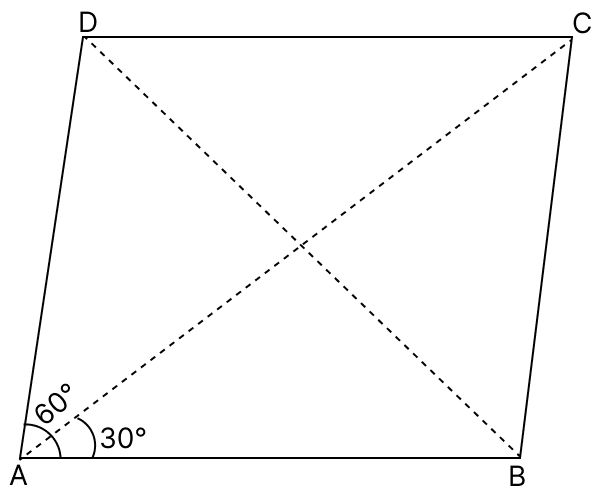
From figure,
∠CAD = ∠BAD - ∠BAC = 60° - 30° = 30°.
If diagonal of a parallelogram bisects a vertex angle, then it is a rhombus.
Thus, ABCD is a rhombus.
In rhombus adjacent angles are supplementary.
Thus,
∠BAD + ∠CBA = 180°
60° + ∠CBA = 180°
∠CBA = 180° - 60° = 120°.
Since, diagonals of rhombus bisect the vertex angle,
∴ ∠CBD = = 60°.
Hence, option 2 is the correct option.
The diagonals of the rectangle ABCD intersect at O. If ∠OBC = 64°, then ∠OAB =
64°
32°
26°
36°
Answer
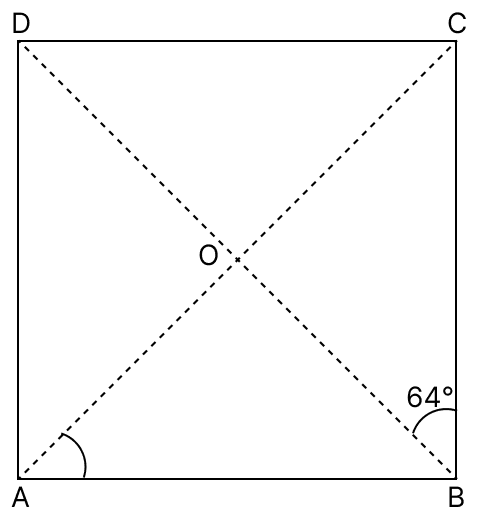
In a rectangle all angles are equal to 90°.
∠ABC = ∠OBC + ∠ABO
90° = 64° + ∠ABO
∠ABO = 90° - 64°
∠ABO = 26°.
The diagonals of a rectangle are equal in length and bisect each other. This means :
⇒ AC = BD
⇒ AO = BO
In an isosceles triangle AOB, the angles opposite the equal sides are equal.
∠OAB = ∠ABO = 26°.
Hence, option 3 is the correct option.
If ∠ADB of the rhombus ABCD is 30°, then ∠ACB =
30°
60°
70°
90°
Answer
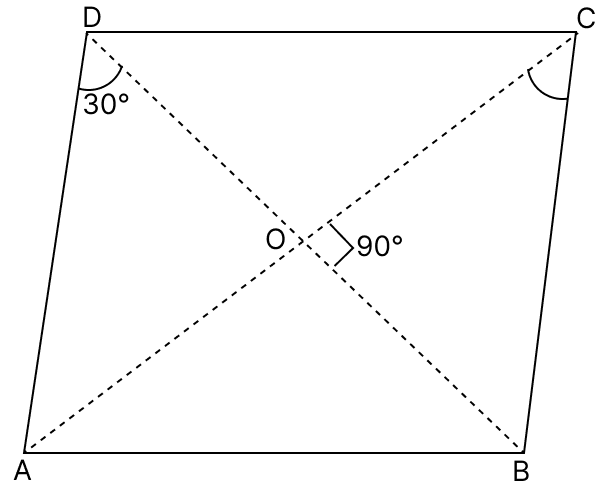
In rhombus opposite sides are parallel. The diagonal BD acts as a transversal line.
Therefore, the alternate interior angles are equal.
∠DBC = ∠ADB = 30°
From figure,
∠OBC = ∠DBC = 30°
∠BOC = 90° [Diagonals of rhombus cut at right angles]
In triangle BOC,
∠OBC + ∠BOC + ∠OCB = 180°
30° + 90° + ∠OCB = 180°
120° + ∠OCB = 180°
∠OCB = 180° - 120°
∠OCB = 60°.
Hence, option 2 is the correct option.
In the parallelogram ABCD, ∠A : ∠B = 3 : 5. ∠C =
67.5°
112.5°
45°
135°
Answer
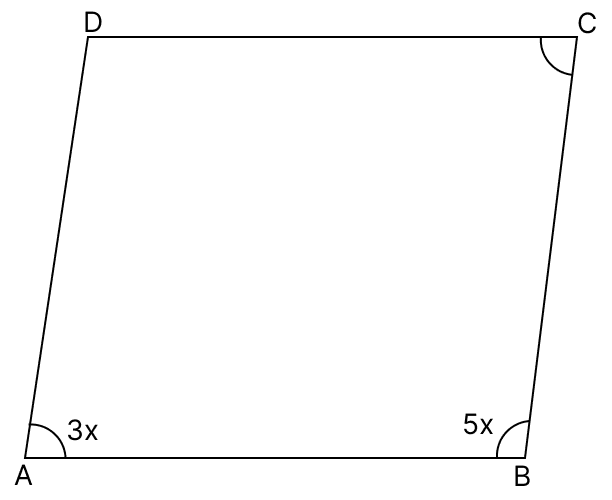
Given the ratio ∠A : ∠B = 3 : 5.
Let ∠A = 3x and ∠B = 5x.
Sum of adjacent angles in a parallelogram = 180°.
3x + 5x = 180°
8x = 180°
x = 22.5°
In a parallelogram, opposite angles are equal.
∠C = ∠A = 3x
∠C = 3 × (22.5°)
∠C = 67.5°
Hence, option 1 is the correct option.
The bisectors of ∠A and ∠B of the parallelogram ABCD intersect at E. ∠AEB =
100°
90°
80°
60°
Answer
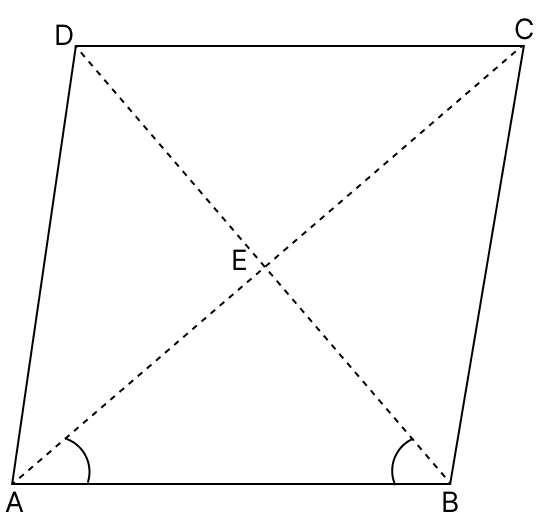
In a parallelogram, consecutive angles are supplementary.
∠A + ∠B = 180°
In triangle AEB,
∠AEB + ∠BAE + ∠EBA = 180°
∠AEB + ∠A + ∠B = 180°
∠AEB + (∠A + ∠B) = 180°
∠AEB + (180°) = 180°
∠AEB + 90° = 180°
∠AEB = 180° - 90°
∠AEB = 90°.
Hence, option 2 is the correct option.
The bisectors of ∠A and ∠B of the parallelogram ABCD intersect at P on the side CD. If BC = 3 cm, then AB =
4 cm
5 cm
6 cm
8 cm
Answer
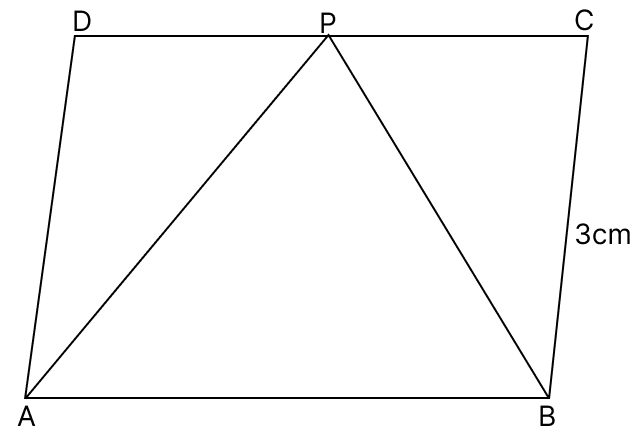
In parallelogram ABCD, we know that AB ∥ DC. The line AP is a transversal.
∠PAB = ∠APD (Alternate interior angles are equal) ....(1)
Since AP is the bisector of ∠A:
∠PAB = ∠PAD .......(2)
From equation (1) and (2), we get :
∴ ∠PAD = ∠APD
In triangle APD, since two angles are equal, the triangle is isosceles.
AD = DP
ABCD is a parallelogram, AD = BC = 3 cm.
Thus, DP = 3 cm.
Similarly, for the bisector BP and transversal BP:
∠PBA = ∠BPC (Alternate interior angles are equal) .......(3)
Since BP bisects ∠B:
∠PBA = ∠PBC ..........(4)
From equation (3) and (4), we get :
∴ ∠BPC = ∠PBC
In triangle BCP, since two angles are equal, the triangle is isosceles.
PC = BC = 3 cm.
Length of CD = DP + PC = 3 + 3 = 6 cm.
AB = CD = 6 cm [Opposite sides of parallelogram are equal]
Hence, option 3 is the correct option.
If the lengths of the diagonals of a rhombus are 24 cm and 10 cm, then the length of its each side is :
26 cm
17 cm
15 cm
13 cm
Answer
Let the rhombus be ABCD and its diagonals AC and BD intersect at point O.
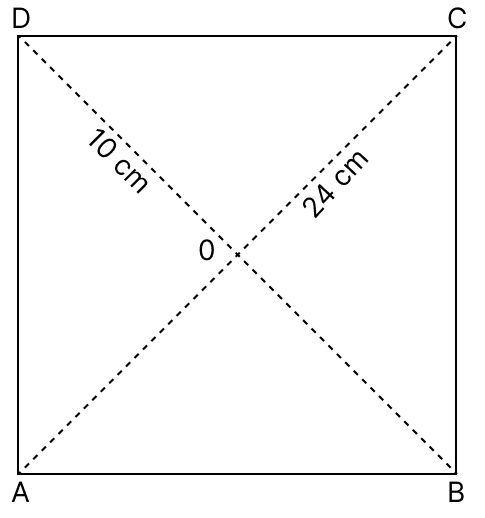
We know that,
Diagonals of a rhombus bisect each other.
AC = 24 cm
OA = = 12 cm.
BD = 10 cm
OB = = 5 cm.
In triangle AOB,
OA2 + OB2 = AB2
122 + 52 = AB2
144 + 25 = AB2
169 = AB2
AB =
AB = 13 cm.
Hence, option 4 is the correct option.
If the opposite angles of a quadrilateral are equal, then it will definitely be a :
rectangle
square
rhombus
parallelogram
Answer
If the opposite angles of a quadrilateral are equal, then it will definitely be a parallelogram.
Hence, option 4 is the correct option.
The diagonals of a quadrilateral are equal and they bisect each other. The quadrilateral is definitely a :
rectangle
square
rhombus
parallelogram
Answer
A rectangle is defined as a parallelogram with equal diagonals. If the diagonals of a quadrilateral bisect each other and are also equal, it must be a rectangle.
Hence, option 1 is the correct option.
PQRS is a rhombus in which PQ = 6 cm and ∠PQR = 120°. The length of the diagonal QS is :
6 cm
7 cm
8 cm
11 cm
Answer
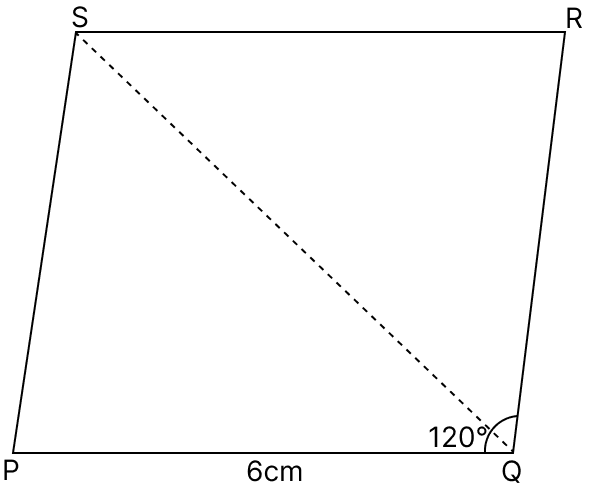
In triangle PQS,
PQ = PS = 6 cm (because all sides of a rhombus are equal).
Therefore, the base angles are equal:
∠PQS = ∠PSQ.
∠PQR = ∠PSR = 120° [Opposite angles of a rhombus are equal]
∠PQR + ∠QPS = 180° [Consecutive angles are supplementary]
∠QPS = 180° - 120°
∠QPS = 60°.
In triangle PQS,
∠QPS + ∠PQS + ∠PSQ = 180°
60° + 2∠PQS = 180°
2∠PQS = 180° - 60°
2∠PQS = 120°
∠PQS = 60°.
Since all three angles (∠QPS, ∠PQS, and ∠PSQ) are 60°, △PQS is an equilateral triangle.
PQ = PS = QS = 6 cm.
Hence, option 1 is the correct option.