
Rajbeer is a farmer. He has a plot of land in the shape of a quadrilateral ABCD as shown in the figure. In ABCD, AB ∥ CD and AD ∥ BC. He divided the field into two parts, viz, triangle BCE and trapezium CDAE by making an embankment CE such that CE = AD.
Based on the above information, answer the following questions :
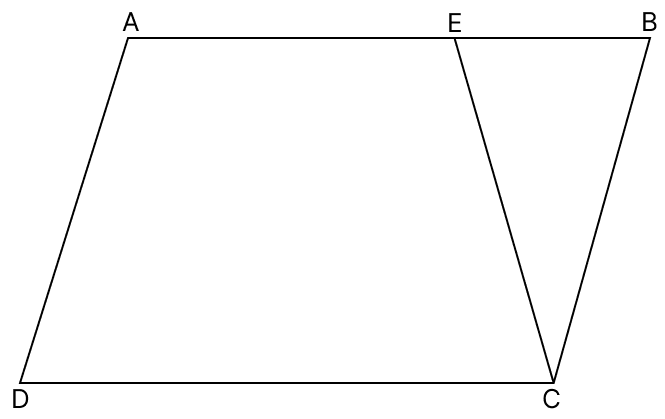
1. ABCD is a :
(a) Rectangle
(b) Parallelogram
(c) Square
(d) Trapezium
2. ∠A is equal to :
(a) ∠D
(b) ∠B
(c) ∠C
(d) ∠E
3. ∠DCE is equal to :
(a) ∠E
(b) ∠A
(c) ∠D
(d) ∠B
4. Which of the following is correct?
(a) ΔAEC ≅ ΔEAD
(b) ΔACE ≅ ΔAED
(c) ΔCEA ≅ ΔEAD
(d) none of these
5. Diagonal DE is equal to :
(a) diagonal DB
(b) diagonal AC
(c) DC
(d) BC
Answer
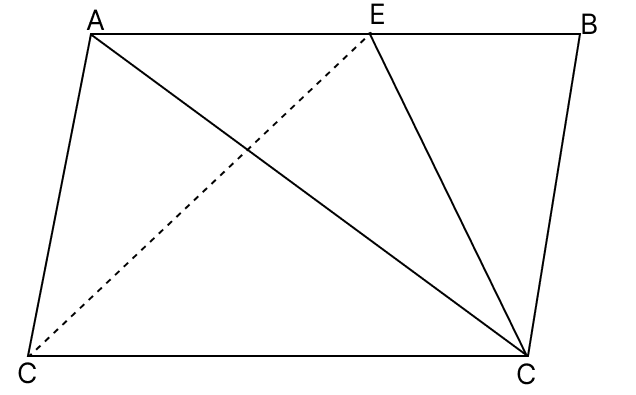
1. Given,
AB ∥ CD and AD ∥ BC
Since both pairs of opposite sides are parallel, the quadrilateral ABCD is a parallelogram.
Hence, option (b) is the correct option.
2. Given,
AD = CE
In trapezium CDAE:
AD and CE are the non-parallel sides and they are equal.
∴ CDAE is an isosceles trapezium.
∠A = ∠E [Angles on the same base of an isosceles triangle area equal]
Hence, option (d) is the correct option.
3. Given,
AD = CE
∴ CDAE is an isosceles trapezium.
∠DCE = ∠ADC [Base angles of an isosceles trapezium are equal.]
Hence, option (c) is the correct option.
4. In ΔAEC and ΔAED,
AD = CE (Given)
AE = AE (common side)
∠AEC = ∠EAD [Base angles of an isosceles trapezium are equal]
∴ ΔAEC ≅ ΔEAD [By S.A.S. axiom]
Hence, option (a) is the correct option.
5. As ADCE is an isosceles trapezium and diagonals of an isosceles trapezium are equal in length.
Hence, option (b) is the correct option.