
Assertion (A) : The two diagonals of a rectangle are equal and bisect each other at right angles.
Reason (R) : Every rectangle is a square.
A is true, R is false
A is false, R is true
Both A and R are true
Both A and R are false
Answer
The diagonals of a rectangle are equal in length and bisect eah other, but not necessarily at right angles.
∴ Assertion (A) is false.
A square is a special type of rectangle where all sides are equal, but a rectangle is not necessarily a square.
A rectangle only requires four right angles; it does not require all four sides to be equal.
Every square is a rectangle, but not every rectangle is a square.
∴ Reason (R) is false.
Both A and R are false.
Hence, option 4 is the correct option.
Assertion (A) : If diagonals of a quadrilateral are equal, then it must be a rectangle.
Reason (R) : The diagonals of a rectangle are equal.
A is true, R is false
A is false, R is true
Both A and R are true
Both A and R are false
Answer
For a quadrilateral to be a rectangle, the diagonals must be equal and they must bisect each other.Having equal diagonals is not enough to say a quadrilateral to be a rectangle.
Assertion (A) is false.
This is a fundamental property of rectangles.
If we have a rectangle ABCD, we can prove the diagonals AC and BD are equal using the SAS congruence rule on △ABC and △DCB.
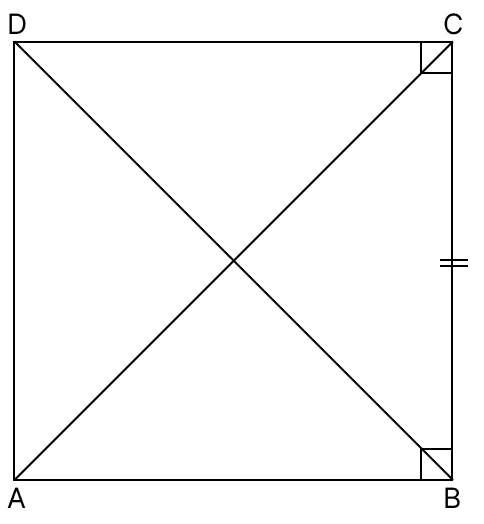
AB = DC (Opposite sides)
∠B = ∠C = 90°
BC = BC (Common side)
Therefore, AC = BD.
Reason (R) is true.
A is false, R is true
Hence, option 2 is the correct option.
Assertion (A) : Every square is a parallelogram.
Reason (R) : In a square as well as in a parallelogram, the diagonals are equal in length.
A is true, R is false
A is false, R is true
Both A and R are true
Both A and R are false
Answer
By definition, a parallelogram is a quadrilateral with two pairs of parallel opposite sides.
A square has all the properties of a parallelogram:
Opposite sides are parallel.
Opposite sides are equal.
Opposite angles are equal.
Diagonals bisect each other.
Because a square meets all these criteria, it is considered a special type of parallelogram.
Assertion (A) is true.
A square has equal diagonals, it is not true for a general parallelogram.
In a standard parallelogram (like a rhombus or a slanted parallelogram), one diagonal is typically longer than the other.
Reason (R) is false.
A is true, R is false.
Hence, option 1 is the correct option.