
If bisectors of ∠A and ∠B of a parallelogram ABCD intersect each other at P, of ∠B and ∠C at Q, of ∠C and ∠D at R and of ∠D and ∠A at S, then PQRS is a :
rectangle
rhombus
parallelogram
quadrilateral whose opposite angles are supplementary
Answer
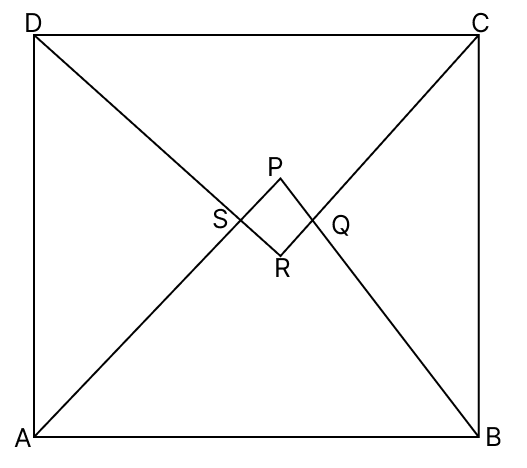
∠A + ∠D = 180° [sum of Co-Int. angles in ∥gm is 180°]
⇒ = 90°
In triangle ASD,
∠DAS + ∠SDA + ∠ASD = 180°
+ ∠ASD = 180°
90° + ∠ASD = 180°
∠ASD = 90°
∠PSR = ∠ASD = 90° [Vertically opposite angles]
∠S = 90°
∠B + ∠C = 180° [sum of Co-Int. angles in ∥gm is 180°]
⇒ = 90°
In triangle BQC,
∠QCB + ∠QBC + ∠CQB = 180°
+ ∠CQB = 180°
90° + ∠CQB = 180°
∠CQB = 90°
∠PQR = ∠CQB = 90° [Vertically opposite angles]
∠Q = 90°
∠A + ∠B = 180° [sum of Co-Int. angles in ∥gm is 180°]
⇒ = 90°
In triangle APB,
+ ∠APB = 180°
90° + ∠APB = 180°
∠APB = 90°
∠P = 90°
In quadrilateral PQRS,
By angle sum property of quadrilateral:
∠P + ∠Q + ∠R + ∠S = 360°
90° + 90° + ∠R + 90° = 360°
∠R + 270° = 360°
∠R = 360° - 270°
∠R = 90°
Since, all angles of PQRS = 90°
∴ PQRS is a rectangle
Hence, option 1 is the correct option.
Diagonals of a quadrilateral ABCD bisect each other. If ∠A = 35°, then ∠B is equal to :
145°
135°
155°
35°
Answer
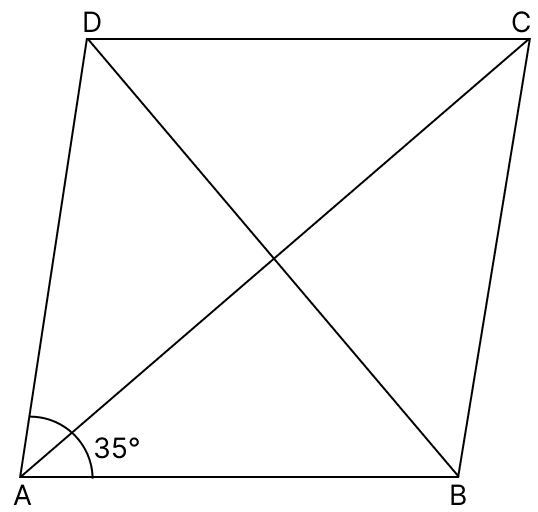
A quadrilateral whose diagonals bisect each other is a Parallelogram.
Since ∠A and ∠B are adjacent angles they are supplementary,
∠A + ∠B = 180°
35° + ∠B = 180°
∠B = 180° - 35°
∠B = 145°.
Hence, option 1 is the correct option.
ABCD is a trapezium and P and Q are the mid-points of the diagonals of AC and BD. Then PQ is equal to :
AB
CD
(AB − CD)
(AB + CD)
Answer
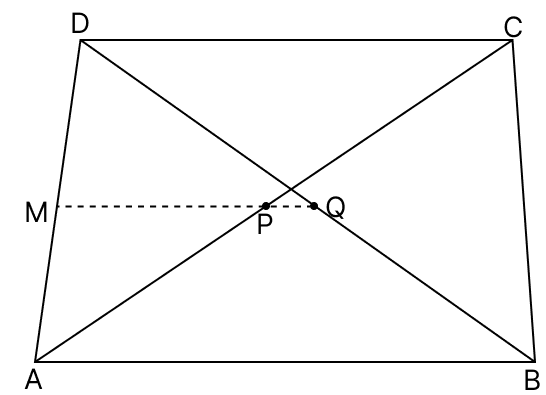
The Mid-point Theorem, which states that the line segment joining the mid-points of two sides of a triangle is parallel to the third side and is half of its length.
In triangle ADC,
M is the mid-point of AD (let)
P is the mid-point of AC
MP ∥ CD
MP = CD
In triangle ABD,
M is the mid-point of AD
Q is the mid-point of BD
MQ ∥ AB
MQ = AB
Since: MP ∥ CD, MQ ∥ AB and AB ∥ CD,
∴ MP ∥ MQ
Both pass through point M. So MP and MQ are the same straight line.
Hence, M, P and Q all lie on same line.
MQ = MP + PQ
PQ = MQ - MP
PQ = AB - CD
PQ = [AB - CD]
Hence, option 3 is the correct option.
The diagonals of a quadrilateral intersect at right angles and it has exactly one axis of symmetry. The quadrilateral is a :
square
rhombus
kite
none of these
Answer
A kite is defined by two pairs of adjacent sides being equal. Because of this specific symmetry, the longer diagonal acts as a mirror line, while the shorter diagonal does not.
Kite has exactly 1 axis of symmetry.
Hence, option 3 is the correct option.
You have been given following specification regarding a quadrilateral. Measure of all the four angles and the length of one side is given. Would you be able to construct a unique quadrilateral in this case? Justify your answer.
Answer
No, we cannot construct a unique quadrilateral with only the measures of all four angles and the length of just one side.
In any quadrilateral, the sum of interior angles is always 360°. So even if all four angles are given, they only tell you the shape’s turning, not its exact size or proportions.
Knowing the length of only one side fixes the scale along that side, but the other sides can still vary.
Therefore, the given information is insufficient, and a unique quadrilateral cannot be constructed.
Which of the following quadrilaterals can you construct if you know the length of its diagonals?
Parallelogram
Rectangle
Rhombus
Square
Answer
Rhombus:
Diagonals of a rhombus are perpendicular bisectors of each other.
Knowing both diagonal lengths completely determines the rhombus.
Square:
A square has equal diagonals that are perpendicular. Knowing the diagonal length fixes the side length.
Hence, square and rhombus can be constructed if we know the length of its diagonals.
ABCD is a rectangle in which diagonal BD bisects ∠B. Can we definitely say that ABCD is a square?
Answer
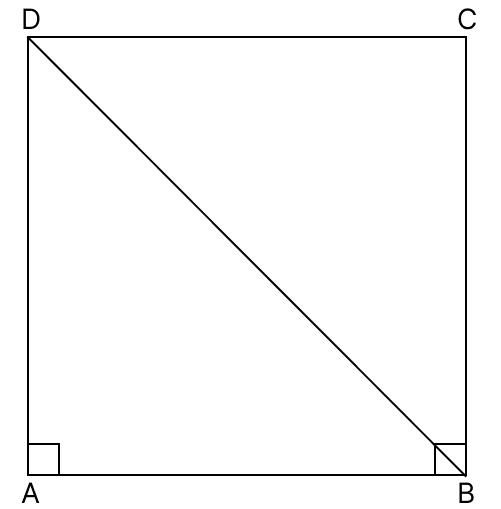
In a rectangle, all angles are 90°.
Given that diagonal bisects ∠B
∠ABD = ∠DBC = 45°
This implies that the diagonal makes equal angles with sides BA and BC, which can happen only if AB = BC.
A rectangle with adjacent sides equal is a square.
Yes, ABCD is a square.