
Mathematics
ABC is an equilateral triangle. If AD bisects angle A, prove that AD is perpendicular bisector of BC.
Triangles
5 Likes
Answer
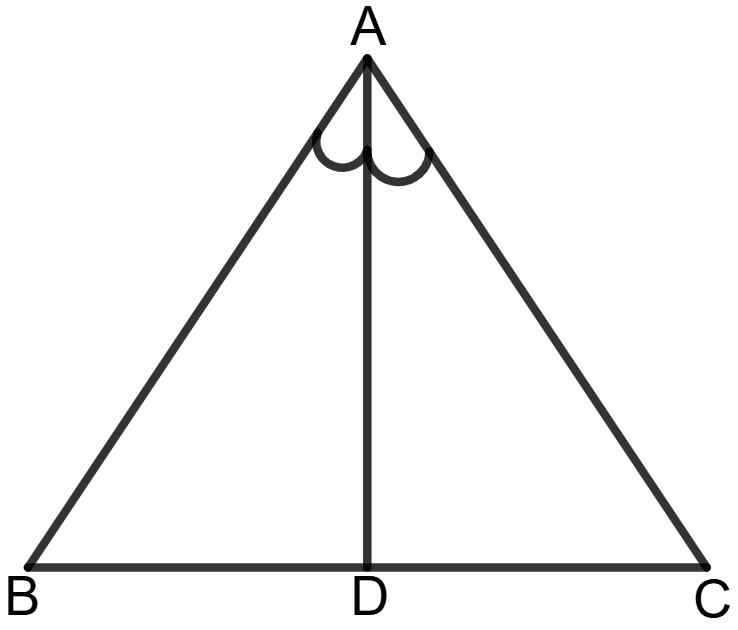
Given: ABC is an equilateral triangle, and AD bisects ∠A.
To Prove: AD is the perpendicular bisector of BC.
Proof: Since AD bisects ∠A, we have:
∠BAD = ∠DAC
In Δ ABD and Δ ADC,
∠BAD = ∠DAC (Given, AD bisects ∠A)
AD = AD (Common side)
AB = AC (Sides of an equilateral triangle)
By SAS congruency, we conclude:
Δ ABD ≅ Δ ADC
Since Δ ABD ≅ Δ ADC, their corresponding parts are equal:
BD = DC
Thus, AD bisects BC.
Since the two triangles are congruent, their corresponding angles are equal:
∠ADB = ∠ADC
From the straight-line property:
∠ADB + ∠ADC = 180°
⇒ ∠ADB + ∠ADB = 180°
⇒ 2∠ADB = 180°
⇒ ∠ADB = = 90°
Thus, AD is perpendicular to BC.
Since AD bisects BC and is perpendicular to BC, we conclude that:
AD is the perpendicular bisector of BC.
Hence, AD is the perpendicular bisector of BC.
Answered By
2 Likes
Related Questions
In the given figure, AD = DB = DE, ∠EAC = ∠FAC and ∠F = 90°
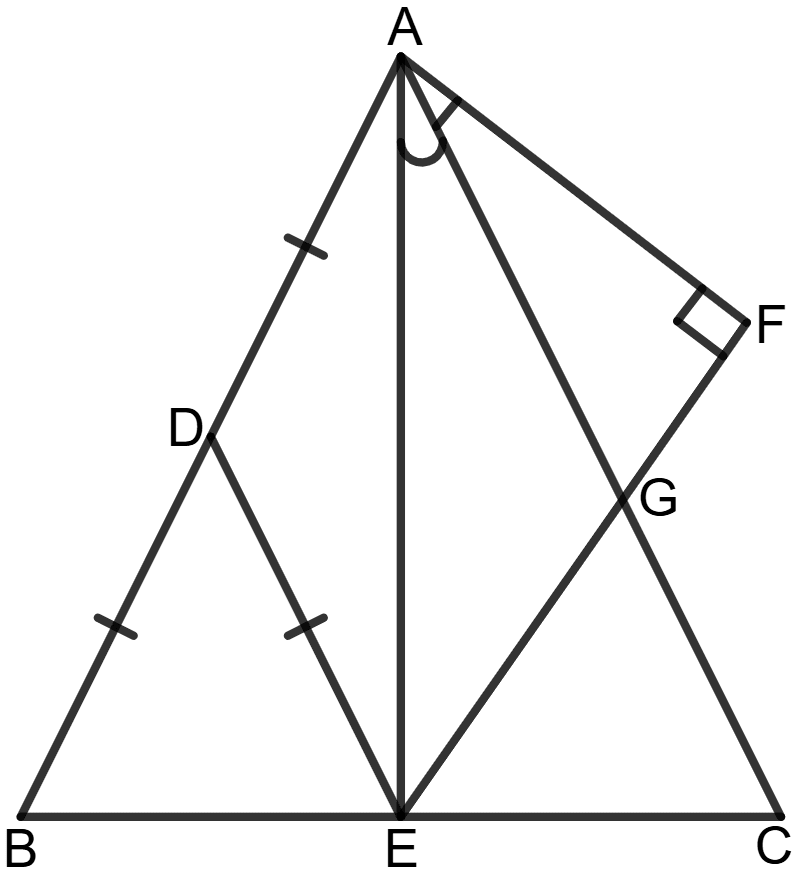
Prove that :
(i) ∠AEB = 90°
(ii) △ CEG is isosceles
(iii) ∠CEG = ∠EAF.
(i) In an isosceles triangle the angles are in the ratio 7 : 4 : 7. Find each base angle of the triangle.
(ii) Find the angles of an isosceles triangle, if the ratio of the base angle to the vertical angle 2 : 5.
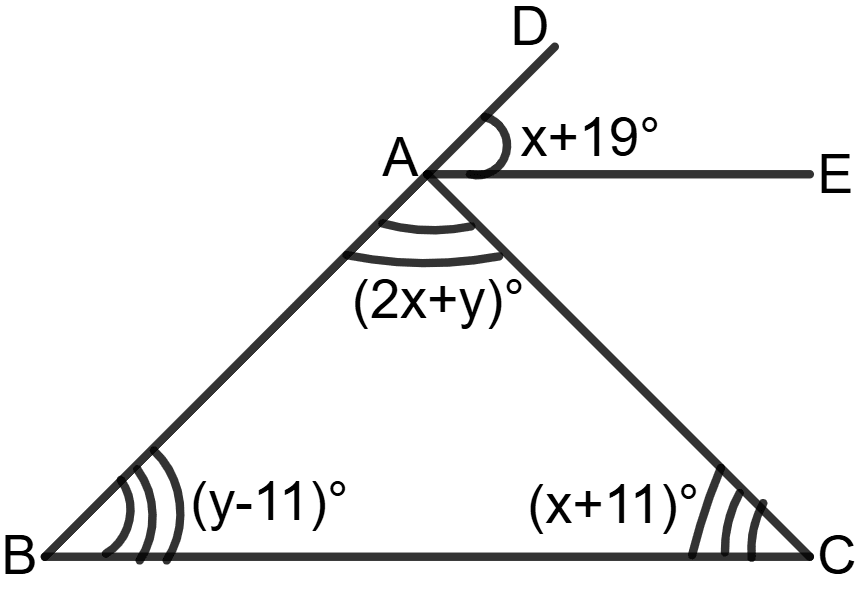
In the following figure, AE//BC. Find values of x and y.
In triangle ABC, given below, P is a point inside △ABC.
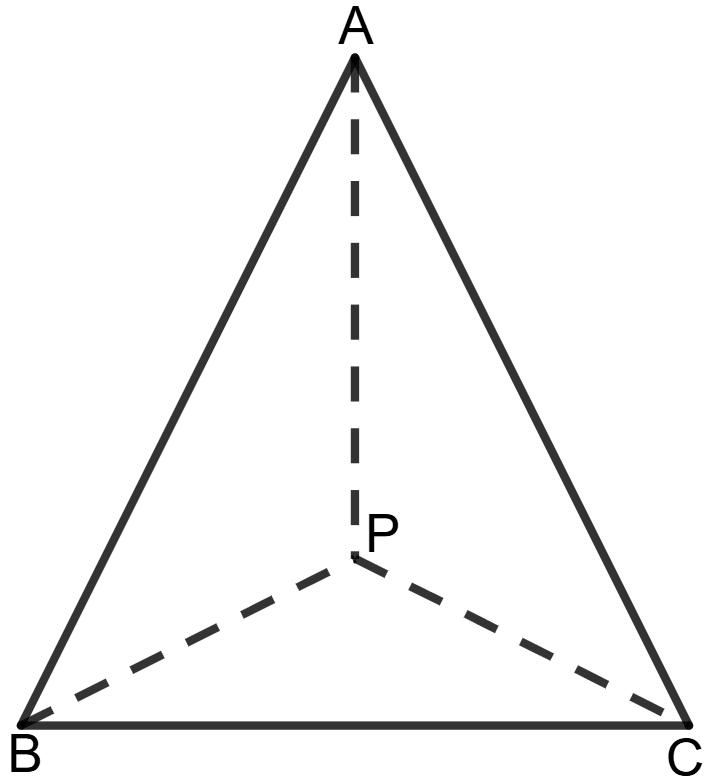
Prove that :
AP + BP + CP > (AB + BC + CA)