
Mathematics
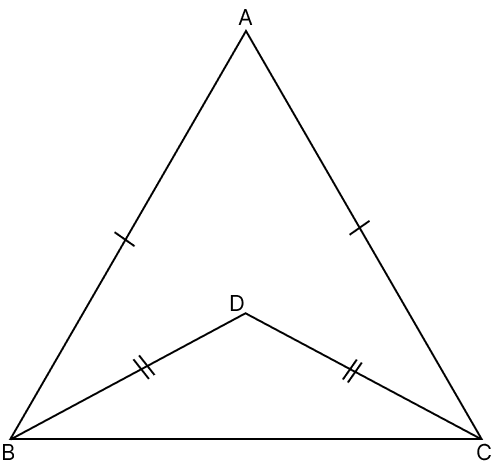
In the adjoining figure, AB = AC, BD = CD, ∠BAD = 32°, ∠BDC = 56°, ∠CAD = 2x° and ∠BDA = (x + y)°. The values of x and y will be :
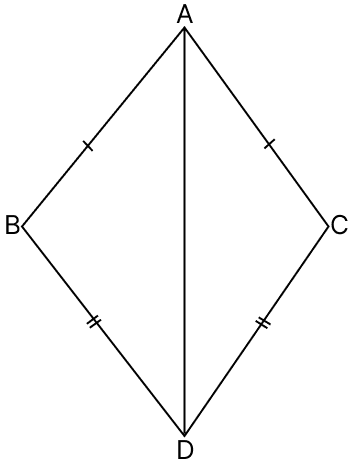
x = 10, y = 16
x = 16, y = 12
x = 18, y = 8
x = 12, y = 16
Triangles
1 Like
Answer
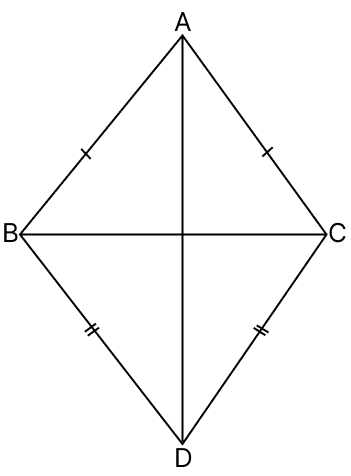
Join BC.
In △BDC,
BD = DC
∠DBC = ∠DCB = a (let)
∴ ∠DBC + ∠DCB + ∠BDC = 180°
⇒ a + a + 56° = 180°
⇒ 2a = 180° - 56°
⇒ 2a = 124°
⇒ a =
⇒ a = 62°
⇒ ∠DBC = ∠DCB = 62°
In △ABC,
AB = AC
∠ABC = ∠ACB
∠ABD = ∠ABC + ∠DBC ….(1)
∠ACD = ∠ACB + ∠DCB
⇒ ∠ACD = ∠ABC + ∠DBC ….(2)
From eq.(1) and (2), we have :
⇒ ∠ABD = ∠ACD
In △ABC,
∴ ∠A + ∠ABC + ∠ACB = 180°
⇒ ∠BAD + ∠CAD + ∠ABC + ∠ABC = 180°
⇒ 32° + 2x° + 2∠ABC = 180°
⇒ 2∠ABC = 180° - 32° - 2x°
⇒ 2∠ABC = 148° - 2x°
⇒ ∠ABC = 74° - x°
Substituting value of ∠ABC in eq.(1):
⇒ ∠ABD = ∠ABC + ∠DBC
⇒ ∠ABD = 74° - x° + 62°
⇒ ∠ABD = 136° - x°
In △ABD,
⇒ ∠ABD + ∠BAD + ∠BDA = 180°
⇒ 136° - x° + 32° + x° + y° = 180°
⇒ 168° + y° = 180°
⇒ y° = 180° - 168°
⇒ y° = 12°
⇒ y = 12.
In an isosceles triangle BDC,
BD = CD
We know that,
Perpendicular drawn from the vertex of an isosceles triangle bisects the base.
⇒ ∠DOB = ∠DOC = 90°
In △DOB,
⇒ ∠DBO + ∠DOB + ∠BDO = 180°
⇒ 62° + 90° + x° + y° = 180°
⇒ 152° + x° + 12° = 180°
⇒ 164° + x° = 180°
⇒ x° = 180° - 164°
⇒ x° = 16°
⇒ x = 16.
Hence, option 2 is the correct option.
Answered By
2 Likes
Related Questions
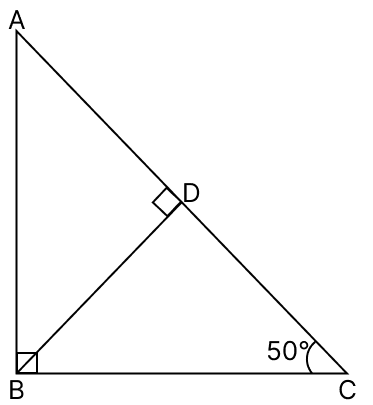
In the adjoining figure, ∠ABC = 90°, ∠BCA = 50° and BD ⊥ AC. Then ∠ABD =
30°
40°
50°
60°
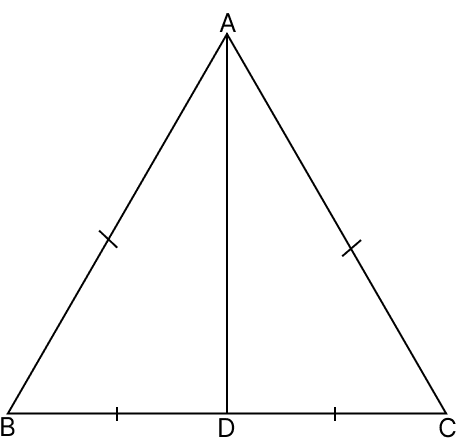
In the adjoining figure, AB = AC and BD = CD. Then, ∠ADC =
60°
75°
90°
100°
In the figure, AB = AC and DB = DC. ∠ABD : ∠ACD is :
1 : 2
2 : 1
1 : 1
1 : 3
In right triangles ABC and DEF, if hypotenuse AB = EF and side AC = DE, then △ABC is congruent to:
△FED
△EFD
△DEF
△FDE