
Mathematics
Draw a line segment AB = 5.5 cm. Mark a point P, such that PA = 6 cm and PB = 4.8 cm. From the point P, draw a perpendicular to AB.
Quadrilaterals Constructions
11 Likes
Answer
Steps:
Make a line AB = 5.5 cm.
With A as center and radius = 6 cm, draw an arc.
With B as center and radius = 4.8 cm, draw an arc which cut the previous arc at P.
Join AP and BP.
With P as center, draw an arc of a suitable radius which cuts AB at points C and D.
With C and D as centers, draw arcs of equal radii and let these arcs intersect each other at point E.
(The radius of these arcs must be more than half of CD and both the arcs must be drawn on the other side.)
Join P and E.
Let PE cut AB at point O.
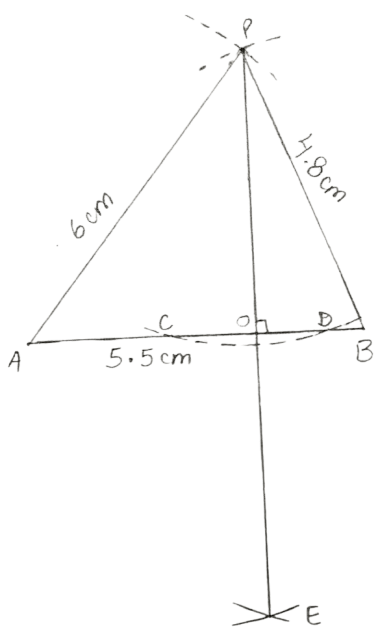
Clearly, ∠AOP = ∠BOP = 90°
Hence, OP is the required perpendicular.
Answered By
5 Likes
Related Questions
Draw angle ABC of any suitable measure.
(i) Draw BP, the bisector of angle ABC.
(ii) Draw BR, the bisector of angle PBC and draw BQ, the bisector of angle ABP.
(iii) Are the angles ABQ, QBP, PBR and RBC equal ?
(iv) Are the angles ABR and QBC equal ?
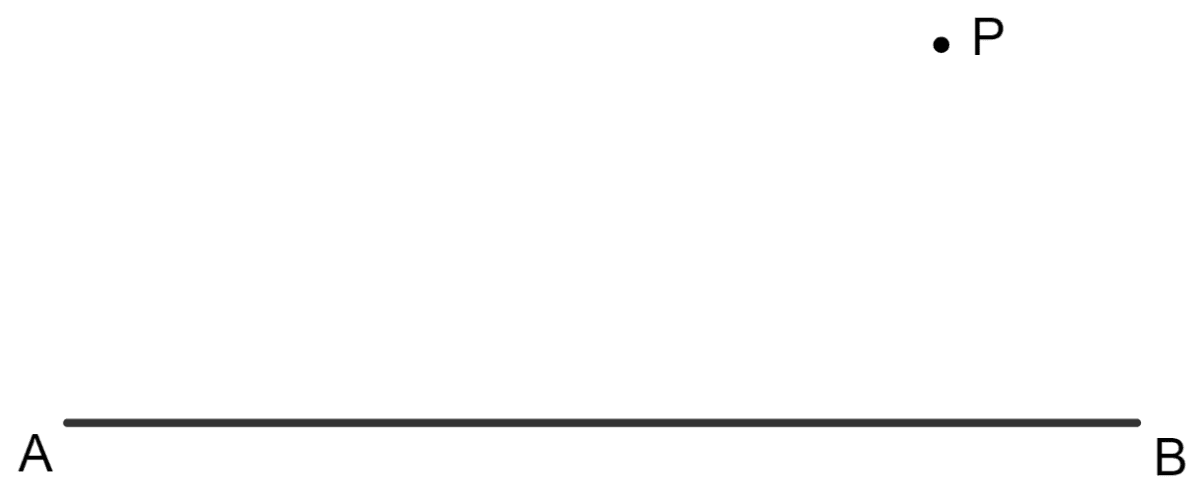
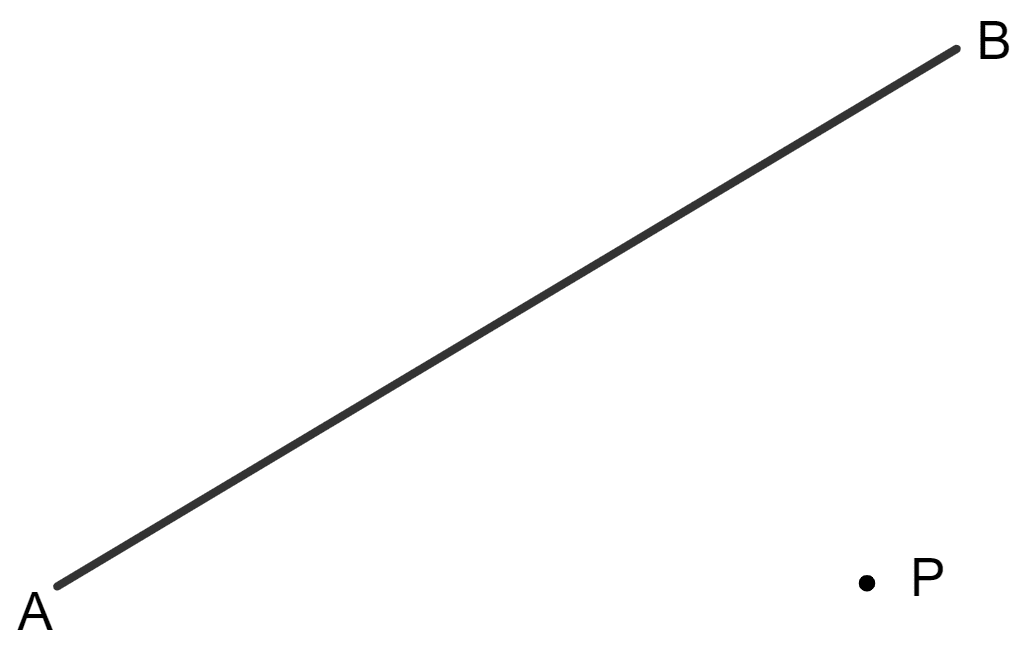
In each of the following, draw a perpendicular through point P to the line segment AB :
(i)
(ii)

(iii)
Draw a line AB = 6 cm. Mark a point P any where outside the line AB. Through the point P, construct a line parallel to AB.
Draw a line MN = 5.8 cm. Locate a point A which is 4.5 cm from M and 5 cm from N. Through A draw a line parallel to line MN.