
Mathematics
Draw angle ABC of any suitable measure.
(i) Draw BP, the bisector of angle ABC.
(ii) Draw BR, the bisector of angle PBC and draw BQ, the bisector of angle ABP.
(iii) Are the angles ABQ, QBP, PBR and RBC equal ?
(iv) Are the angles ABR and QBC equal ?
Quadrilaterals Constructions
14 Likes
Answer
(i) Steps:
Draw an angle ABC.
With B as centre, draw an arc EF of any suitable radius.
With E as centre, draw an arc of same radius as taken in step 2.
With F as centre, draw an arc of same radius as taken in step 2 and cutting the previous arc at point G.
Join B and G and produce it till point P.
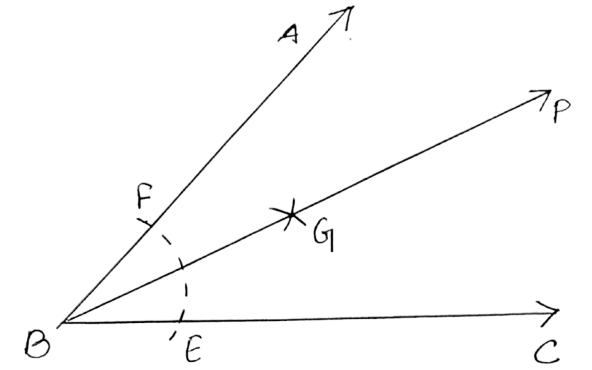
Hence, BP is angle bisector of angle ABC.
(ii) Steps:
Draw angle ABC and its angle bisector BP as explained in part i.
With B as center, draw an arc of any suitable radius which cuts AB at point G and BP at point F.
Taking G and F as centers, draw arcs of equal radii and let these arcs cut each other at point H. (The radii of these arcs must be more than half the distance between points G and F)
Join BH and produce upto point Q. BQ is the required bisector of ∠ABP. Thus, .
With B as center, draw an arc of any suitable radius which cuts BP at point F and BC at point E.
Taking F and E as centers, draw arcs of equal radii and let these arcs cut each other at point I.
(The radii of these arcs must be more than half the distance between points F and E)Join BI and produce upto point R. BR is the required bisector of ∠PBC. Thus, .
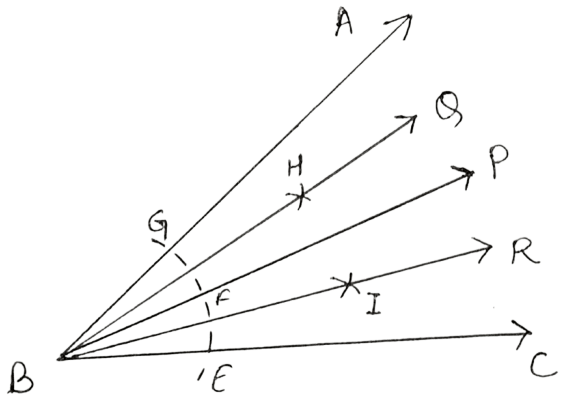
Hence, BR is angle bisector of angle PBC and BQ is angle bisectors of angle ABP.
(iii)
(iv) ∠ABR = ∠ABQ + ∠QBP + ∠PBR
∠QBC = ∠QBP + ∠PBR + ∠RBC
∵ ∠RBC = ∠ABQ
∴ ∠QBC = ∠ABQ + ∠QBP + ∠PBR
∴ ∠ABR = ∠QBC
Answered By
9 Likes
Related Questions
In which of the following cases, it is not possible to construct a square when :
A. one diagonal is given
B. one side is given
C. one angle is given which is 90°
D. one side and the angle between a side and a diagonal are given.
A
B
C
D
Given below are the angles x and y.
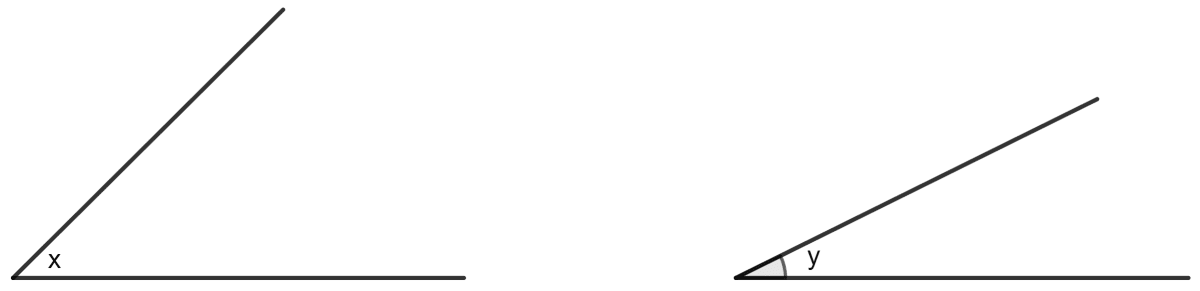
Without measuring these angles, construct :
(i) ∠ABC = x + y
(ii) ∠ABC = 2x + y
(iii) ∠ABC = x + 2y
In each of the following, draw a perpendicular through point P to the line segment AB :
(i)
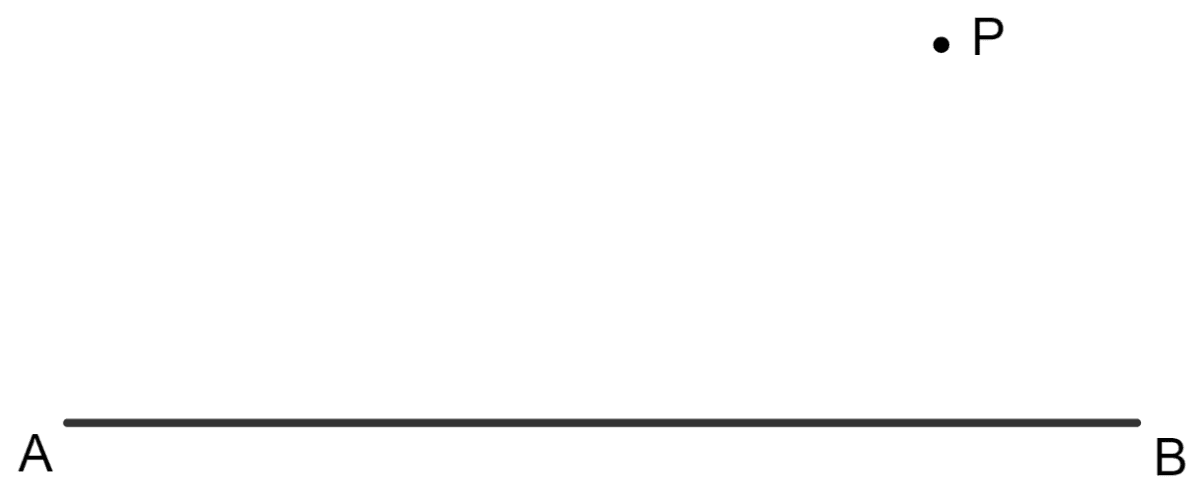
(ii)

(iii)
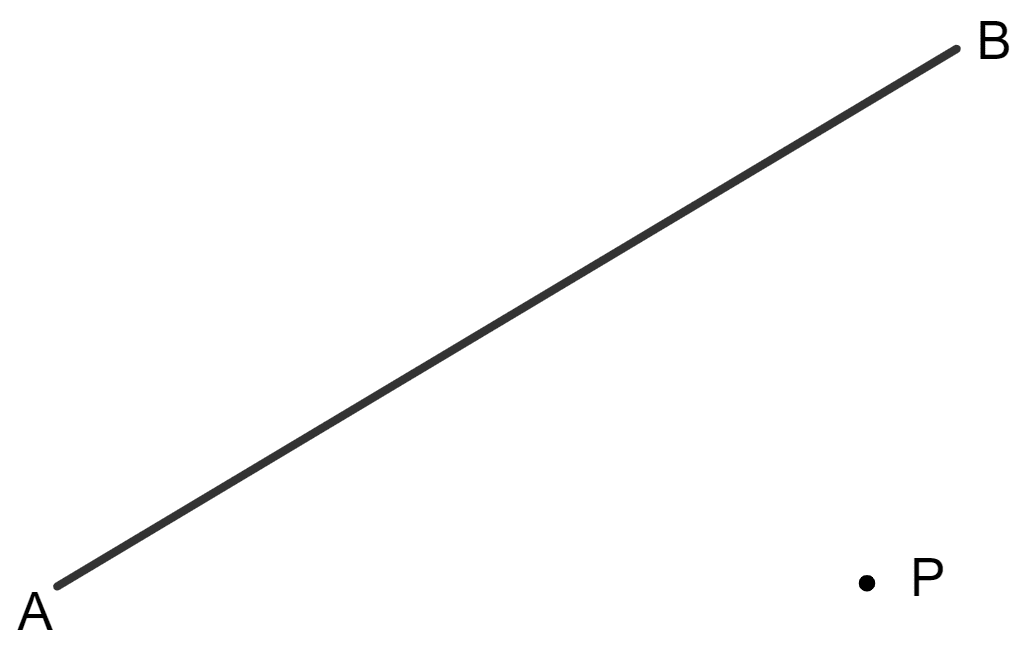
Draw a line segment AB = 5.5 cm. Mark a point P, such that PA = 6 cm and PB = 4.8 cm. From the point P, draw a perpendicular to AB.