
Mathematics
Each of equal sides of an isosceles triangle is 4 cm greater than its height. If the base of the triangle is 24 cm; calculate the perimeter and the area of the triangle.
Mensuration
50 Likes
Answer
Each of equal sides of an isosceles triangle is 4 cm greater than its height.
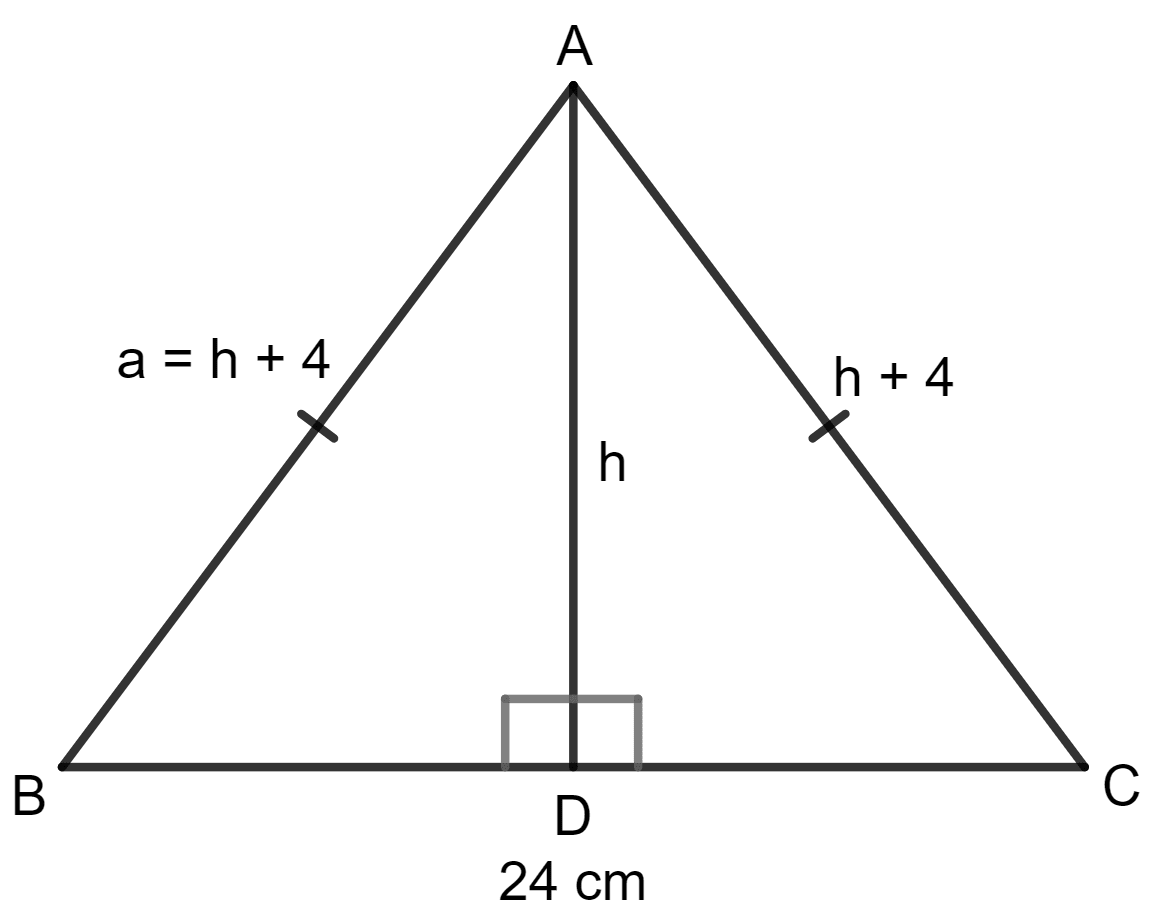
Let h be the height of the triangle.
Equal sides: AB = AC = h + 4
Base: BC = 24 cm
In Δ ABD and Δ ACD,
AD = AD [∵ Common Side]
∠ ADB = ∠ ADC [∵ Both are 90°]
AB = AC [∵ Δ ABC is isosceles]
∴ Δ ABD ≅ Δ ACD [RHS axiom]
∴ BD = CD [C.P.C.T]
∴ BD = CD = = = 12 cm
By using the Pythagoras theorem in Δ ABD,
BD2 + AD2 = AB2
⇒ 122 + h2 = (h + 4)2
⇒ 144 + h2 = h2 + 42 + 2 x h x 4
⇒ 144 + = + 16 + 8h
⇒ 144 - 16 = 8h
⇒ 128 = 8h
⇒ h =
⇒ h = 16 cm
⇒ a = h + 4 = 16 + 4 = 20 cm
Perimeter of triangle = Sum of all sides
= AB + AC + BC
= (20 + 20 + 24) cm
= 64 cm
Area of triangle = x base x height
= x 24 x 16
= 12 x 16
= 192 cm2
Hence, the perimeter is 64 cm and the area is 192 cm2.
Answered By
21 Likes
Related Questions
The base of a triangular field is three times its height. If the cost of cultivating the field at ₹ 36.72 per 100 m2 is ₹ 49,572; find its base and height.
The sides of a triangular field are in the ratio 5 : 3 : 4 and its perimeter is 180 m. Find :
(i) its area.
(ii) altitude of the triangle corresponding to its largest side.
(iii) the cost of levelling the field at the rate of ₹ 10 per square metre.
Calculate the area and the height of an equilateral triangle whose perimeter is 60 cm.
In triangle ABC; angle A = 90°, side AB = x cm, AC = (x + 5) cm and area = 150 cm2. Find the sides of the triangle.