
Mathematics
Each side of a rectangle is doubled. Find the ratio between :
(i) perimeters of the original rectangle and the resulting rectangle
(ii) areas of the original rectangle and the resulting rectangle
Area Trapezium Polygon
20 Likes
Answer
(i) Given:
Each side of a rectangle is doubled.
Let the length and breadth of the rectangle be l and b.
Thus, the new length and breadth of the rectangle are 2l and 2b.
As we know, the perimeter of a rectangle = 2 (length + breadth)
The perimeter of the original rectangle = 2 (l + b)
The perimeter of the new rectangle = 2 (2l + 2b)
= 4 (l + b)
Thus, the ratio of the perimeters of the original rectangle and the resulting rectangle =
=
=
=
Hence, the ratio of the perimeters of the original rectangle and the resulting rectangle is .
(ii) As we know, the area of a rectangle = length x breadth
The area of the original rectangle = l x b
= lb
The area of the new rectangle = 2l x 2b
= 4 lb
Thus, the ratio of the areas of the original rectangle and the resulting rectangle =
=
=
Hence, the ratio of areas of the original rectangle and the resulting rectangle is .
Answered By
15 Likes
Related Questions
The length of a rectangle is 16 cm and its perimeter is equal to the perimeter of a square with side 12.5 cm. Find the area of the rectangle.
The perimeter of a square is numerically equal to its area. Find its area.
In each of the following cases ABCD is a square and PQRS is a rectangle. Find, in each case, the area of the shaded portion. (All measurements are in metre).
(i)
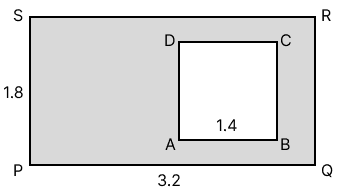
(ii)

A path of uniform width, 3 m, runs around the outside of a square field of side 21 m. Find the area of the path.