Mathematics
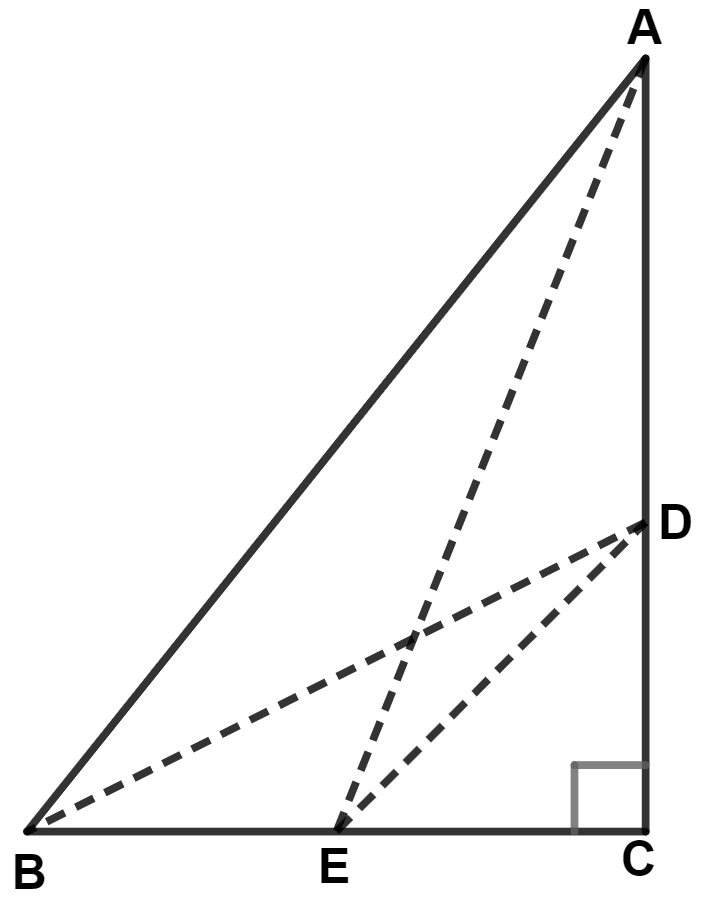
In the given diagram, AE2 + BD2 is equal to :
AB2 - DE2
DE2 - AB2
AB2 + DE2
DE × AB
Answer
By Formula,
By pythagoras theorem,
(Hypotenuse)2 = (Perpendicular)2 + (Base)2.
In right-angled triangle ABC,
⇒ AB2 = AC2 + BC2 ……..(1)
In right-angled triangle DEC,
⇒ DE2 = CD2 + EC2 ……..(2)
In right-angled triangle AEC,
⇒ AE2 = AC2 + EC2 ……..(3)
In right-angled triangle BDC,
⇒ BD2 = CD2 + BC2 ……..(4)
Adding equations (3) and (4), we get :
⇒ AE2 + BD2 = AC2 + EC2 + CD2 + BC2
= (AC2 + BC2) + (CD2 + EC2)
= AB2 + DE2 [From equations (1) and (2)].
Hence, Option 3 is the correct option.
Related Questions
Two poles of heights 6 m and 11 m stand vertically on a plane ground. If the distance between their feet is 12 m; find the distance between their tips.
In △ ABC, ∠C = 90° and AC = BC, then AB2 is equal to :
AC2
2AC2
BC2
2BC2 - AC2
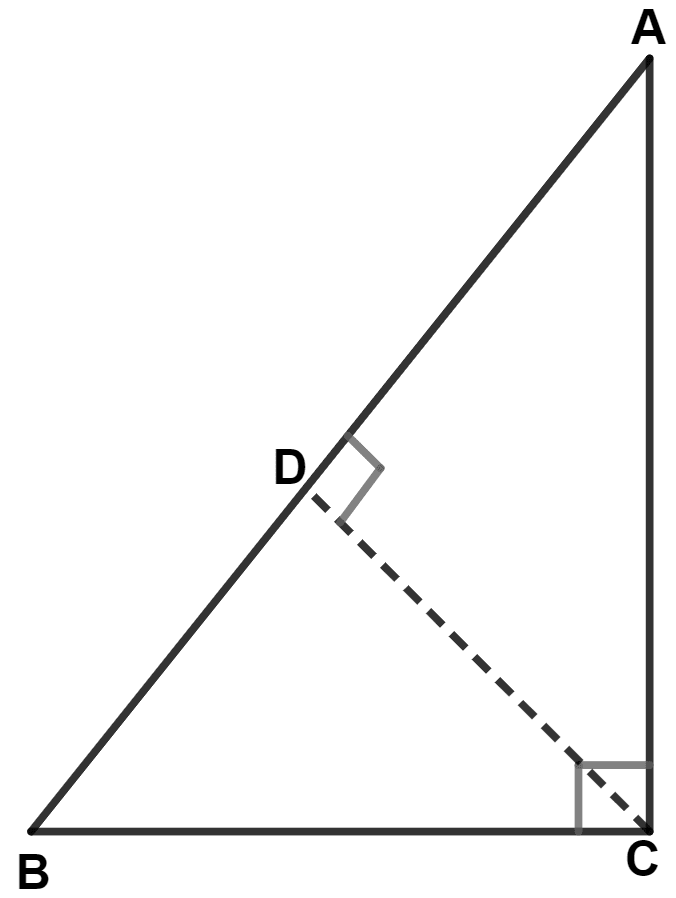
In the given figure, the value of AB × CD is :
AC × BC
AC × CD
AC × AB
AC2 + BC2
ABC is an isosceles triangle right-angled at C. Then 2AC2 is equal to :
BC2
AC2
AC2 - BC2
AB2