
History & Civics
The Indian Nationalists described the Great Uprising of 1857 as the First War of Independence. With reference to this, answer the following questions:
(i) Mention any three policies used by the British to expand their political power in India.
(ii) The Revolt of 1857 is also known as the Sepoy Mutiny. Mention any three military causes which led to the uprising.
(iii) Mention any four economic causes of the Revolt.
Revolt 1857
3 Likes
Answer
(i) Three policies used by the British to expand their political power in India are:
- By Outright Wars: To expand their territorial power in India and to safeguard their economic and political interests the British waged many wars against the Indian rulers of different states.
- By Subsidiary Alliance: Subsidiary Alliance, introduced by Lord Wellesley, was an agreement between the British East India Company and the Indian Princely States by virtue of which these states lost their sovereignty (the power of a ruler to rule independently without any outside interference) to the British.
- By Using the Doctrine of Lapse: Lord Dalhousie, the Governor-General of India, annexed many Indian States to the Company using the Doctrine of Lapse. According to this Doctrine, if an Indian ruler died without a male heir, his kingdom would lapse, that is, it would come under the Company's territory in India.
(ii) Three military causes which led to the uprising of 1857 are:
Ill-treatment of Indian soldiers: Indian soldiers were poorly paid, ill-fed and badly housed. British military authorities forbade the sepoys from wearing caste or sectarian marks, beards or turbans, and they showed disregard for the sentiments of the sepoys.
General Service Enlistment Act (1856): As per this Act, Indian soldiers could be sent overseas on duty. The Act did not take into account the sentiment of the Indian soldiers. This led to a feeling of resentment among them.
Lower Salaries: The wages of the Indian soldiers were inadequate to support their families. On the other hand, the British soldiers received more than eight times the salary of the Indian soldiers.
(iii) Four economic causes which led to the uprising of 1857 are:
- The resources from India were exploited for the benefit of the British people and the growth of industries in Britain. The raw material was exported and finished goods were imported. It ruined the Indian industries and handicrafts.
- There was a gradual decline in Indian handicrafts which now began to compete with the textiles manufactured in England. The British put pressure on the East India Company to forbid the sale of Indian textiles in England. They impose heavy export duties on India’s export of handicraft products, but allowed free export of India’s raw material to Britain and free import of British finish goods into India. Machine made British cloth was cheaper and of better quality. This eventually led to the shutting down of looms in India.
- People moved to cities to find employment, which was very difficult to get. Peasants were forced to pay tax in cash, which pushed them into the hands of the moneylenders, as the tax was collected even during the famines.
- As the Indigo trade was highly profitable to the British, the peasants were forced to cultivate only indigo in the fields chosen by the British planters. If they planted anything else, their crops were destroyed, and their cattle were carried off as punishment.
Answered By
1 Like
Related Questions
The President is the head of the State and exercises his / her powers on the advice of the Prime Minister and the Council of Ministers. With reference to this, answer the following questions:
(i) What are the three types of emergencies that can be proclaimed by the President?
(ii) Mention any three legislative powers of the President.
(iii) Give any two reasons to justify the need for indirect election of the President. What is the composition of the Electoral College which elects the President?
The Constitution of India provides for a High Court for each State. With reference to the High Courts and Subordinate Courts, answer the following questions:
(i) Who appoints the judges of the High Court? Mention any two qualifications required for a person to be appointed as a judge of a High Court.
(ii) Mention any three cases that come under the Original Jurisdiction of the High Court.
(iii) What are Lok Adalats? Mention any three advantages of the Lok Adalats.
Look at the picture given below and answer the following questions:
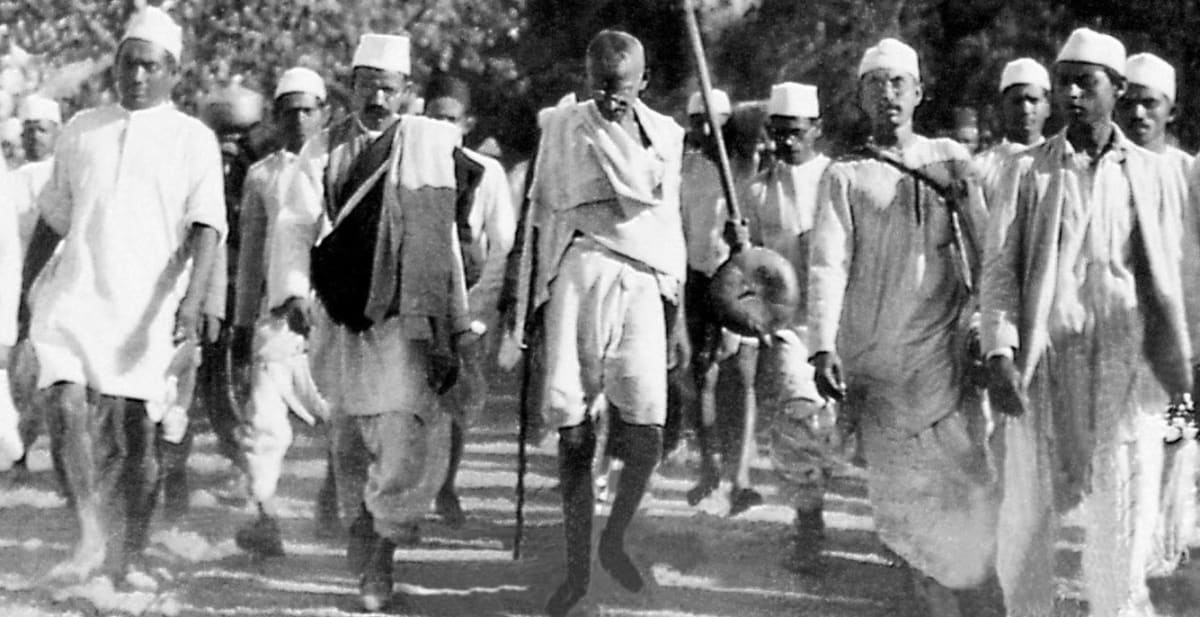
(i) Name the march being led by Gandhiji in the above picture. Which movement did this march launch?
(ii) What were the three causes of the Non-Cooperation Movement? Name the incident which led to the suspension of this movement.
(iii) Mahatma Gandhi and Lord Irwin signed a pact in 1931. Mention any two conditions that the Congress agreed to and two conditions that the British Government agreed to according to this pact.
The heroism of the Indians was revealed by the courage of Subash Chandra Bose and the Indian National Army. With reference to this, answer the following questions:
(i) Mention any three objectives of the Forward Bloc.
(ii) Mention any three contributions of Subash Chandra Bose.
(iii) Who was the founder of the Indian National Army? Mention any three of its objectives.