
History & Civics
The Constitution of India provides for a High Court for each State. With reference to the High Courts and Subordinate Courts, answer the following questions:
(i) Who appoints the judges of the High Court? Mention any two qualifications required for a person to be appointed as a judge of a High Court.
(ii) Mention any three cases that come under the Original Jurisdiction of the High Court.
(iii) What are Lok Adalats? Mention any three advantages of the Lok Adalats.
High Courts
6 Likes
Answer
(i) The Chief Justice of a High Court is appointed by the President in consultation with the Chief Justice of the Supreme Court and the Governor of the concerned state. While appointing other judges, the President consults the Chief Justice of India, the Governor of the State and the Chief Justice of that High Court.
To be appointed as a Judge of a High Court, a person:
- Should be a citizen of India.
- Should not be over 62 years.
(ii) Three cases that come under the Original Jurisdiction of the High Court are:
- Every High Court has the power to interpret the Constitution. This power is known as the power of Judicial Review.
- It enjoys original jurisdiction for the enforcement of Fundamental Rights guaranteed by the Constitution. It can also issue writs for the enforcement of Fundamental Rights.
- The High Court has original jurisdiction in cases such as, election petitions challenging the election of the Members of Parliament or a member of the State Legislative Assembly or other local bodies.
(iii) Lok Adalat means 'People's Court'. It is an alternative dispute redressal mechanism where disputes/cases pending in the court of law or at pre-litigation stage are settled amicably. There is no court fee payable when a matter is filed in a Lok Adalat.
The Lok Adalats are advantageous in the following ways:
- to provide legal aid and quick justice to those who are not in a position to engage lawyers.
- to relieve the courts of heavy backlog of cases.
- to eliminate high costs and delays in imparting justice.
Answered By
2 Likes
Related Questions
The Union Legislature comprises the President and the two houses of the Parliament. With reference to the Parliament, answer the following questions:
(i) Mr. Raj wants to be a member of the Lok Sabha. Mention any three qualifications required to contest elections for the Lok Sabha.
(ii) Mention any three legislative powers of the Union Parliament.
(iii) The Parliament controls the Executive. Mention any four ways in which it exercises its control.
The President is the head of the State and exercises his / her powers on the advice of the Prime Minister and the Council of Ministers. With reference to this, answer the following questions:
(i) What are the three types of emergencies that can be proclaimed by the President?
(ii) Mention any three legislative powers of the President.
(iii) Give any two reasons to justify the need for indirect election of the President. What is the composition of the Electoral College which elects the President?
The Indian Nationalists described the Great Uprising of 1857 as the First War of Independence. With reference to this, answer the following questions:
(i) Mention any three policies used by the British to expand their political power in India.
(ii) The Revolt of 1857 is also known as the Sepoy Mutiny. Mention any three military causes which led to the uprising.
(iii) Mention any four economic causes of the Revolt.
Look at the picture given below and answer the following questions:
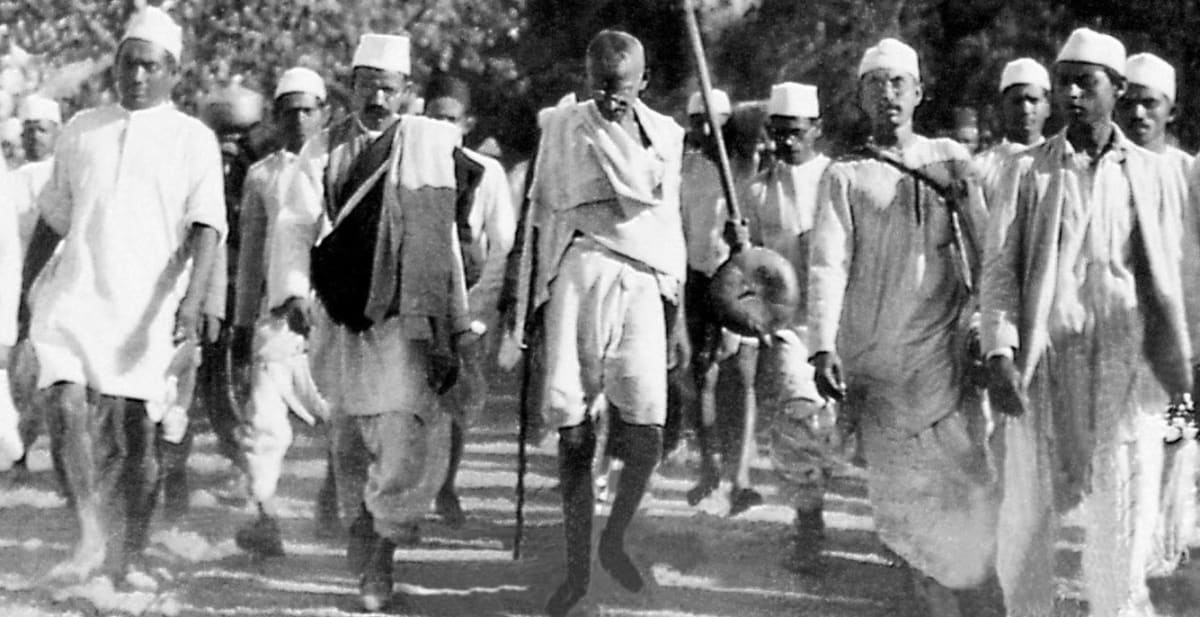
(i) Name the march being led by Gandhiji in the above picture. Which movement did this march launch?
(ii) What were the three causes of the Non-Cooperation Movement? Name the incident which led to the suspension of this movement.
(iii) Mahatma Gandhi and Lord Irwin signed a pact in 1931. Mention any two conditions that the Congress agreed to and two conditions that the British Government agreed to according to this pact.