
History & Civics
Look at the picture given below and answer the following questions:
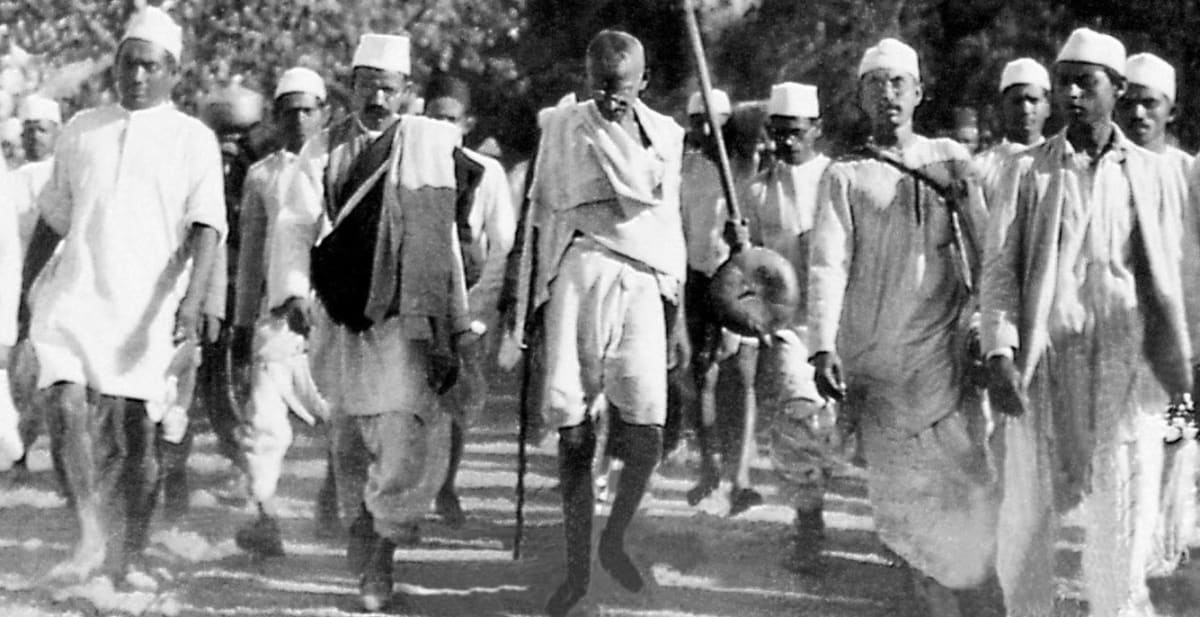
(i) Name the march being led by Gandhiji in the above picture. Which movement did this march launch?
(ii) What were the three causes of the Non-Cooperation Movement? Name the incident which led to the suspension of this movement.
(iii) Mahatma Gandhi and Lord Irwin signed a pact in 1931. Mention any two conditions that the Congress agreed to and two conditions that the British Government agreed to according to this pact.
Mahatma Gandhi
2 Likes
Answer
(i) The march being led by Gandhiji in the given picture is known as the Dandi March. This march led to the beginning of the Civil Disobedience Movement of 1930.
(ii) There were three main reasons behind the Non-cooperation movement:
- Rowlatt Act: The Rowlatt Act authorised the Government to imprison any person without trial and convict him in a court. It implied:
- Arrest of a person without warrant.
- In camera trial (trial in seclusion).
- Restrictions on movements of individuals.
- Suspension of the Right of Habeas Corpus.
Gandhiji appealed to the Viceroy to withhold his consent to the Rowlatt Act. However his appeal was ignored. He started 'Satyagraha' as a challenge to the government.
Jallianwala Bagh Tragedy: Jallianwala Bagh Tragedy happened in Amritsar on April 13, 1919. On that day, peaceful gathering had assembled at Jallianwala Bagh to protest against the Rowlatt Act. Without any warning, General Dyer ordered his troops to open fire on the unarmed crowd, resulting in hundreds of deaths and thousands of injuries. It was made clear to the Indians that the British had no intention of parting with political power or sharing it with Indians.
Khilafat Movement: In the First World War Turkey was defeated and the Sultan of Turkey, who was the Caliph was deprived of all authority. The Muslim population in India started a powerful agitation known as the Khilafat Movement, under the leadership of the Ali Brothers. 'Khilafat Day' was observed on October 17, 1919 on an all-India scale. Gandhiji took the chance to unite Hindus and Muslims. Mahatma Gandhi was elected as President of the All-India Khilafat Conference in November 1919. He advised the Khilafat Committee to adopt a policy of Non-Cooperation with the Government.
Suspension of the Non-Cooperation Movement — The Non-Cooperation Movement was withdrawn by Mahatma Gandhi after the Chauri Chaura incident. Gandhiji believed in peaceful and non-violent protests, and the violent turn of events at Chauri Chaura deeply distressed him. Therefore, he withdrew the movement.
(iii) Mahatma Gandhi and Lord Irwin signed Gandhi-Irwin Pact pact in March, 1931.
Two conditions that the Congress agreed to are-
- Participation in Round Table Conference — The Indian National Congress agreed to take part in the second session of the Round Table Conference.
- Suspend Civil Disobedience Movement — The Congress agreed to suspend the Civil Disobedience Movement.
Two conditions that the British Government agreed to are-
- Withdrawal of Ordinances — The British government agreed to withdraw all ordinances and end prosecution.
- Removal of Salt Tax — The British government permitted free collection or manufacture of salt by persons near the seacoast.
Answered By
3 Likes
Related Questions
The Constitution of India provides for a High Court for each State. With reference to the High Courts and Subordinate Courts, answer the following questions:
(i) Who appoints the judges of the High Court? Mention any two qualifications required for a person to be appointed as a judge of a High Court.
(ii) Mention any three cases that come under the Original Jurisdiction of the High Court.
(iii) What are Lok Adalats? Mention any three advantages of the Lok Adalats.
The Indian Nationalists described the Great Uprising of 1857 as the First War of Independence. With reference to this, answer the following questions:
(i) Mention any three policies used by the British to expand their political power in India.
(ii) The Revolt of 1857 is also known as the Sepoy Mutiny. Mention any three military causes which led to the uprising.
(iii) Mention any four economic causes of the Revolt.
The heroism of the Indians was revealed by the courage of Subash Chandra Bose and the Indian National Army. With reference to this, answer the following questions:
(i) Mention any three objectives of the Forward Bloc.
(ii) Mention any three contributions of Subash Chandra Bose.
(iii) Who was the founder of the Indian National Army? Mention any three of its objectives.
The world wars marked a turning point in the history of the world. With reference to this period, answer the following questions:
(i) Mention any three similarities between the ideologies of Fascism and Nazism.
(ii) State the three consequences of the Second World War.
(iii) Mention any four causes of the Second World War.