
History & Civics
Look at the newspaper clipping given on the next page and answer the questions that follow:

(a) What was the immediate impact of the incident mentioned in newspaper clipping? Who organised the assassination? What was the objectives behind the assassination?
(b) Besides the incident mentioned in the newspaper, state three other reasons that led to a turning point in the history of the world.
(c) Name the treaty that was designed to prevent Germany from going to war again. State any three clauses of this treaty.
1ˢᵗ World War
69 Likes
Answer
(a) The immediate impact of the incident mentioned in the newspaper above was beginning of the First World War.
The assassination was organised by a secret society called 'Black Hand' or 'Union of Death’ formed by extremist Serbian nationalists whose aim was to unite all Serbians into a single Serbian State. The political objective behind the assassination was to free Bosnia and Herzegovina from Austria-Hungarian rule and establish a common South Slav state.
(b) Three other reasons that led to a turning point in the history of the world were:
- Nationalism, Aggressive nationalism and Imperialism — In the latter half of the 19th century, the Nationalism turned into extreme pride, which made the people of many countries believe that their country is superior to the other countries. This led to the development of aggressive nationalism in Europe. The aggressive nationalism also led to the rise of imperialism. Imperialism refers to the state policy or practice by which a powerful nation establishes its control over another country, either by direct territorial acquisition or by gaining political and economic control.
- Race for Armaments — The mad race for armaments which began soon after the Franco-Prussian War (1870) was one of the reasons which led to the First World War. Every major power began stockpiling armaments in the name of self-defence and preservation of peace.
- Division of Europe into Two Hostile Groups — There were two kinds of States in Europe in the early 20th century. On the one hand there were single Nation-States like France, Holland and Germany whose national identities were based on their common language and traditions. On the other, there were imperial States like the Austria-Hungarian Empire and the Russian Empire. The rivalry happened for colonies, trade and trade routes.
(c) The Treaty of Versailles was designed to prevent Germany from going to war again. The three clauses of this treaty were:
- The Treaty declared Germany guilty of aggression.
- Germany was required to pay for the loss and damages suffered by the allies during the war. The amount of reparations was fixed at 33 billion dollars. Germany had to cede her merchant ships to the allies as compensation and had to supply huge quantities of coal to France, Italy and Belgium for ten years.
- The area of the Rhine Valley was to be demilitarised and the German territory west of Rhine was to be occupied by the Allied troops for 15 years.
Answered By
44 Likes
Related Questions
The First World War was unique in history. In this context, answer the following:
(a) Any three causes that led to the war.
(b) The extent and methods used in this war.
(c) Economic consequences of this war.
With reference to the First World War, answer the following questions:
(a) State any three consequences of the war.
(b) Mention three points under the Treaty of Versailles, which affected Germany.
(c) What were the objectives of the League of Nations? Name the organisation formed in October 1945 with objectives similar to those of the League of Nations.
Look at the newspaper excerpt given on the right and answer the questions that follow:
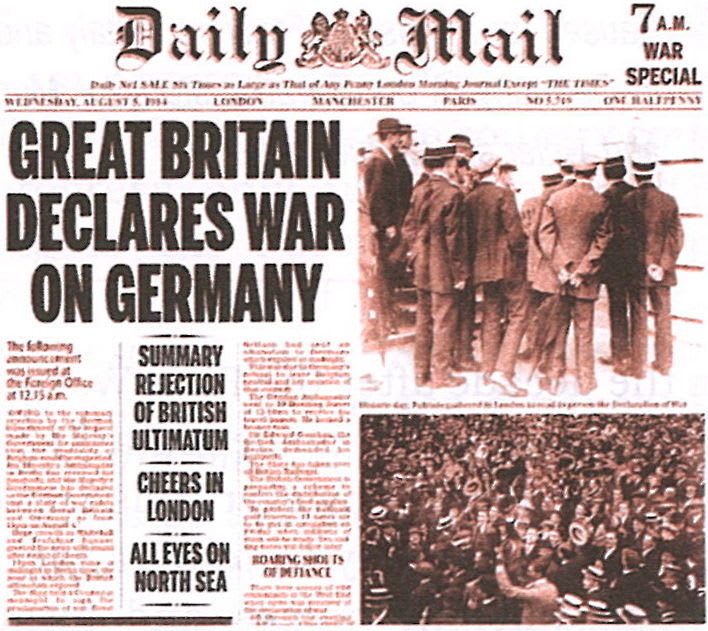
(a) Who summarily rejected British ultimatum? Why?
(b) Why did Great Britain declare war on Germany?
(c) What was the final outcome of the war that began after Great Britain declared war on Germany? How did it affect both the countries?
More than national pride, it was the greed to acquire colonies and thereby, more money and resources that led to the First World War. Explain.