History & Civics
Read the excerpt given below and answer the question that follows:
"From the mid-18th century, it was a European corporation, the East India Company - run from the City of London by merchants and accountants, with their ledgers and careful accounting - that ran amok and seized and subjugated a fragmented and divided India in what was probably the supreme act of corporate violence in history."
—William Dalrymple
(a) What term is used to describe the East India Company's act of running India's trade and finance from the city of London? How did it work?
(b) What was its impact on the artisans and craftsmen?
(c) The author has described the East India Company's act as 'Corporate violence'. What term was used by Dadabhai Naoroji for such an act? Describe how it worked.
Answer
(a) The term used is "Corporate violence".
The British exploited India economically to promote their own interests at the cost of welfare of Indians. The government took away a large part of the peasants' produce in the form of land revenue and other taxes. India became a source of raw material for the industries of Britain and a market for its finished products. The Working Class were exploited by the factory owners, and for educated Indians, the chance to get government service was bleak due to high competition.
(b) The English East India Company used its political power to destroy Indian handicrafts and industry. Hence, India became a source of raw materials for the industries of Britain and a market for its finished products. This policy crippled the artisans and the craftsmen as they were devoid of their sources of livelihood. Declining income, coupled with heavy taxation, pushed them into debt and extreme poverty.
(c) Dadabhai Naoroji used the term "Drain Theory" to describe "Corporate violence" of East India Company.
In his book "Poverty and Un-British Rule in India", he explained his famous 'Drain Theory' outlining the various ways in which India's wealth was being 'drained' to England. He came to the conclusion that the root cause for the economic ills of India was the exploitation of India by the British.
Related Questions
Various factors led to the rise and growth of nationalism in India in the 19th century. In this context, explain the role of each of the following:
(a) Economic Exploitation.
(b) Repressive Colonial Policies.
(c) The Press.
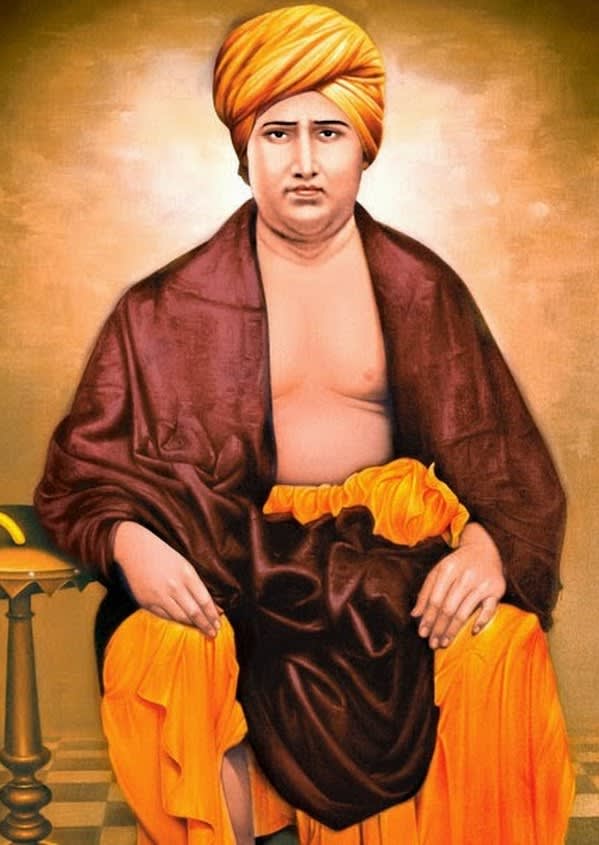
(a) Identify the person in the given picture. Name the organisation formed by him. State any two beliefs of this organisation with regard to upliftment of women.

(b) Mention his contribution to the growth of Indian National movement.
(c) How did the socio-religious reform movements of the 19th century act as pioneers of Indian Nationalism?
(a) Identify the person in the given picture. Name the organisation formed by him. State any two beliefs of this organisation with regard to opposition of social evils.
(b) Mention his contribution to the spread of education in India.
(c) State one basic difference between Raja Rammohan Roy and the person in the Picture.
With reference to Nationalism and the birth of the Indian National Congress, explain each of the following:
(a) Role of Swami Vivekananda.
(b) State any three objectives of the Indian National Congress.
(c) Role of Dadabhai Naoroji.