
Mathematics
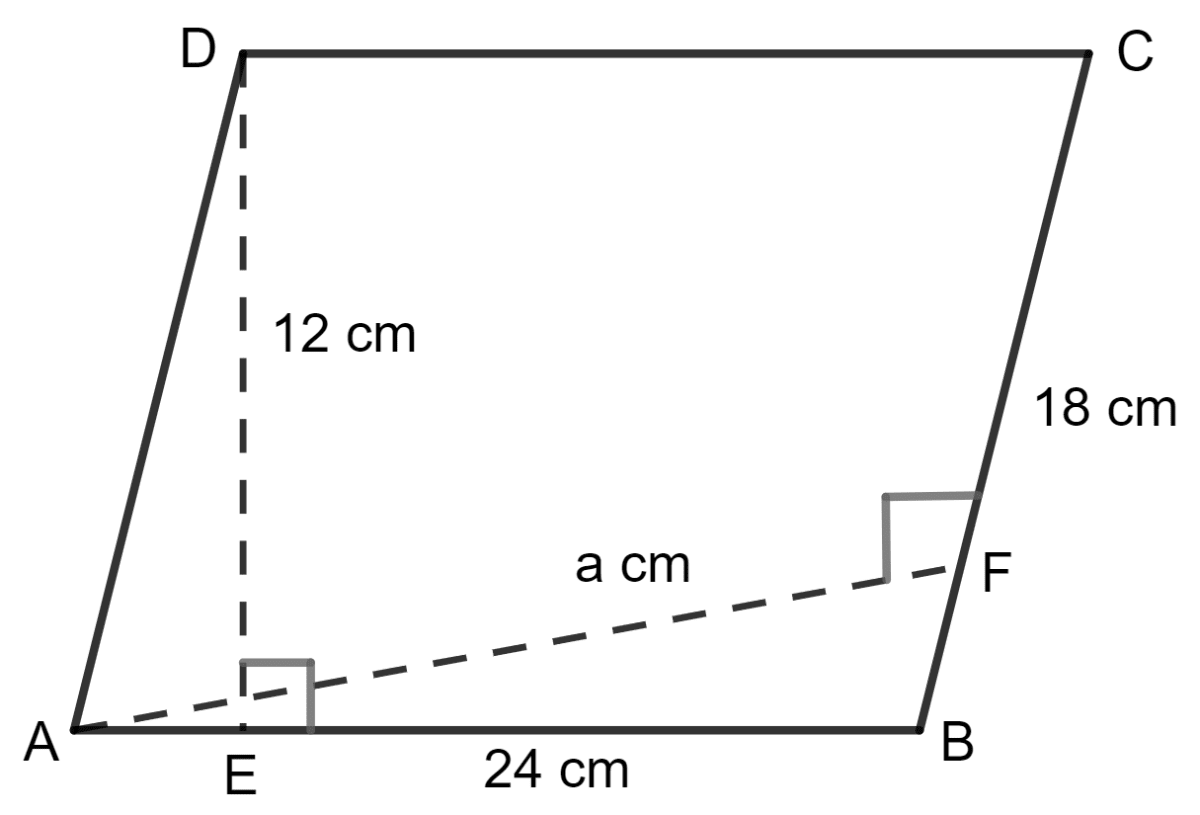
Two adjacent sides of parallelogram are 24 cm and 18 cm. If the distance between the longer sides is 12 cm; find the distance between the shorter sides.
Mensuration
39 Likes
Answer
Step 1 Finding the area of the parallelogram.
Length of one side of the parallelogram (longer side) = 24 cm
Length of the adjacent side (shorter side) = 18 cm
The distance between the longer sides = 12 cm
Area of parallelogram = base x height
= AB x DE
= 24 x 12 cm2
= 288 cm2
Step 2 Finding the sides of the parallelogram.
Let a be the distance between the shorter sides.
Area = base x height
= BC x AF
= 18 x a
Since area of the parallelogram will be same, if we consider AB as the base or BC as the base.
⇒ AB x DE = BC x AF
⇒ 288 = 18 x a
⇒ a =
⇒ a = 16 cm
Hence, the distance between the shorter sides of the parallelogram is 16 cm.
Answered By
25 Likes
Related Questions
The shaded region of the given diagram represents the lawn in the form of a house. On the three sides of the lawn there are flower-beds having a uniform width of 2 m.
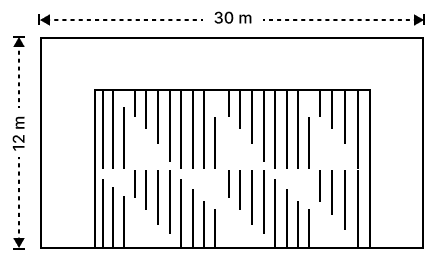
(i) Find the length and the breadth of the lawn.
(ii) Hence, or otherwise, find the area of the flower-beds.
A floor which measures 15 m x 8 m is to be laid with tiles measuring 50 cm x 25 cm. Find the number of tiles required.
Further, if a carpet is laid on the floor so that a space of 1 m exists between its edges and the edges of the floor, what fraction of the floor is left uncovered.
Two adjacent sides of a parallelogram are 28 cm and 26 cm. If one diagonal of it is 30 cm long; find the area of the parallelogram. Also, find the distance between its shorter sides.
The area of a rhombus is 216 sq. cm. If its one diagonal is 24 cm; find :
(i) length of its other diagonal,
(ii) length of its side,
(iii) perimeter of the rhombus.