
History & Civics
The United Nations Organisation aims to maintain international peace. With reference to its organs and agencies, answer the following:
(i) What is the composition of the Security Council? What is the term of the non-permanent members?
(ii) Mention any three functions of the General Assembly.
(iii) Give the full form of UNESCO. Mention any three of its functions.
United Nations
4 Likes
Answer
(i) The Security Council consists of 15 members.
- It has five permanent members —
- China
- France
- Russia
- Britain
- The United States of America
- The regional representation of the ten non-permanent members is:
- Afro-Asian countries — 5
- Latin American countries — 2
- West European and other countries — 2
- East European countries — 1.
- The ten non-permanent members are elected by the General Assembly by a two-third majority for a term of two years.
- A retiring member is not eligible for immediate re-election.
- The Presidency of the Council rotates monthly, according to the English alphabetical listing of its member States.
(ii) Three functions of the General Assembly are:
- To consider and make recommendations on the principles of cooperation, in the maintenance of international peace and security.
- To consider and approve the budget of the United Nations and to apportion the contributions among members.
- To elect the non-permanent members of the Security Council, the Economic and Social Council and the Trusteeship Council, and to elect the judges of the International Court of Justice.
(iii) UNESCO stands for United Nations Educational, Scientific and Cultural Organization.
Three functions of UNESCO are:
- Removal of illiteracy by encouragement to adult education, distance-education and the open school system.
- It promotes basic research in fields like geology, mathematics, physics and oceanography. As a result, it finances engineering and technology schemes in a number of developing countries.
- It has set up regional networks, trained technicians and deals with both hardware and software aspects of informatics.
Answered By
2 Likes
Related Questions
The Indian Nationalists described the Great Uprising of 1857 as the First War of Independence. With reference to this, answer the following questions:
(i) Mention any three policies used by the British to expand their political power in India.
(ii) The Revolt of 1857 is also known as the Sepoy Mutiny. Mention any three military causes which led to the uprising.
(iii) Mention any four economic causes of the Revolt.
Look at the picture given below and answer the following questions:
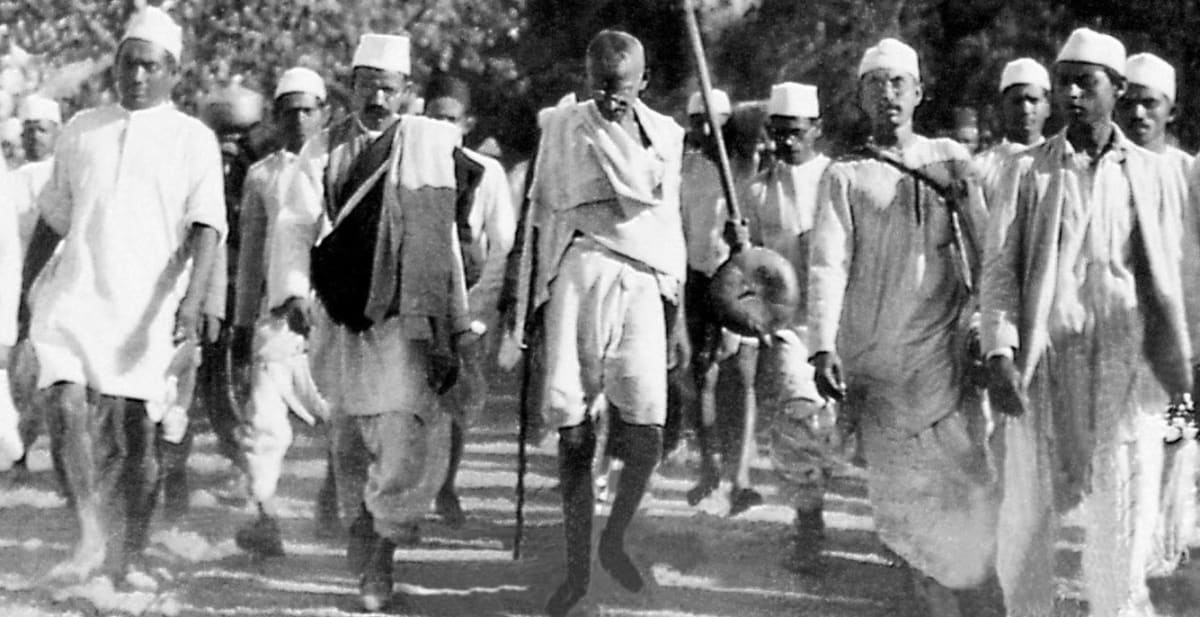
(i) Name the march being led by Gandhiji in the above picture. Which movement did this march launch?
(ii) What were the three causes of the Non-Cooperation Movement? Name the incident which led to the suspension of this movement.
(iii) Mahatma Gandhi and Lord Irwin signed a pact in 1931. Mention any two conditions that the Congress agreed to and two conditions that the British Government agreed to according to this pact.
The heroism of the Indians was revealed by the courage of Subash Chandra Bose and the Indian National Army. With reference to this, answer the following questions:
(i) Mention any three objectives of the Forward Bloc.
(ii) Mention any three contributions of Subash Chandra Bose.
(iii) Who was the founder of the Indian National Army? Mention any three of its objectives.
The world wars marked a turning point in the history of the world. With reference to this period, answer the following questions:
(i) Mention any three similarities between the ideologies of Fascism and Nazism.
(ii) State the three consequences of the Second World War.
(iii) Mention any four causes of the Second World War.