Physics
Answer the following with respect to a concave lens (L).
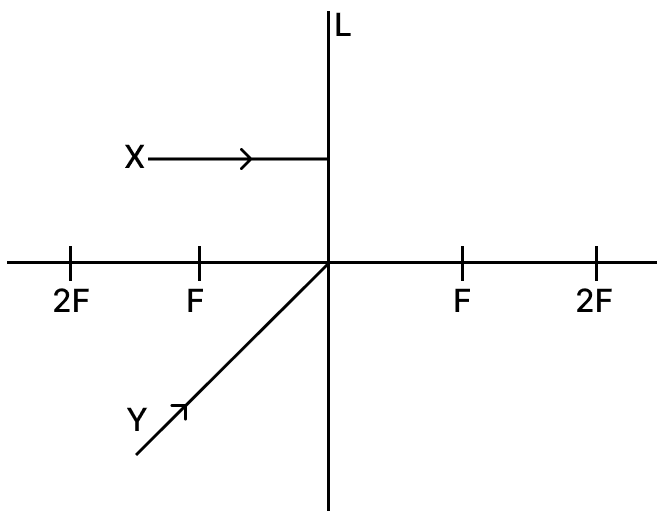
(a) Describe the path of the rays X and Y through the lens.
(b) Give one use of this lens.
(c) Calculate its power if the focal length of this lens is 20 cm.
Related Questions
(a) A coin lies at the bottom of a beaker. Water is poured into the beaker upto a height of 8 cm. Calculate the shift seen in the position of the coin.
(The refractive index of water is 4/3. The width of the glass wall of the beaker is negligible.)(b) How will the apparent depth be affected if the temperature of water is increased?
Draw a ray diagram to invert the image without deviation of light using right angle isosceles prism.
The diagram given below shows a triangular prism of a certain material with fluorescent screen placed adjacent to it. The yellow light ray striking the surface ST of the prism shows a fluorescent spot at point X.
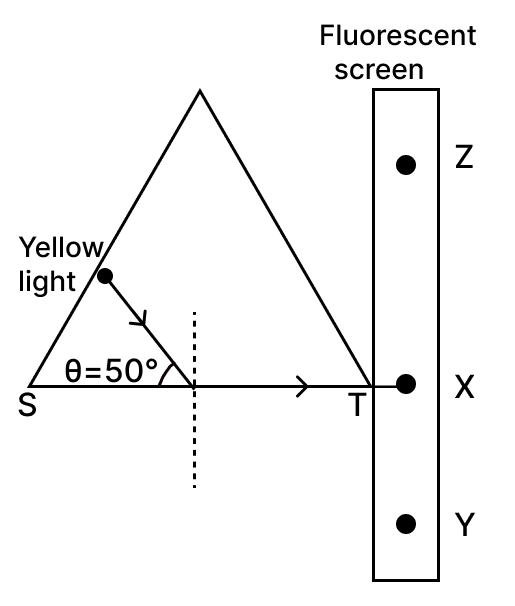
(a) Calculate the critical angle of the material of the prism for yellow colour.
(b) To move the fluorescent spot towards Y, the value of θ should be …………… [> 50, < 50 or = 50].
(c) Which direction will the florescent spot move if yellow light is replaced with indigo light? (towards Y or towards Z)
An object is placed at a distance of 10 cm from a convex lens of focal length 20 cm.
(a) Find the position of the image.
(b) What is the nature of the image?