
Mathematics
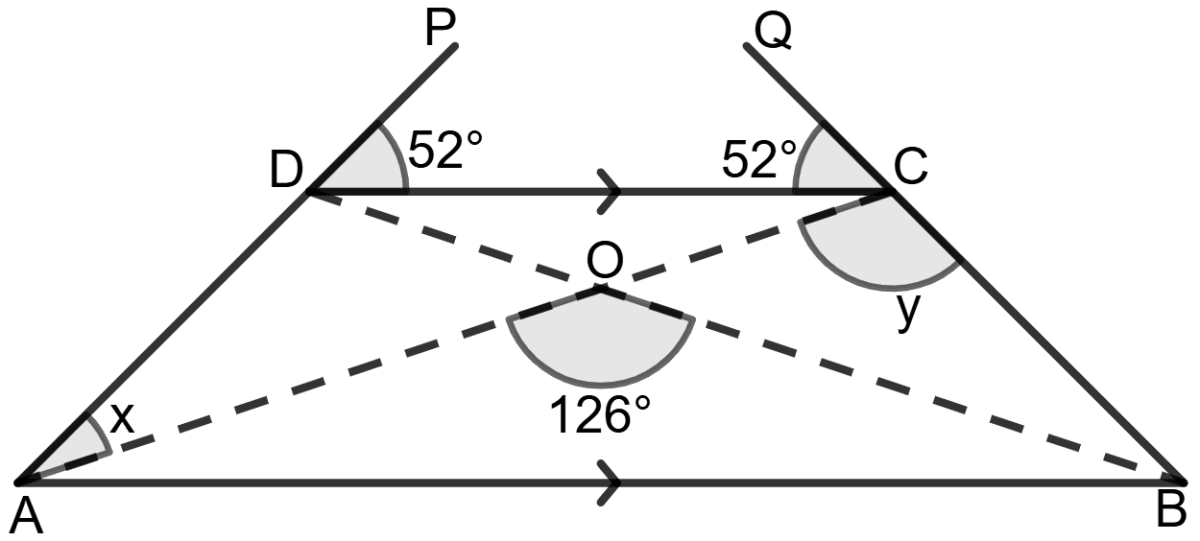
In the given figure, ABCD is a trapezium with DC//AB, ∠AOB = 126° and ∠DCQ = ∠CDP = 52°.
Find the values of x and y.
Rectilinear Figures
5 Likes
Answer
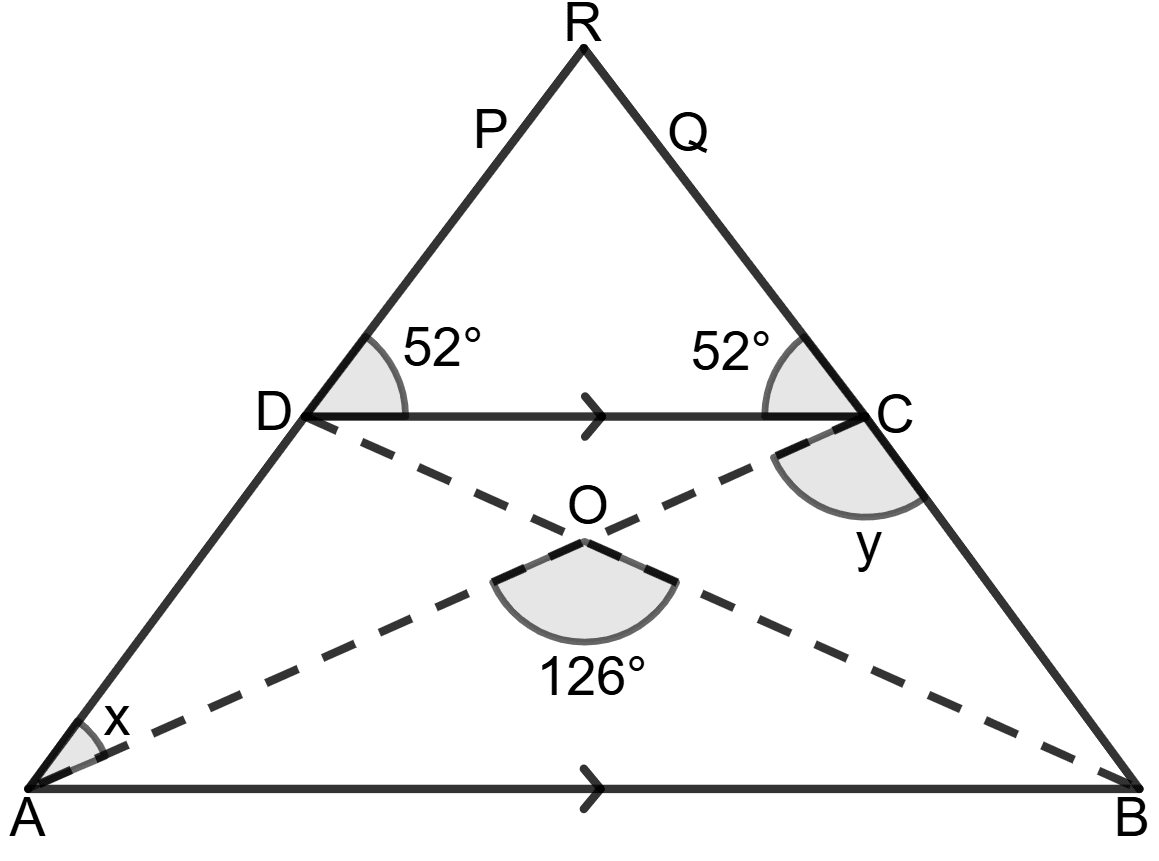
Given: ABCD is a trapezium with DC//AB, ∠AOB = 126° and ∠DCQ = ∠CDP = 52°.
To find: The values of x and y.
Construction: Extend P and Q such that they meet at R.
In Δ RDC,
⇒ ∠RDC = ∠RCD = 52° (since DCQ = CDP = 52°) ……………….(1)
Since the base angles are equal, Δ RDC is isosceles, which means:
⇒ DR = CR.
In quadrilateral ABCD, since AB ∥ DC, we use the property of corresponding angles:
⇒ ∠RAB = ∠RDC = 52° ( Corresponding angles) ………………..(2)
⇒ ∠RBA = ∠RCD = 52° ( Corresponding angles) ………………..(3)
Since ∠RAB = ∠RBA, we conclude that:
⇒ AR = RB
From the figure, we also note:
AD = AR - DR = RB - CR = BC
Therefore, we can say that ABCD is an isosceles trapezium.
Since, OA = OB, we conclude that:
⇒ ∠OAB = ∠OBA
Using the angle sum property in Δ AOB:
⇒ ∠OAB + ∠OBA + ∠AOB = 180°
⇒ ∠OAB + ∠OAB + 126° = 180°
⇒ 2∠OAB + 126° = 180°
⇒ 2∠OAB = 180° - 126°
⇒ 2∠OAB = 54°
⇒ ∠OAB = = 27°
Now, ∠x = ∠DAB - ∠OAB = 52° - 27° = 25°
Using angle sum property in Δ ABC:
∠ABC + ∠BAC + ∠ACB = 180°
⇒ 52° + 27° + y = 180°
⇒ 79° + y = 180°
⇒ y = 180° - 79° = 101°
Hence, the value of x = 25° and y = 101°.
Answered By
3 Likes
Related Questions
ABC is a triangle in which AB = AC and D is any point on BC. Prove that :
AB2 - AD2 = BD.CD
ABC is an isosceles triangle with AB = AC = 2a and BC = a. If AD ⊥ BC, find the length of AD.
The perimeter of a parallelogram ABCD = 40 cm, AB = 3x cm, BC = 2x cm and CD = 2(y + 1) cm. Find the values of x and y.
ABCDE is a pentagon in which AB = AE, BC = ED and ∠ABC = ∠AED.
(a) Prove that :
(i) AC = AD
(ii) ∠BCD = ∠EDC
(b) If BC and ED are produced to meet at X, prove that BX = EX.