
Mathematics
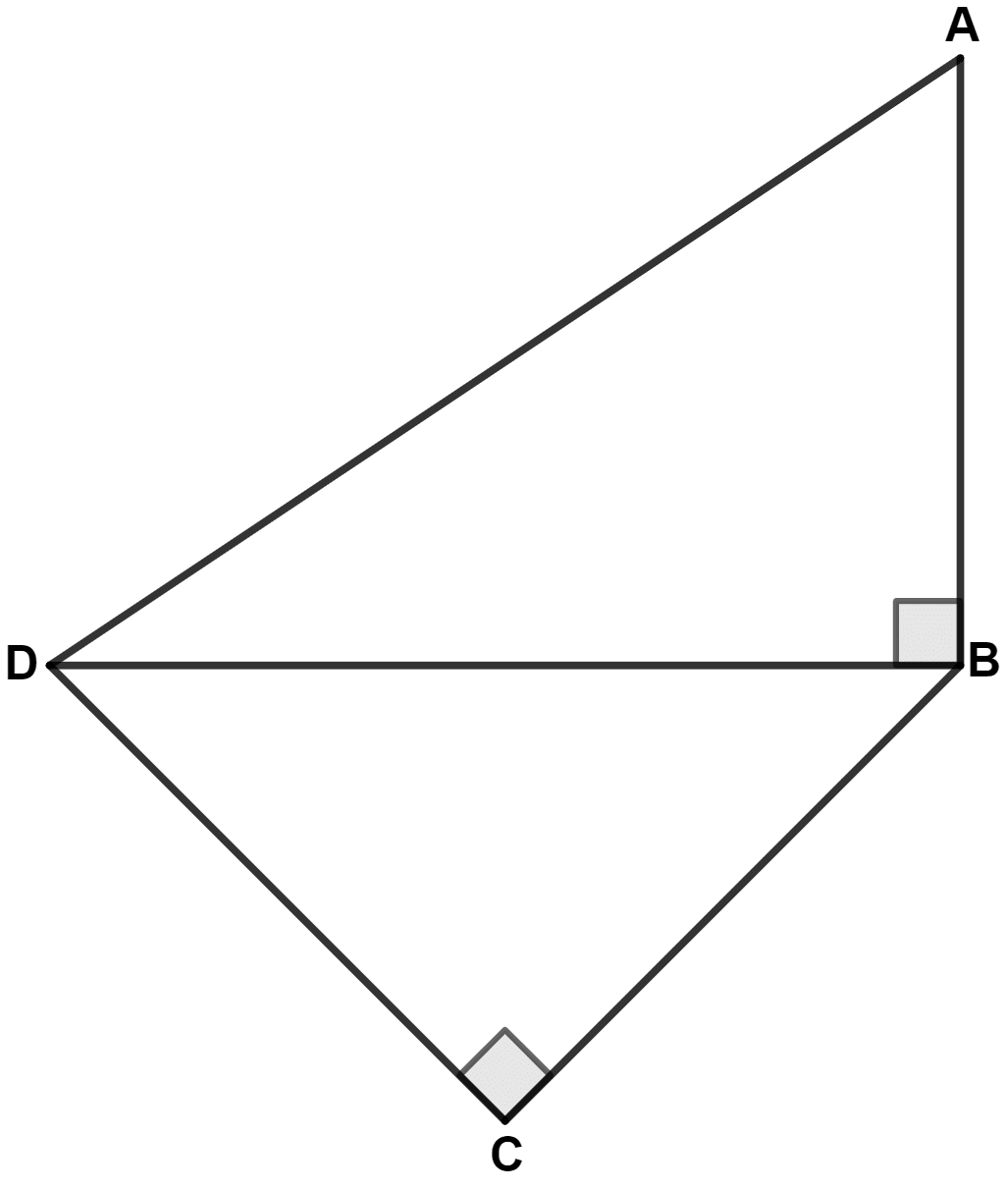
In the given figure, AD = 13 cm, DC = 12 cm and BC = 3 cm, then AB is equal to :
4 cm
3 cm
5 cm
6 cm
Pythagoras Theorem
32 Likes
Answer
In right angled △ DCB,
By pythagoras theorem,
⇒ (Hypotenuse)2 = (Perpendicular)2 + (Base)2
⇒ BD2 = DC2 + BC2
⇒ BD2 = (12)2 + (3)2
⇒ BD2 = 144 + 9
⇒ BD2 = 153
⇒ BD = cm.
In right angle △ ABD,
By pythagoras theorem,
⇒ (Hypotenuse)2 = (Perpendicular)2 + (Base)2
⇒ AD2 = AB2 + BD2
⇒ 132 = AB2 +
⇒ 169 = AB2 + 153
⇒ AB2 = 169 - 153
⇒ AB2 = 16
⇒ AB = = 4 cm.
Hence, Option 1 is the correct option.
Answered By
18 Likes
Related Questions
ABC is an isosceles triangle with AB = AC = 12 cm and BC = 8 cm. The area of the triangle is :
cm2
cm2
cm2
cm2
In a rhombus, its diagonals are 30 cm and 40 cm, its perimeter is :
20 cm
10 cm
60 cm
100 cm
A ladder 13 m long rests against a vertical wall. If the foot of the ladder is 5 m from the foot of the wall, find the distance of the other end of the ladder from the ground.
A man goes 40 m due north and then 50 m due west. Find his distance from the starting point.