
Mathematics
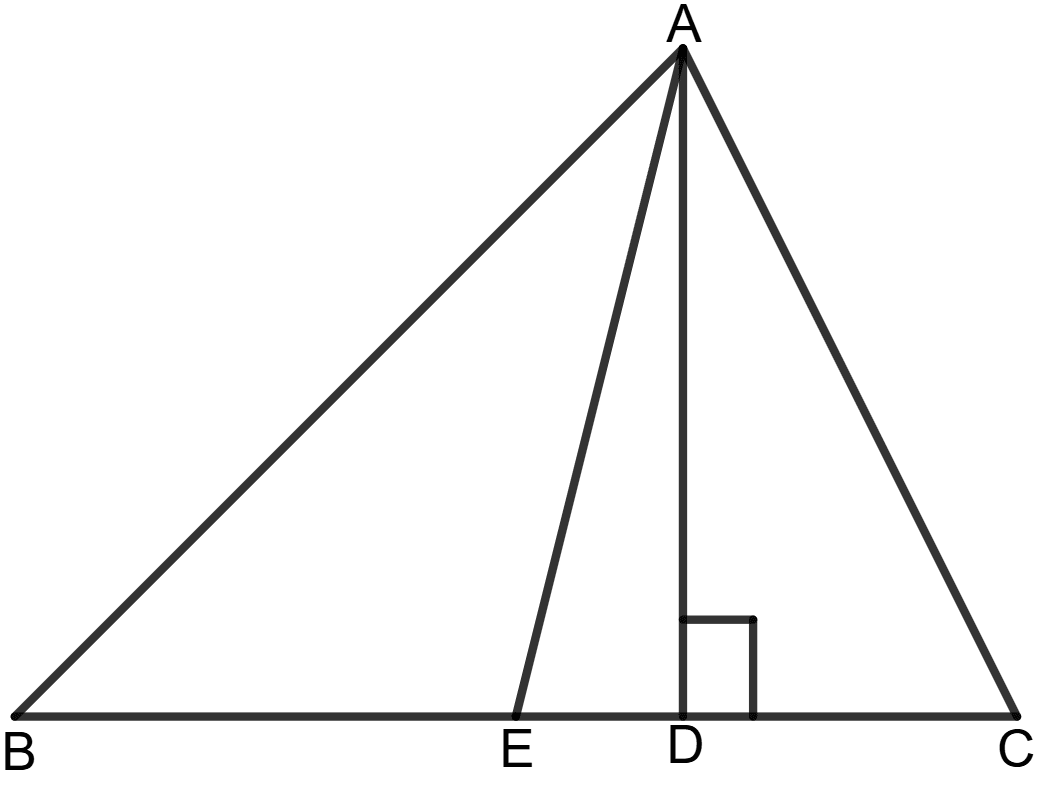
In triangle ABC, AB > AC. E is the mid-point of BC and AD is perpendicular to BC. Prove that :
AB2 + AC2 = 2AE2 + 2BE2
Pythagoras Theorem
10 Likes
Answer
Given: AB > AC, E is the mid-point of BC, so BE = EC and AD ⊥ BC.
To prove: AB2 + AC2 = 2AE2 + 2BE2
Proof: In Δ ABD, using Pythagorean theorem,
Hypotenuse2 = Height2 + Base2
⇒ AB2 = BD2 + AD2
⇒ AB2 = (BE + ED)2 + AD2
⇒ AB2 = BE2 + ED2 + 2.BE.ED + AD2 ……………….(1)
Similarly in Δ ADC, using Pythagorean theorem,
⇒ AC2 = CD2 + AD2
Since CD = CE - ED, we substitute:
⇒ AC2 = (CE - ED)2 + AD2
⇒ AC2 = CE2 + ED2 - 2.CE.ED + AD2 ……………….(2)
Similarly in Δ AED, using Pythagorean theorem,
⇒ AE2 = ED2 + AD2 ……………….(3)
Adding the equations (1) and (2),
⇒ AB2 + AC2 = (BE2 + ED2 + 2.BE.ED + AD2) + (CE2 + ED2 - 2.CE.ED + AD2)
⇒ AB2 + AC2 = BE2 + 2ED2 + 2AD2 + CE2 + 2.BE.ED - 2.CE.ED
⇒ AB2 + AC2 = BE2 + 2ED2 + 2AD2 + BE2 + 2.BE.ED - 2.BE.ED [∴ BE = CE]
⇒ AB2 + AC2 = 2BE2 + 2ED2 + 2AD2
⇒ AB2 + AC2 = 2BE2 + 2(ED2 + AD2)
⇒ AB2 + AC2 = 2BE2 + 2AE2 [∴ Using equation (3)]
Hence, AB2 + AC2 = 2BE2 + 2AE2.
Answered By
6 Likes
Related Questions
Show that the quadrilateral formed by joining the mid-points of the adjacent sides of a square, is also a square.
ABC is an isosceles triangle with AB = AC = 13 cm and BC = 10 cm. Calculate the length of the perpendicular from A to BC.
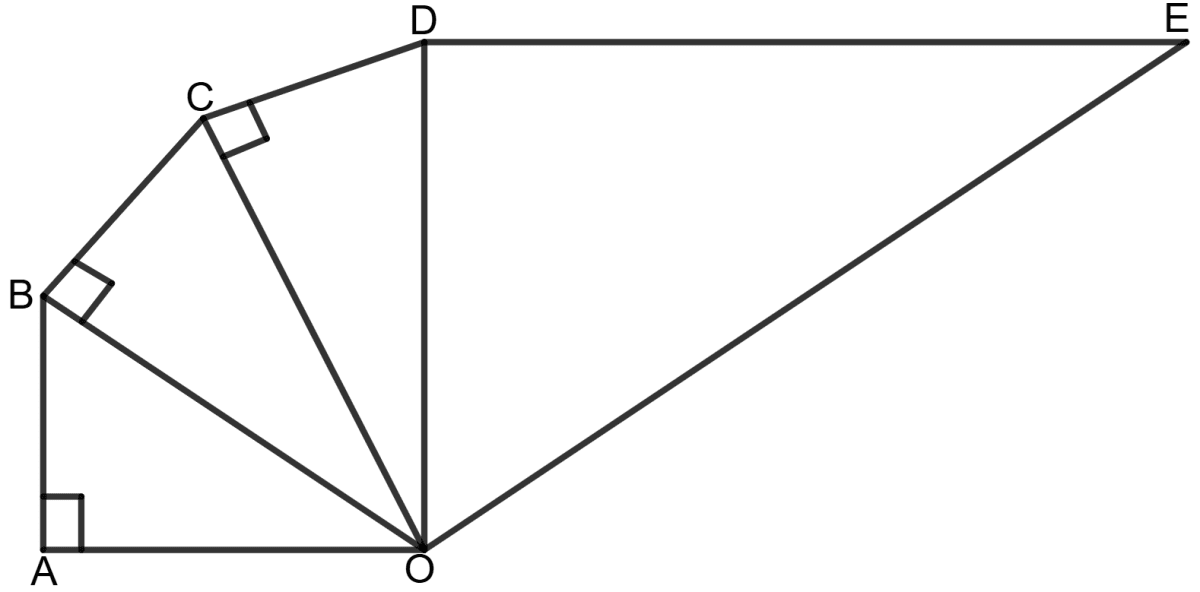
In the following figure :
OA = 2 cm = AB = 2BC = CD = DE
Find the length of OE.
ABC is a triangle in which AB = AC and D is any point on BC. Prove that :
AB2 - AD2 = BD.CD