History & Civics
The world wars marked a turning point in the history of the world. With reference to this period, answer the following questions:
(i) Mention any three similarities between the ideologies of Fascism and Nazism.
(ii) State the three consequences of the Second World War.
(iii) Mention any four causes of the Second World War.
Answer
(i) Three similarities between the ideologies of Fascism and Nazism are:
- To have faith in the totalitarian rule.
- To hold that the State is supreme and it could suppress the fundamental rights and freedoms of individuals.
- To believe in aggressive nationalism and imperialism.
(ii) Three consequences of the Second World War are:
Defeat of the Axis Powers — The Axis Powers made remarkable success initially but were defeated by the Allied Powers.
Formation of the UN — The United Nations Organisation was established to bring peace and avoid another world war.
Cold War — After the Second World War, the USA and the erstwhile USSR emerged as two great powers representing contrasting ideologies. They divided the world into two rival blocs —
The Capitalist bloc led by the USA
The Communist bloc led by the USSR.
There was a state of extreme political tension between the two but no armed conflict. This is known as the Cold War.
(iii) Four causes of the Second World War are:
Dissatisfaction with the Treaty of Versailles: The Treaty of Versailles was based on the spirit of revenge and Germany was forced to sign the treaty, which included harsh terms. All the German colonies were forcibly taken away from her and she was divided into two parts for the benefit of Poland. She was burdened with huge war indemnity and her military power was reduced. This humiliation gave rise to the spirit of revenge and this was not possible without an aggressive policy and armaments. Hence, the war became inevitable.
Rise of Fascism and Nazism: The rise of extreme nationalism in Italy and Germany in the form of Fascism and Nazism, respectively contributed to the causes which led to the - Second World War. Both countries formed a ten years alliance in 1939 to - strengthen their position. Mussolini established dictatorship in Italy, while Hitler established dictatorship in Germany. Both leaders opposed the Treaty of Versailles, and went on to strengthen their respective countries. The League of Nations failed to take any action against them, which exhibited the weakness of the League. Thus, Mussolini and Hitler drove the countries of the world towards another World War.
Japanese Invasion of China: In 1931, Japan intervened in Manchuria and, set up a government there. Japan also started an undeclared war against China in 1931. China appealed to the League of Nations to declare sanctions against Japan, but it was ignored. Japan joined the Berlin-Rome Axis to form the Berlin-Rome-Tokyo Axis to further its policy of expansion and conquest. In 1933, Japan left the League of Nations and started occupying the British and American properties in China. Thus, a war was inevitable under these circumstances.
Hitler's invasion of Poland: Hitler's invasion of Poland in September, 1939 was the immediate cause of the Second World War. On December 7, 1941, Japan under the Premiership of General Tojo, ordered a surprise aerial attack on the Pearl Harbour. This incident caused America to declare war on Japan, Germany and Italy.
Related Questions
The Indian Nationalists described the Great Uprising of 1857 as the First War of Independence. With reference to this, answer the following questions:
(i) Mention any three policies used by the British to expand their political power in India.
(ii) The Revolt of 1857 is also known as the Sepoy Mutiny. Mention any three military causes which led to the uprising.
(iii) Mention any four economic causes of the Revolt.
Look at the picture given below and answer the following questions:
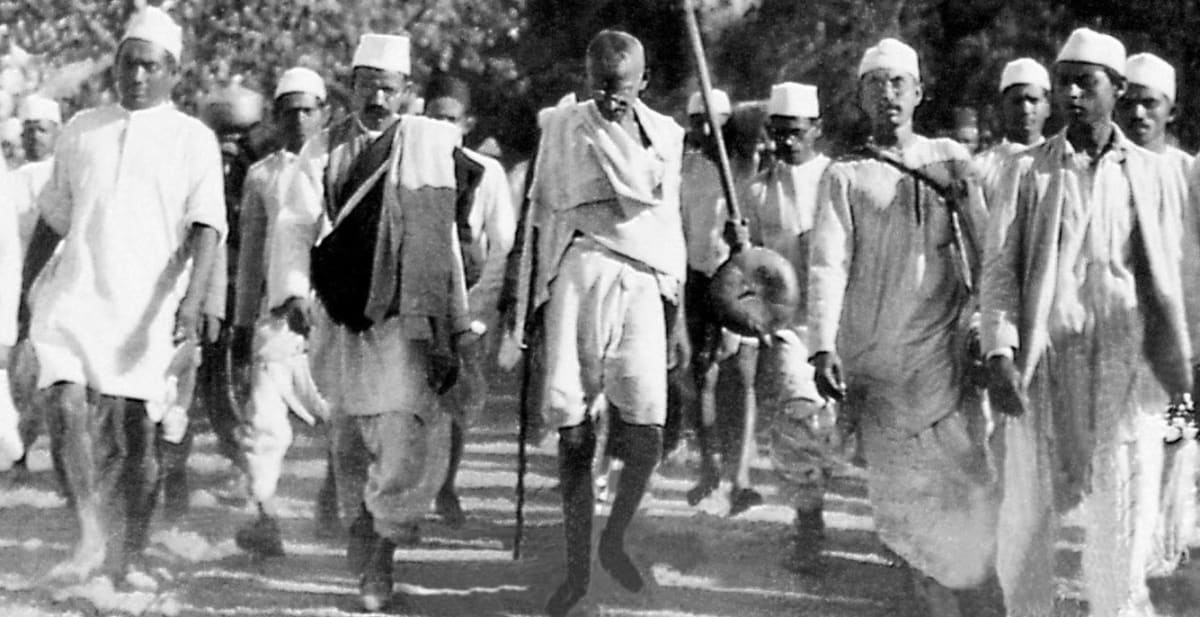
(i) Name the march being led by Gandhiji in the above picture. Which movement did this march launch?
(ii) What were the three causes of the Non-Cooperation Movement? Name the incident which led to the suspension of this movement.
(iii) Mahatma Gandhi and Lord Irwin signed a pact in 1931. Mention any two conditions that the Congress agreed to and two conditions that the British Government agreed to according to this pact.
The heroism of the Indians was revealed by the courage of Subash Chandra Bose and the Indian National Army. With reference to this, answer the following questions:
(i) Mention any three objectives of the Forward Bloc.
(ii) Mention any three contributions of Subash Chandra Bose.
(iii) Who was the founder of the Indian National Army? Mention any three of its objectives.
The United Nations Organisation aims to maintain international peace. With reference to its organs and agencies, answer the following:
(i) What is the composition of the Security Council? What is the term of the non-permanent members?
(ii) Mention any three functions of the General Assembly.
(iii) Give the full form of UNESCO. Mention any three of its functions.