
The smallest particle of matter which may or may not have independent existence is :
- Molecule
- Atom
- Radical
- Element
Answer
Atom
Reason — An atom is the smallest particle of an element (matter) which may or may not have independent existence.
A molecule is the smallest particle of a pure substance (element or compound) which has independent existence. An element is a pure substance that cannot be converted further into anything simpler than itself by any physical or chemical process. A radical is an atom of an element or a group of atoms of different elements that behaves as a single unit with a positive or negative charge on it.
The number of atoms of the same type which combine to form a molecule of an element is called its :
- Atomicity
- Valency
- Molecular formula
- Compound
Answer
Atomicity
Reason — The number of atoms of an element that join together to form a molecule of that element is known as the atomicity of that molecule.
Valency is the combining capacity of an element or of a radical. A compound is a pure substance formed by the chemical combination of two or more elements in a fixed ratio by mass. The molecular formula of an element is the symbolic representation of its molecule. It indicates the number of atoms present in it.
The atomicity of phosphorus is :
- 1
- 2
- 3
- 4
Answer
4
Reason — Phosphorus exists as a molecule of phosphorus, written as P4. This means one molecule of phosphorus contains four atoms of phosphorus. Since atomicity is the number of atoms present in one molecule of an element, the atomicity of phosphorus is 4.
The number of atoms present in a molecule of water is:
- 2
- 3
- 4
- 5
Answer
3
Reason — A water molecule has the chemical formula H2O. This means it contains 2 hydrogen atoms, and 1 oxygen atom.
What does 2H represent ?
- two atoms of hydrogen
- two molecules of hydrogen
- one molecule of hydrogen
- none of the above
Answer
two atoms of hydrogen
Reason — The symbol H represents one atom of hydrogen. When a number is written before a symbol, it shows the number of separate atoms. Therefore, 2H means two separate atoms of hydrogen.
It does not represent two molecules of hydrogen because a molecule of hydrogen is written as H2, not H.
The symbol for calcium ion is :
- Ca
- Ca+
- Ca2+
- Mg2+
Answer
Ca2+
Reason — The symbol for calcium ion is Ca2+. Ca represents a neutral calcium atom, Ca+ is not the usual calcium ion, and Mg2+ is the magnesium ion.
Which of the following sets of elements are present in the same group of the Periodic Table ?
- sodium, magnesium
- beryllium, boron
- oxygen, sulphur
- carbon, nitrogen
Answer
oxygen, sulphur
Reason — Oxygen and Sulphur are both present in Group 16 of the periodic table.
Sodium is present in Group 1. Beryllium and magnesium are present in Group 2. Boron is present in Group 13. Carbon is present in Group 14. Nitrogen is present in Group 15.
Which of the following is a non-metallic polyatomic cation ?
- nitrate ion
- ammonium ion
- aluminium ion
- chloride ion
Answer
ammonium ion
Reason — A cation is a positively charged ion, and polyatomic means it is made up of more than one atom. Ammonium ion, NH4+, is made up of nitrogen and hydrogen atoms, both of which are non-metals, and it carries a positive charge. Therefore, it is a non-metallic polyatomic cation.
Nitrate ion and chloride ion are negatively charged anions, while aluminium ion is a metallic monoatomic cation.
The valency of iron in Fe2O3 is:
- 1
- 2
- 3
- 6
Answer
3
Reason — The valency of iron in Fe2O3 is 3. Two iron atoms (Fe) combine with three oxygen atoms (O) to form the compound.
Which of the following has valency 4?
- Aluminium
- Oxygen
- Carbon
- Phosphorus
Answer
Carbon
Reason — The valency of Carbon (C) is 4.
The valencies of Aluminium, Oxygen and Phosphorus are 3, 2 and 3, respectively.
The sulphate radical is written as SO42-. What will be the formula of calcium sulphate?
- Ca(SO4)2
- Ca2(SO4)
- Ca(SO4)3
- CaSO4
Answer
CaSO4
Reason — The formula of Calcium Sulphate is CaSO4. Sulphate ion (SO42-) has a charge of (-2), while Calcium ion (Ca2+) has a charge of (+2). So, Ca2+ and SO42- combine in a 1:1 ratio to balance the charges, and form a neutral compound.
Which of the following exhibits variable valency?
- Calcium
- Copper
- Carbon
- Chlorine
Answer
Copper
Reason — Variable valency means an element can show more than one valency (i.e., it can lose different numbers of electrons in different compounds). Copper shows two valencies of 1 and 2.
Assertion (A): Atoms of an element exhibit all the properties of that element.
Reason (R): Atoms of an element have the same atomic number.
- Both A and R are true and R is the correct explanation of A.
- Both A and R are true but R is not the correct explanation of A.
- A is true but R is false.
- A is false but R is true.
Answer
Both A and R are true and R is the correct explanation of A.
Reason — A is true as an atom is the smallest particle of an element that exhibits all the properties of that element.
R is true as atoms of an element have the same atomic number. Since atoms of an element have the same atomic number, they exhibit the properties of that element.
Therefore, Both A and R are true and R is the correct explanation of A is the correct answer.
Assertion (A): A hydrogen molecule is monoatomic.
Reason (R): The number of atoms of an element that combine to form a molecule is known as its atomicity.
- Both A and R are true and R is the correct explanation of A.
- Both A and R are true but R is not the correct explanation of A.
- A is true but R is false.
- A is false but R is true.
Answer
A is false but R is true.
Reason — A is false as a hydrogen molecule is H2, which contains two atoms. So it is diatomic, not monoatomic.
R is true as the number of atoms of an element that combine to form a molecule is known as its atomicity.
Therefore, A is false but R is true is the correct option.
Assertion (A): Radicals or ions are electrically charged atoms or a group of atoms formed by losing or gaining electrons.
Reason (R): Basic radicals, also called as cations are formed by gaining electrons.
- Both A and R are true and R is the correct explanation of A.
- Both A and R are true but R is not the correct explanation of A.
- A is true but R is false.
- A is false but R is true.
Answer
A is true but R is false.
Reason — A is true as ions or radicals are formed when atoms lose or gain electrons, giving them a charge.
R is false as cations are formed by losing electrons, not gaining. Gaining electrons forms anions, not cations.
Therefore, A is true but R is false is the correct option.
Assertion (A): Periodic table is a tabular arrangement of elements in vertical columns called groups and horizontal rows called periods.
Reason (R): The arrangement of elements is done for their systematic and convenient study.
- Both A and R are true and R is the correct explanation of A.
- Both A and R are true but R is not the correct explanation of A.
- A is true but R is false.
- A is false but R is true.
Answer
Both A and R are true and R is the correct explanation of A.
Reason — A is true as periodic table is a tabular arrangement of elements in vertical columns called groups and horizontal rows called periods.
R is true as the periodic table was designed to organize elements so their properties can be studied easily and patterns can be observed.
Therefore, Both A and R are true and R is the correct explanation of A is the correct option.
Assertion (A): An atom consists of three fundamental particles called electrons, protons and neutrons.
Reason (R): The sum of the number of protons and neutrons is called the mass number of an atom.
- Both A and R are true and R is the correct explanation of A.
- Both A and R are true but R is not the correct explanation of A.
- A is true but R is false.
- A is false but R is true.
Answer
Both A and R are true but R is not the correct explanation of A.
Reason — A is true as electrons, protons and neutrons are three fundamental particles of an atom.
R is true as the sum of the number of protons and neutrons is called the mass number of an atom.
However, the reason only defines mass number. It does not explain why an atom consists of electrons, protons and neutrons. Hence, Both A and R are true but R is not the correct explanation of A is the correct option.
Fill in the blanks:
(a) Atoms are ............... .
(b) An ion with positive charge is called ............... .
(c) An ion with negative charge is called ............... .
(d) 2H2 means two ............... of hydrogen.
(e) ............... is a triatomic molecule.
(f) Some metals have ............... valency.
(g) Chemical name of caustic soda is ............... .
Answer
(a) indivisible
(b) Cation
(c) Anion
(d) molecules
(e) Ozone
(f) variable
(g) Sodium hydroxide (NaOH)
Write true or false for the following statements:
(a) An atom is the smallest particle of an element that exhibits all its properties.
(b) The molecules of compounds are formed when atoms of the same type combine chemically.
(c) A basic radical is negatively charged.
(d) The valency of oxygen is three.
(e) An atom is electrically neutral.
Answer
(a) True
(b) False
Correct Statement — The molecules of compounds are formed when atoms of different elements combine chemically.
(c) False
Correct Statement — A basic radical is positively charged.
(d) False
Correct Statement — The valency of oxygen is two.
(e) True
Match the following :
| Column A | Column B |
|---|---|
| (a) The combining power of an element. | (i) Inert gas |
| (b) The negatively charged particle of an atom. | (ii) Period |
| (c) Helium | (iii) Valency |
| (d) Positively charged ion | (iv) Electron |
| (e) Horizontal rows in a periodic table. | (v) Cation |
Answer
| Column A | Column B |
|---|---|
| (a) The combining power of an element. | (iii) Valency |
| (b) The negatively charged particle of an atom. | (iv) Electron |
| (c) Helium | (i) Inert gas |
| (d) Positively charged ion | (v) Cation |
| (e) Horizontal rows in a periodic table. | (ii) Period |
Name or give appropriate terms for the following :
(a) The smallest particle of an element.
(b) The smallest particle of a molecule.
(c) The positively charged subatomic particle of an atom.
(d) The centrally located part of an atom.
(e) The subatomic particle of an atom which has no charge.
(f) The number of atoms present in a molecule of an element.
(g) The symbolic representation of a molecule.
(h) A group of atoms that react as a single unit.
(i) The combining capacity of an element.
(j) The tabular arrangement of elements in horizontal rows and vertical columns.
Answer
(a) Atom
(b) Atom
(c) Proton
(d) Nucleus
(e) Neutron
(f) Atomicity
(g) Molecular formula
(h) Radical
(i) Valency
(j) Periodic Table
Name the following radicals :
(a) SO42-
(b) HCO3-
(c) OH-
(d) Cr2O72-
Answer
(a) Sulphate ion
(b) Bicarbonate ion
(c) Hydroxide ion
(d) Dichromate ion
Look at the diagram given below carefully and answer the questions that follow :
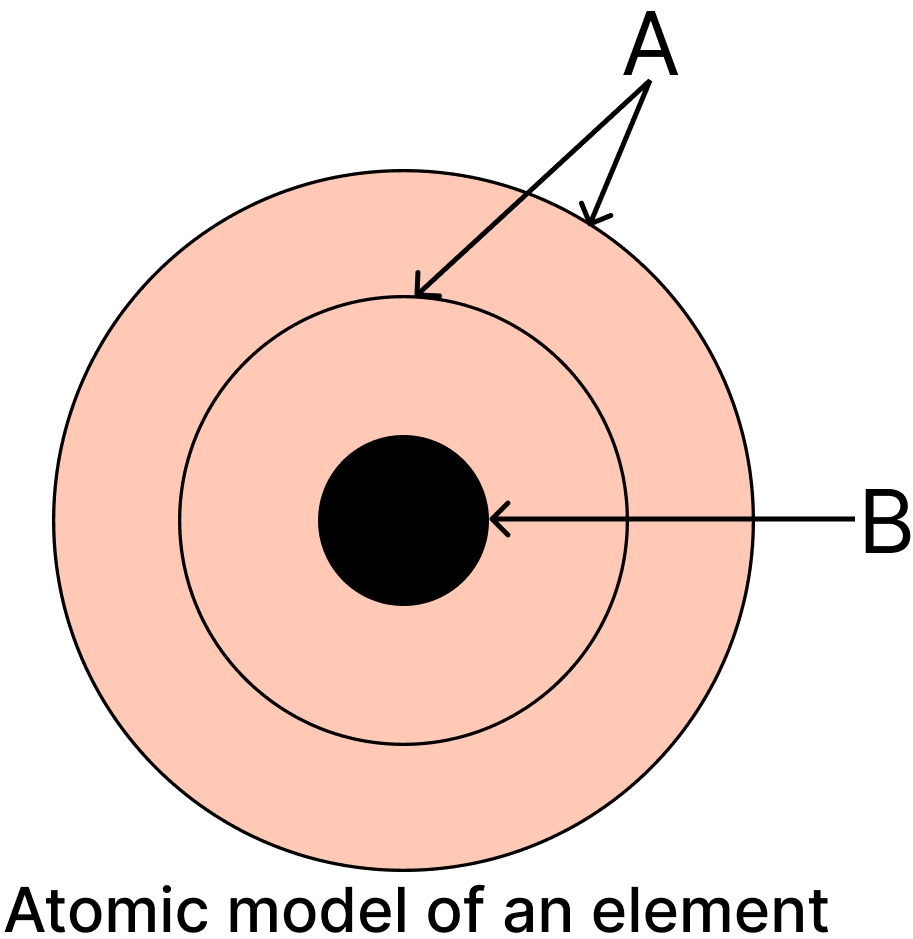
(a) Label A and B.
(b) Name the particles present in (i) A and (ii) B.
(c) Which of the particles mentioned in A and B are:
(i) negatively charged
(ii) positively charged
(iii) neutral
Answer
(a) A represents orbits or shells and B is nucleus.
(b) Electrons are present in A.
Protons and neutrons are present in B.
(c) The particles are charged as follows:
(i) Electrons are negatively charged.
(ii) Protons are positively charged.
(iii) Neutrons are neutral.
Write the names of the following compounds.
(a) (NH4)2SO4
(b) Ca(NO3)2
(c) FeS
(d) Na3PO4
(e) NH4OH
(f) CuCO3
(g) HgO
(h) ZnCl2
(i) ZnS
(j) H2S
Answer
(a) Ammonium sulphate
(b) Calcium nitrate
(c) Iron (II) sulphide
(d) Sodium phosphate
(e) Ammonium hydroxide
(f) Copper (II) carbonate
(g) Mercuric oxide
(h) Zinc chloride
(i) Zinc sulphide
(j) Hydrogen sulphide
Write the names of the elements present in the following compounds.
(a) Common salt
(b) Ammonia
(c) Sulphuric acid
(d) Glucose
(e) Sodium hydroxide
(f) Acetic acid
Answer
| Compounds | Elements |
|---|---|
| Common salt | Sodium, chlorine |
| Ammonia | Nitrogen, hydrogen |
| Sulphuric acid | Hydrogen, sulphur, oxygen |
| Glucose | Carbon, hydrogen, oxygen |
| Sodium hydroxide | Sodium, oxygen, hydrogen |
| Acetic acid | Carbon, hydrogen, oxygen |
Write the symbols and valencies of the following radicals:
(a) Magnesium ion
(b) Ammonium
(c) Carbonate
(d) Nitrate
(e) Oxide
(f) Bisulphate
(g) Aluminium ion
Answer
| Radicals | Symbols | Valency |
|---|---|---|
| Magnesium ion | Mg2+ | 2 |
| Ammonium | NH4+ | 1 |
| Carbonate | CO32- | 2 |
| Nitrate | NO3- | 1 |
| Oxide | O2- | 2 |
| Bisulphate | HSO4- | 1 |
| Aluminium ion | Al3+ | 3 |
Define the following terms:
(a) Atoms
(b) Molecules
(c) Radicals
(d) Valency
(e) Periodic table
Answer
(a) An atom is the smallest particle of an element that exhibits all the properties of that element. It may or may not exist independently but takes part in every chemical reaction.
(b) A molecule is the smallest particle of an element or compound which has independent existence and exhibits all the properties of that element or compound.
(c) A radical is an atom of an element or a group of atoms of different elements that behaves as a single unit with a positive or negative charge on it.
(d) Valency is the combining capacity of an element or of a radical.
(e) Periodic table is a tabular arrangement of elements in vertical columns and horizontal rows indicating the regular trends in the properties of elements.
Give the group numbers of the following elements present in the periodic table.
(a) Magnesium
(b) Carbon
(c) Sulphur
(d) Neon
Answer
(a) IIA
(b) IVA
(c) VIA
(d) Zero
What does each of the following represent?
(a) 2CO2
(b) 2H2S
(c) 5H2SO4
(d) 6NaNO3
Answer
(a) 2 molecules of carbon dioxide
(b) 2 molecules of hydrogen sulphide
(c) 5 molecules of sulphuric acid
(d) 6 molecules of sodium nitrate
The valency of calcium is 2. Write the valencies of other radicals in the following compounds:
(a) CaO
(b) Ca(OH)2
(c) CaCO3
(d) CaCl2
Answer
(a) Oxide (O2-) valency is 2
(b) Hydroxide (OH-) valency is 1
(c) Carbonate (CO32-) valency is 2
(d) Chloride (Cl-) valency is 1
Write the molecular formula of:
(a) Sodium sulphide
(b) Magnesium oxide
(c) Calcium hydroxide
(d) Hydrogen chloride
(e) Sulphuric acid
(f) Iron (II) sulphide
(g) Iron (III) sulphate
(h) Nitric acid
(i) Calcium phosphate
(j) Aluminium sulphate
(k) Magnesium nitride
Answer
(a) Na2S
(b) MgO
(c) Ca(OH)2
(d) HCl
(e) H2SO4
(f) FeS
(g) Fe2(SO4)3
(h) HNO3
(i) Ca3(PO4)2
(j) Al2(SO4)3
(k) Mg3N2
Give two examples of polyatomic molecules.
Answer
Phosphorus (P4) and Sulphur (S8)
Give the name and symbol of an ion each with the valency of +1, +2 and +3.
Answer
The name and symbol of an ion each with the valency of +1, +2 and +3 are:
| Name of element | Symbol | Valency |
|---|---|---|
| Sodium | Na+ | +1 |
| Calcium | Ca2+ | +2 |
| Aluminium | Al3+ | +3 |
Give the name and symbol of an ion each with the valency of -1, -2 and -3.
Answer
The name and symbol of an ion each with the valency of -1, -2 and -3 are:
| Name of element | Symbol | Valency |
|---|---|---|
| Chloride ion | Cl- | -1 |
| Sulphate ion | SO42- | -2 |
| Phosphate ion | PO43- | -3 |
What are the particles present in the nucleus of an atom ?
Answer
The particles present in the nucleus of an atom are:
- Protons – positively charged particles
- Neutrons – neutral particles (no charge)
Give one difference between the molecules of an element and those of a compound.
Answer
A molecule of an element is made up of atoms of the same element, whereas a molecule of a compound is made up of atoms of different elements chemically combined together.
For example, O2 is a molecule of an element because it contains only oxygen atoms, while H2O is a molecule of a compound because it contains hydrogen and oxygen atoms.
How is a basic radical (cation) formed ?
Answer
A basic radical (cation) is formed when an atom loses one or more electrons. When electrons are lost, the atom becomes positively charged because the number of protons (positively charged) exceeds the number of electrons (negatively charged). For example:
Na → Na+ + e-
State five characteristics of an atom.
Answer
Five characteristics of an atom are given below:
- An atom is the smallest particle of matter which cannot be divided further into smaller particles.
- Atoms of the same element are all identical but they differ from the atoms of other elements.
- An atom of an element exhibits all the properties of that element. Different elements differ in their properties.
- Atoms can neither be created nor be destroyed.
- Atoms may or may not have independent existence but they can take part in chemical reactions.
State five characteristics of a molecule.
Answer
Five characteristics of a molecule are given below:
- A molecule is formed by the chemical combination of two or more atoms of the same element or different elements.
- A molecule exhibits all the properties of that element or compound.
- In a molecule of a compound, atoms of different elements combine in a fixed whole number ratio.
- In a molecule, the atoms are chemically bonded together by attractive forces.
- A molecule can be represented by a chemical formula.
Give two differences between molecules and radicals.
Answer
Two differences between molecules and radicals are given below:
| Molecules | Radicals | |
|---|---|---|
| 1. | A molecule is the smallest particle of an element or a compound capable of independent existence, made up of one or more than one atom of same or different types. | A radical is a single atom of an element or a group of atoms of different elements behaving as a single unit with a positive or negative charge on it. |
| 2. | A molecule represents all the properties of that element or compound. | Oppositely charged radicals combine to form molecules of compounds. |
| 3. | Examples — H2O and CO2. | Examples — Cl-, NH4+ and SO42- |
(a) Name the three fundamental particles present in an atom.
(b) What are the two main parts of an atom?
(c) Give the location of the three fundamental particles in an atom.
Answer
(a) An atom is made up of three fundamental or subatomic particles. They are:
- Electrons : Electrons are the negatively charged particles in an atom with one unit negative charge and negligible mass.
- Protons : Protons are the positively charged particles present in an atom with one unit positive charge and one unit mass.
- Neutrons : Neutrons are the particles with no electrical charge, so they are neutral but have one unit mass.
(b) The two main parts of an atom are:
- Nucleus : Contains protons and neutrons.
- Orbits or Shells : The region around the nucleus where electrons revolve in circular paths.
(c) The three fundamental particles in an atom are located as given below:
- Electrons are located in orbits around the nucleus.
- Protons and Neutrons are present in the centrally located part called the nucleus.
What is variable valency ? Give two examples of elements showing variable valency.
Answer
Certain elements exhibit more than one valency that means these elements show variable valency.
Examples: Iron and copper.
| Metal | Radicals | Valency |
|---|---|---|
| Iron (Fe) | Ferrous, Ferric | 2, 3 |
| Copper (Cu) | Cuprous, Cupric | 1, 2 |
(a) What is a Periodic Table ?
(b) What are Periods and Groups of the Periodic Table ?
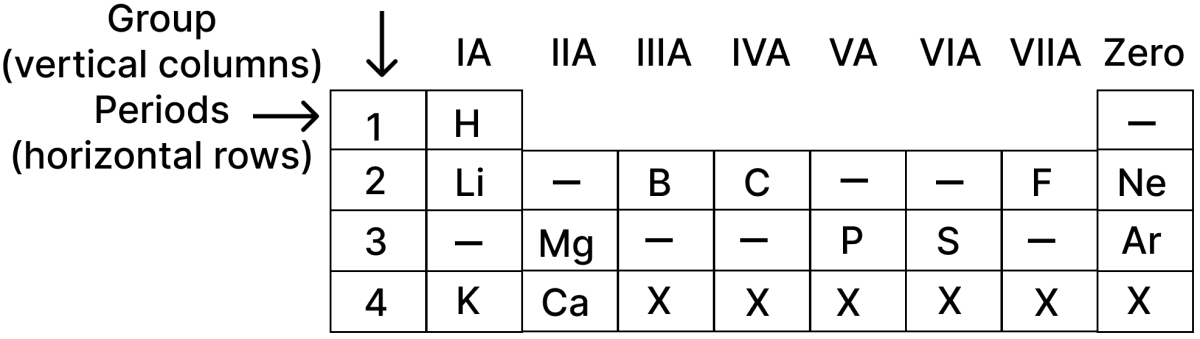
(c) A part of the periodic table is shown below in which symbols of some elements are given, while some are missing. (Only the first 20 elements are given).
(i) Give the names and symbols of the missing elements.
(ii) Also mention whether they are metals, non-metals, metalloids or inert gases.
Answer
(a) Periodic table is a tabular arrangement of elements in vertical columns and horizontal rows indicating the regular trends in the properties of elements.
(b) The horizontal rows of the periodic table are called periods. The vertical columns are called groups.
(c) The completed periodic table is given below:
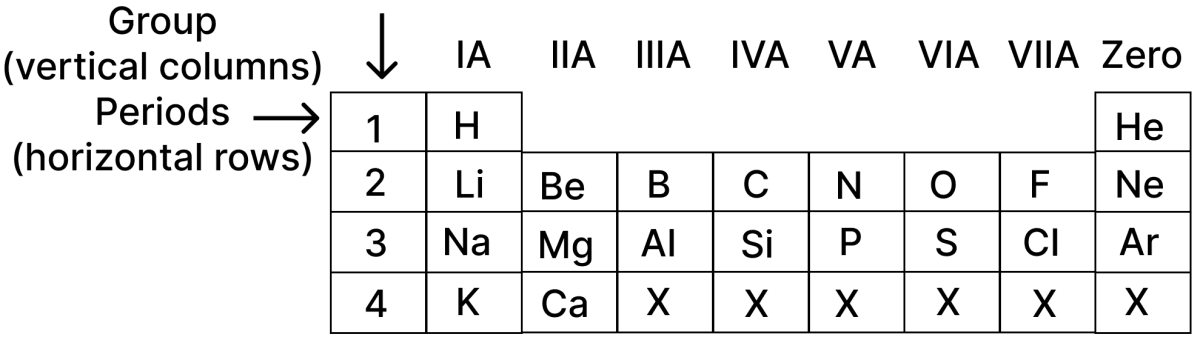
The names and symbols of the missing elements, along with their type are:
| Symbol | Name of element | Type |
|---|---|---|
| He | Helium | Inert gas (noble gas) |
| Be | Beryllium | Metal |
| N | Nitrogen | Non-metal |
| O | Oxygen | Non-metal |
| Na | Sodium | Metal |
| Al | Aluminium | Metal |
| Si | Silicon | Metalloid |
| Cl | Chlorine | Non-metal |
The symbols and valencies of some metal ions (cations) are given below. Write the molecular formulae of their oxides, sulphides and chlorides, provided that the valencies of oxygen, sulphur and chloride are -2, -2 and -1 respectively.
| Cation | Valency | Oxide | Sulphide | Chloride |
|---|---|---|---|---|
| Na | 1 | .......... | Na2S | .......... |
| Mg | 2 | MgO | .......... | .......... |
| Fe | 3 | .......... | .......... | FeCl3 |
Answer
The molecular formulae of the oxides, sulphides and chlorides of the given metal ions (cations) are provided below:
| Cation | Valency | Oxide | Sulphide | Chloride |
|---|---|---|---|---|
| Na | 1 | Na2O | Na2S | NaCl |
| Mg | 2 | MgO | MgS | MgCl2 |
| Fe | 3 | Fe2O3 | Fe2S3 | FeCl3 |
The valency and symbols of some cations and anions are given below.
Cations: Ca2+, Fe2+, Al3+
Anions: SO42-, HCO3-, OH-, PO43-
Write the formula of:
(a) Calcium phosphate
(b) Aluminium sulphate
(c) Iron (II) hydroxide
(d) Calcium bicarbonate
(e) Aluminium hydroxide
Answer
(a) Calcium phosphate
Formula of the compound formed between calcium ion and phosphate ion is :
∴ Chemical formula of calcium phosphate is Ca3(PO4)2.
(b) Aluminium sulphate
Formula of the compound formed between aluminium ion and sulphate ion is :
∴ Chemical formula of aluminium sulphate is Al2(SO4)3.
(c) Iron (II) hydroxide
Formula of the compound formed between iron (II) ion and hydroxide ion is :
∴ Chemical formula of iron (II) hydroxide is Fe(OH)2.
(d) Calcium bicarbonate
Formula of the compound formed between calcium ion and bicarbonate ion is :
∴ Chemical formula of calcium bicarbonate is Ca(HCO3)2.
(e) Aluminium hydroxide
Formula of the compound formed between aluminium ion and hydroxide ion is :
∴ Chemical formula of aluminium hydroxide is Al(OH)3.
Read the given passage carefully and answer the questions that follow :
An atom is the basic unit of matter.
Following are the two statements about atoms :
(a) An atom is the smallest particle of matter which cannot be divided further into smaller particles.
(b) An atom of an element exhibits all the properties of that element.
- Name the scientist who proposed the above two characteristics of an atom.
- Which of the above two statements is true?
- Name the particles formed when two or more atoms combine chemically.
Answer
(i) The scientist who proposed these characteristics was John Dalton.
(ii) Statement (b) is true. Statement (a) was accepted earlier as a characteristic proposed by Dalton, but it is not considered true now because an atom is made up of still smaller subatomic particles — electrons, protons and neutrons.
(iii) When two or more atoms combine chemically, they form molecules.