
The most abundant metal present in the earth's crust is :
- Iron
- Calcium
- Aluminium
- Potassium
Answer
Aluminium
Reason — Aluminium is the most abundant metal found in the earth's crust.
Iron is abundant, but not the most abundant metal in the Earth’s crust. Calcium is quite abundant (found in limestone, etc.), but less than aluminium. Potassium is present in minerals, but not the most abundant.
The most abundant non-metal present in earth's crust is :
- Oxygen
- Nitrogen
- Carbon
- Hydrogen
Answer
Oxygen
Reason — The most abundant non-metal in earth's crust is oxygen.
Nitrogen is most abundant in the atmosphere, not in the Earth’s crust. Carbon is present in many compounds, but not very abundant in the crust. Hydrogen is found in water and compounds, but not the most abundant in the crust.
A metal found in a free state is :
- Copper
- Zinc
- Sodium
- Gold
Answer
Gold
Reason — Gold is one of the few metals that naturally occurs in its free (native) state in nature, meaning it isn't combined with other elements as ores.
Copper is usually found in combined state (like copper ores), though rarely native. Zinc is always found in combined form (e.g., zinc sulphide). Sodium is very reactive, never found free in nature.
A non-metal occurring in the solid state is:
- Bromine
- Phosphorus
- Chlorine
- Nitrogen
Answer
Phosphorus
Reason — Phosphorus is the non-metal that occurs in the solid state.
Bromine is a liquid non-metal at room temperature. Chlorine and nitrogen are gas at room temperature.
Which of the following metals exists as a liquid under normal conditions?
- Mercury
- Bromine
- Magnesium
- Lithium
Answer
Mercury
Reason — Mercury (Hg) is the only metal that exists as a liquid at room temperature.
Bromine is a liquid, but it is a non-metal. Magnesium and Lithium are solid metals.
A metal with melting point less than 50°C is:
- Gallium
- Iron
- Gold
- Aluminium
Answer
Gallium
Reason — Gallium changes into liquid above 30°C i.e. even when placed on palm of hand.
Melting point of iron is 1538°C. Melting point of gold is 1064°C. Melting point of aluminium is 660°C.
A metal which is neither ductile nor malleable is:
- Copper
- Silver
- Zinc
- Aluminium
Answer
Zinc
Reason — Zinc is neither ductile nor malleable but it is brittle.
Copper is highly ductile and malleable. Silver is one of the most malleable and ductile metals. Aluminium is malleable and ductile.
The colour of rust which is a hydrated oxide of iron is:
- Reddish-brown
- Green
- White
- Black
Answer
Reddish-brown
Reason — Iron when exposed to moist air forms a reddish brown layer known as rust on its surface. Rust is hydrated ferric oxide.
Aluminium is not used to make :
- Foils
- Wires
- Fireworks
- Utensils
Answer
Fireworks
Reason — Aluminium is used to make foils, wires, utensils. Magnesium is used in fireworks as it burns with dazzling light but aluminium does not.
A metalloid used in the manufacture of computer microchips is:
- Antimony
- Germanium
- Silicon
- Arsenic
Answer
Silicon
Reason — Highly pure Silicon is used in the manufacture of microchips used in computer.
Antimony is a metalloid, but mainly used in alloys and flame retardants. Germanium is used in early semiconductors, but less commonly used today. Arsenic is used in some compounds (like gallium arsenide), but not the main material.
A metalloid used to make glass is :
- Sulphur
- Germanium
- Silicon
- Antimony
Answer
Silicon
Reason — Sand which is silicon dioxide, is the principal ingredient of glass.
Sulphur is a non-metal. Germanium is a metalloid, but mainly used in electronics, not glass. Antimony is used in alloys and flame retardants.
Assertion (A): Most of the metals can be beaten into sheets without breaking.
Reason (R): Most of the metals are malleable.
- Both A and R are true and R is the correct explanation of A.
- Both A and R are true but R is not the correct explanation of A.
- A is true but R is false.
- A is false but R is true.
Answer
Both A and R are true and R is the correct explanation of A.
Reason — A is true as Most metals can be beaten into thin sheets without breaking. This property is called malleability.
R is true as most of the metals are malleable.
Therefore, Both A and R are true and R is the correct explanation of A is the correct option.
Assertion (A): Mercury is used as a thermometric liquid.
Reason (R): Mercury can expand and contract only at high temperatures.
- Both A and R are true and R is the correct explanation of A.
- Both A and R are true but R is not the correct explanation of A.
- A is true but R is false.
- A is false but R is true.
Answer
A is true but R is false.
Reason — A is true as Mercury is used in thermometers. It expands uniformly with temperature.
R is false as mercury expands and contracts even with small temperature changes, which is why it is useful in thermometers.
Therefore, A is true but R is false is the correct option.
Assertion (A): Non-metals have low melting and boiling points.
Reason (R): Diamond and graphite are lustrous solids.
- Both A and R are true and R is the correct explanation of A.
- Both A and R are true but R is not the correct explanation of A.
- A is true but R is false.
- A is false but R is true.
Answer
Both A and R are true but R is not the correct explanation of A.
Reason — A is true as most non-metals generally have low melting and boiling points because they have weak intermolecular forces.
R is true as Diamond and Graphite are forms of carbon. They are lustrous solids.
Therefore, Both A and R are true but R is not the correct explanation of A is the correct option.
Assertion (A): The second most abundant non-metal in the earth's crust is silicon in the form of sand.
Reason (R): A compound of silicon called silicon carbide is the hardest substance prepared by man.
- Both A and R are true and R is the correct explanation of A.
- Both A and R are true but R is not the correct explanation of A.
- A is true but R is false.
- A is false but R is true.
Answer
Both A and R are true but R is not the correct explanation of A.
Reason — A is true as Silicon is the second most abundant element in the Earth’s crust after oxygen. It occurs mainly as sand.
R is true as Silicon carbide is an extremely hard substance made artificially.
Therefore, Both A and R are true but R is not the correct explanation of A is the correct option.
Assertion (A): Helium is used for filling up weather observation balloons.
Reason (R): The inert gas helium is the second lightest element known to humans.
- Both A and R are true and R is the correct explanation of A.
- Both A and R are true but R is not the correct explanation of A.
- A is true but R is false.
- A is false but R is true.
Answer
Both A and R are true and R is the correct explanation of A.
Reason — A is true as Helium is used to fill weather balloons. It is light and non-reactive, so balloons rise safely.
R is true as helium is the second lightest element (after hydrogen). It is also an inert gas, meaning it does not react easily.
Therefore, Both A and R are true and R is the correct explanation of A is the correct option.
Fill in the blanks:
(a) The most ductile metal is ............... .
(b) A metal stored in kerosene oil is ............... .
(c) Tungsten metal is a good conductor of ............... .
(d) ............... is a soft metal.
(e) ............... is the hardest compound known to us.
(f) A non-metal used to purify water is ............... .
(g) A metal that gives dazzling effect to crackers when they explode is ............... .
(h) A chemical compound that makes up the striking heads of match sticks is ............... .
Answer
(a) Gold
(b) Sodium
(c) electricity
(d) Pure gold
(e) Silicon carbide
(f) Chlorine
(g) Magnesium
(h) Phosphorus sulphide
Write True or False for the following statements:
(a) Silver is used to make electric cables.
(b) Iodine acts as an antiseptic in the form of tincture of iodine.
(c) Sodium can be cut with a knife.
(d) Antimony is a metal.
(e) Sand is an oxide of silicon.
Answer
(a) False
Correct Statement — Copper is used to make electric cables.
(b) True
(c) True
(d) False
Correct Statement — Antimony is a metalloid.
(e) True
Match the following:
| Column A | Column B |
|---|---|
| (a) Helium | (1) Electric bulb |
| (b) Neon | (2) Thermometer |
| (c) Argon | (3) Semiconductor |
| (d) Germanium | (4) Weather observation balloons |
| (e) Mercury | (5) Advertising signboards |
Answer
| Column A | Column B |
|---|---|
| (a) Helium | (4) Weather observation balloons |
| (b) Neon | (5) Advertising signboards |
| (c) Argon | (1) Electric bulb |
| (d) Germanium | (3) Semiconductor |
| (e) Mercury | (2) Thermometer |
Name a metal which is:
(a) the most malleable,
(b) brittle,
(c) as precious as gold,
(d) easily cut with a knife,
(e) used in making electric cables,
(f) used as a thermometric liquid,
(g) the best conductor of electricity.
Answer
(a) Gold
(b) Zinc
(c) Platinum
(d) Sodium
(e) Copper
(f) Mercury
(g) Silver
Name a non-metal which is:
(a) a good conductor of heat and electricity,
(b) the hardest naturally occurring substance,
(c) used to kill germs in water,
(d) lustrous,
(e) used for filling into electric bulbs,
(f) used for cancer therapy,
(g) liquid at room temperature.
Answer
(a) Graphite (a form of carbon)
(b) Diamond (a form of carbon)
(c) Chlorine
(d) Iodine
(e) Argon
(f) Radon
(g) Bromine
Choose the odd one out and give reason for your answer.
(a) Gold, silver, copper, sodium
(b) Iron, aluminium, silicon, tin
(c) Silver, copper, aluminium, zinc
(d) Sulphur, phosphorus, carbon, bromine
(e) Brass, bronze, steel, iron
Answer
(a) Odd one — Sodium
Reason — Gold, silver and copper are comparatively less reactive metals and can occur in the free state, whereas sodium is a highly reactive metal and is stored in kerosene oil.
(b) Odd one — Silicon
Reason — Iron, aluminium, and tin are metals, whereas silicon is a metalloid.
(c) Odd one — Zinc
Reason — Silver, copper, and aluminium are highly malleable and ductile metals — they can be easily drawn into wires and beaten into sheets. Zinc, however, is brittle at room temperature and not very malleable or ductile.
(d) Odd one — Bromine
Reason — Sulphur, phosphorus, and carbon are solid non-metals, while bromine is a liquid non-metal.
(e) Odd one — Iron
Reason — Brass, bronze, and steel are alloys, while iron is a metal.
Name the metals present in the following alloys:
(a) Brass
(b) Bronze
(c) Duralumin
(d) Stainless steel
Answer
(a) Copper, zinc
(b) Copper, tin
(c) Aluminium, manganese, magnesium, copper
(d) Iron, chromium, nickel
Mention two uses of the following metals and non-metals:
(a) Iron
(b) Aluminium
(c) Gold
(d) Oxygen
(e) Iodine
(f) Germanium
(g) Tungsten
Answer
(a) Iron is used for:
- Construction of power transmission towers.
- Making pipes, tanks, cylinders, nails, agricultural tools, railings, wire meshes etc.
(b) Aluminium is used for:
- Making utensils, cans for drinks, furniture, window frames etc.
- Packaging foodstuffs and wrappers of medicines in the form of aluminium foil.
(c) Gold is used for:
- Making jewellery and gold coins.
- In dentistry to fill in teeth cavities in the form of an alloy with silver.
(d) Oxygen is used for:
- Breathing and respiration, in hospitals oxygen cylinders are used for serious patients to help them in breathing.
- It is essential for combustion.
(e) Iodine is used for:
- Making photographic films in the form of potassium iodide.
- Making tincture of iodine and iodex which are used as an antiseptic and pain reliever respectively.
(f) Germanium is used :
- as a semiconductor.
- It is also used to form alloys and as a phosphor in fluorescent lamps.
(g) Tungsten is used in:
- making electrodes.
- electric bulbs as filaments and cathode ray tubes.
Give one use of the following inert gases :
(a) Helium
(b) Neon
(c) Argon
(d) Radon
Answer
(a) Helium is used in weather observation balloons.
(b) Neon is used in advertising signboards and tubelights.
(c) Argon is used in electric bulbs to provide an inert atmosphere.
(d) Radon is used for cancer treatment as it is radioactive in nature.
Give reasons:
Magnesium is used in fireworks.
Answer
Magnesium burns with a dazzling light so it is used in fireworks.
Give reasons:
Aluminium is used in making aircrafts.
Answer
Aluminium is light and, when mixed with other metals like copper, magnesium and manganese, it forms strong alloys. Hence, it is used in making aircraft.
Give reasons:
Copper is used in making electric cables.
Answer
Copper is highly ductile and is a very good conductor of heat and electricity, so it is used in making electric cables.
Give reasons:
Graphite is used in the leads of pencils.
Answer
Graphite is soft and its layers slip, leaving black marks on paper. Hence, it is used in the leads of pencils.
Give reasons:
Impure diamond is used to cut glass.
Answer
Diamond is the hardest substance so it is used to cut glass.
Give reasons:
Gold is mixed with copper and nickel.
Answer
Gold is the most malleable metal and is very soft. To make it harder and cheaper gold is mixed with copper and nickel.
Give reasons:
Tungsten is used in electric bulbs.
Answer
Tungsten can withstand high temperature and has the highest melting point, so it is used as filaments in electric bulbs.
Give four differences between metals and non-metals with reference to their:
(a) Melting point and boiling point,
(b) Conductivity of heat and electricity,
(c) Malleability,
(d) Solubility in water.
Answer
(a) Metals have high melting point and boiling point whereas non-metals have low melting point and boiling point.
(b) Metals are good conductors of heat and electricity but non-metals are bad conductors of heat and electricity.
(c) Metals are mostly malleable while non-metals are not malleable.
(d) Metals are insoluble in water while non-metals can be soluble or insoluble in water.
(a) What are metalloids ?
(b) Give two uses of :
(i) Silicon
(ii) Antimony
Answer
(a) Metalloids are the elements which show some properties of metals and some properties of non-metals. Examples: Silicon (Si), Germanium (Ge), Antimony (Sb).
(b)
(i) Two uses of silicon are:
- It is used to make water proof materials like bags, umbrellas, raincoats etc.
- Highly pure silicon is used in making microchips for computers, transistors, solar cells, rectifiers.
(ii) Two uses of antimony are:
- It is used in electric industry to make semiconductor devices.
- It is used in printing presses as type metal.
(a) What is rusting?
(b) What is the chemical formula of rust ?
(c) What happens to iron due to rusting?
(d) State two methods by which rusting of iron can be prevented.
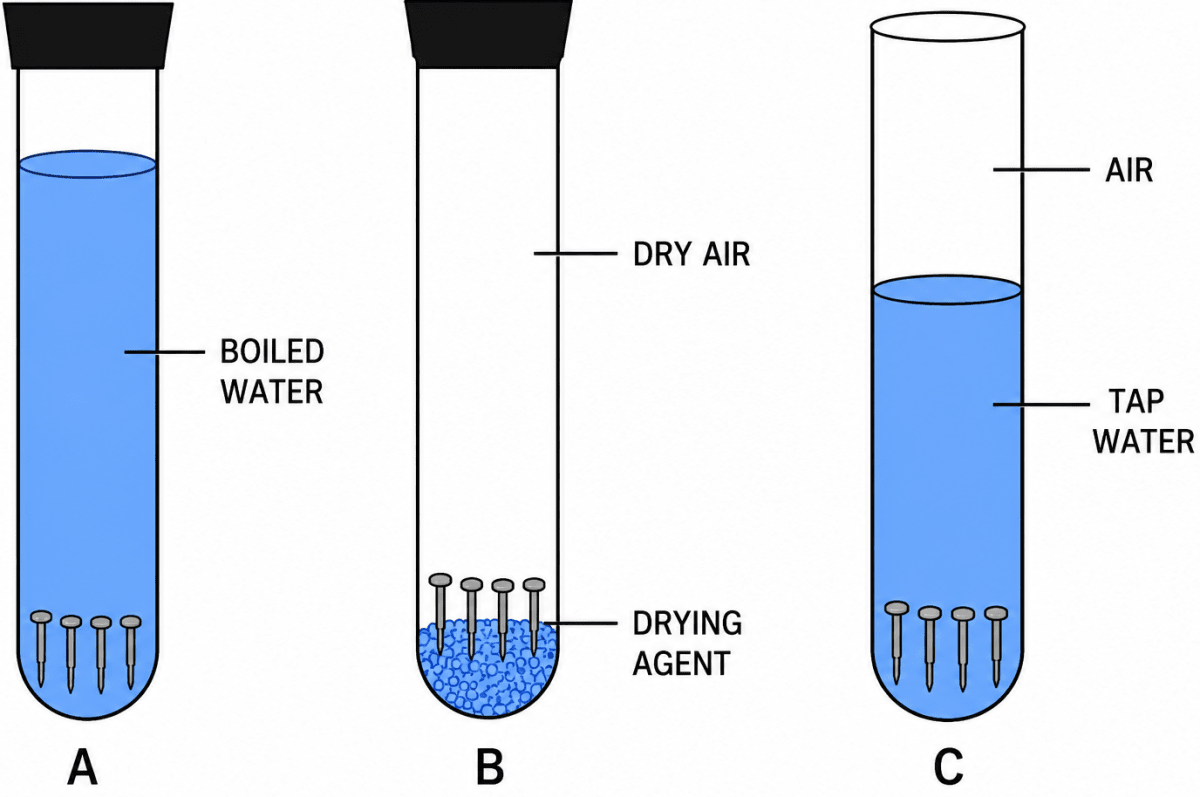
(e) Three test tubes A, B and C are shown ahead containing clean iron nails.
In test tube A iron nails are kept in boiled water.
In test tube B, iron nails are in contact with dry air only.
In test tube C nails are kept in tap water.
(i) Nails in which of the test tubes will get rusted? Why?
(ii) Why is there no rusting of iron nails in the other two test tubes? Explain.
Answer
(a) Rusting is a slow oxidation process in which iron slowly reacts with oxygen (of the air) in the presence of moisture and produces a flaky brown substance, called rust.
(b) Fe2O3·xH2O
(c) Rusting corrodes iron, weakens iron structures and slowly destroys the metal.
(d) Two methods by which rusting can be prevented are:
- By Painting — Painting with red lead, oil paint, coating with enamel, coal tar, and plastic coating are some ways which help to prevent rusting.
- Metallic Coating — In this process, iron articles are dipped in various types of molten metal like zinc, tin, aluminium, etc. The metallic coating prevents the formation of rust. Galvanization is used for those iron articles which are exposed to heavy moisture such as roof sheds, buckets, tubs, water pipes, etc. In this process, iron articles are dipped in molten zinc.
(e)
(i) The nails in test tube C will get rusted. This is because they are in contact with both air and water, which are the two necessary conditions for rusting.
(ii) The nails in test tubes A and B do not rust because in test tube A, boiled water contains no dissolved air/oxygen, and in test tube B, the drying agent absorbs moisture and keeps the air dry. Thus, in both cases, one of the necessary conditions for rusting is absent.
Solve the following crossword puzzle with the help of the given clues.
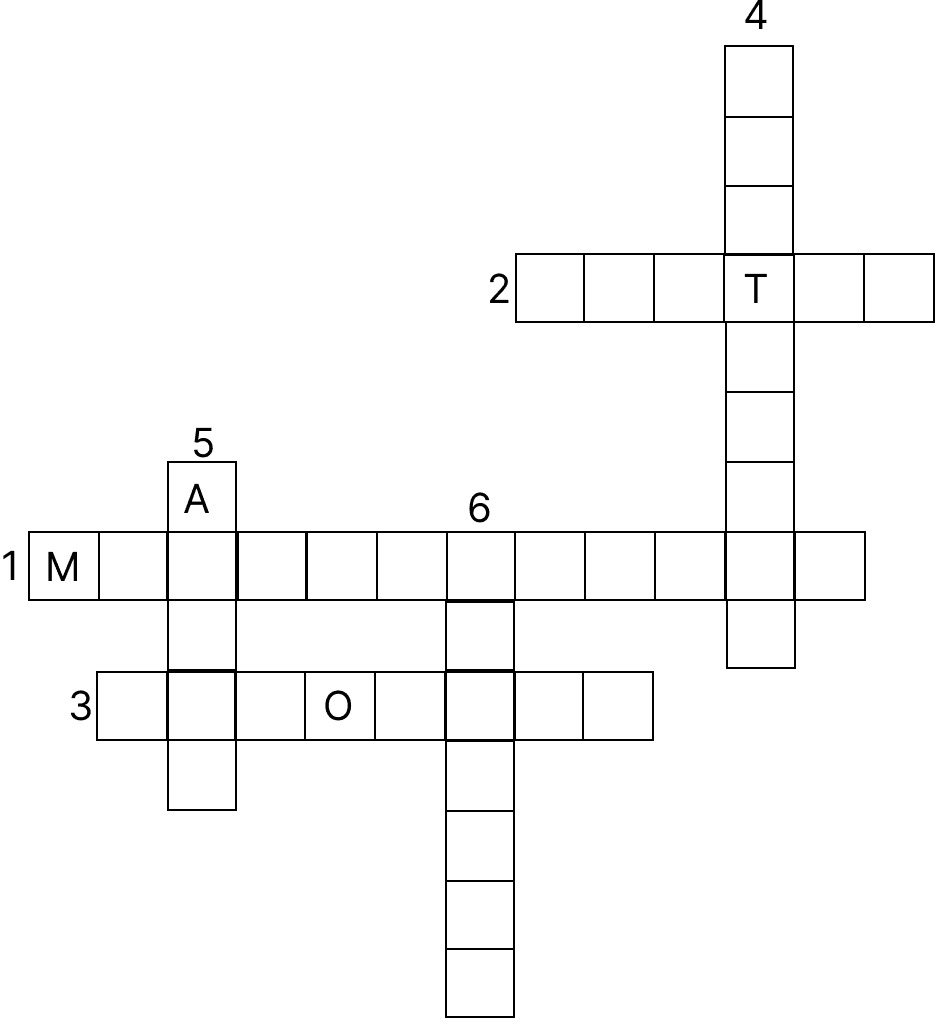
Across :
1. The property due to which a metal can be beaten into sheets.
2. This is the property due to which the metals shine.
3. The property due to which metals produce sound.
Down :
4. The property due to which a metal can be drawn into wires.
5. The substance formed when two or more metals are mixed together.
6. Non-metals are given this term because they can be easily broken down into pieces.
Answer

Across :
1. MALLEABILITY
2. LUSTRE
3. SONORITY
Down :
4. DUCTILITY
5. ALLOY
6. BRITTLE
Pratham was looking at the silver trophy he had won in a school competition last year. He noticed that its shine had diminished. He went and asked his chemistry teacher why this would happen and he was told about corrosion of metals.
(a) Why does the shine of the silver trophy diminish after sometime ?
(b) Name the metal on which a green deposit is formed when exposed to air. What is that green deposit ?
(c) Why is it necessary to paint bridges, car bodies, telephone poles, etc. ?
Answer
(a) The shine of the silver trophy diminishes after some time because a coating of black silver sulphide is formed on the surface of silver due to pollutant gases present in atmospheric air.
(b) Copper forms a green deposit of basic copper carbonate when exposed to moist air.
(c) It is necessary to paint bridges, car bodies, telephone poles, etc., to prevent rusting/corrosion. Paint forms a protective layer and prevents iron from coming in contact with air and moisture.