
The thrust exerted by a body placed on a surface is :
- less than the weight of the body
- more than the weight of the body
- equal to the weight of the body
- independent of the weight of the body
Answer
equal to the weight of the body
Reason — The thrust exerted by a body placed on a surface is equal to its weight. Thrust is a vector quantity.
The pressure exerted on a surface depends on :
- the nature of the surface on which the thrust is applied
- the area on which the thrust is applied
- the magnitude of the thrust applied
- both the area of contact and the magnitude of the thrust applied
Answer
both the area of contact and the magnitude of the thrust applied
Reason — The pressure exerted on a surface depends on two factors :
- the area on which the thrust is applied and
- magnitude of thrust.
Pressure and thrust are :
- vector quantities
- scalar quantities
- scalar and vector quantities respectively
- vector and scalar quantities respectively
Answer
scalar and vector quantities respectively
Reason — Pressure is a scalar quantity whereas thrust is a vector quantity, because pressure is defined in terms of magnitude only, and thrust is defined in terms of both magnitude and direction.
The C.G.S. unit of pressure is :
- Pa
- N m-2
- dyne cm-2
- dyne cm2
Answer
dyne cm-2
Reason — C.G.S. unit of pressure is dyne cm-2 where 1 dyne cm-2 = 0.1 N m-2 or 1 N m-2 = 10 dyne cm-2
One bar is equal to :
- 103 N m-2
- 104 N m-2
- 105 N m-2
- 106 N m2
Answer
105 N m-2
Reason — 1 bar = 105 N m-2.
1 atm of pressure is equal to :
- 0.076 m of Hg
- 760 torr
- 76 torr
- 7.6 mm of Hg
Answer
760 torr
Reason — torr is a unit of atmospheric pressure after the name of the scientist Torricelli where, 1 torr = 1 mm of Hg and 1 atm = 760 mm of Hg = 760 torr.
The pressure on a surface is reduced by :
- using high thrust
- increasing the area of surface
- decreasing the area of surface
- none of these
Answer
increasing the area of surface
Reason — Larger the area on which a given thrust acts, lesser is the pressure exerted by it, as pressure is inversely proportional to the area of surface.
Cutting tools have either sharp or pointed edges so that a ............... thrust may cause a ............... pressure at that edges and cutting can be done with less effort.
- high, high
- small, small
- high, small
- small, high
Answer
small, high
Reason — For a given thrust, the pressure on a surface is increased by reducing the area of surface on which it is acting, hence, cutting tools have either sharp or pointed edges so that a small thrust may cause a high pressure at that edges and cutting can be done with less effort.
The pressure inside a liquid of density ρ at a depth h is:
Answer
Reason — The three factors on which the pressure at a point in a liquid depends are —
depth of the point below the free surface (h)
density of liquid (ρ) and
acceleration due to gravity (g)
Pressure = hρg
Out of the following, which one is correct about the law of liquid pressure?
- Pressure is different in all directions about a point inside the liquid.
- In a stationary liquid, pressure is different at all points on a horizontal plane.
- Inside the liquid, pressure decreases with an increase in depth from its free surface.
- It increases with an increase in the density of the liquid.
Answer
It increases with an increase in the density of the liquid.
Reason — As Pressure = hρg, so pressure is directly proportional to the density of the liquid. Hence, it increases with an increase in the density of the liquid.
The pressure P1 at a certain depth in river water and P2 at the same depth in sea water are related as:
- P1 > P2
- P1 = P2
- P1 < P2
- P1 - P2 = atmospheric pressure
Answer
P1 < P2
Reason — As the density of sea water is more than the density of river water, hence, the pressure at a certain depth in sea water is more than that at the same depth in river water because pressure increases with the increase in density of liquid.
The pressure P1 at the top of a dam and P2 at a depth h from the top inside water (density ρ) are related as:
- P1 > P2
- P1 = P2
- P1 - P2 = hρg
- P2 - P1 = hρg
Answer
P2 - P1 = hρg
Reason — The pressure at a point inside a liquid at a depth h is P2
P2 = pressure at the top of a dam (P1) + pressure due to liquid column
= P1 + hρg
So, P2 = P1 + hρg
Hence, P2 - P1 = hρg
The wall of a dam is made thicker at the bottom because :
- the pressure exerted by a liquid remains the same with its depth.
- the pressure exerted by a liquid decreases with its depth.
- the pressure exerted by a liquid increases with its depth.
- of safety from outer forces.
Answer
the pressure exerted by a liquid increases with its depth.
Reason — A dam has broader walls at the bottom than at the top as the pressure exerted by the liquid increases with it's depth. Thus, as depth increases, more and more pressure is exerted by water on the walls of the dam.
Hydraulic machines work on the principle of :
- Newton's first law
- Newton's third law
- Pascal's law
- both Newton’s first law and Newton’s third law
Answer
Pascal's law
Reason — The principle of a hydraulic machine is that a small force applied on a smaller piston is transmitted to produce a large force on the bigger piston. This principle is based on Pascal's law.
Hydraulic machines act like a :
- force subtractor
- force reducer
- force multiplier
- both a force subtractor and a force multiplier
Answer
force multiplier
Reason — The principle of a hydraulic machine is that a small force applied on a smaller piston is transmitted to produce a large force on the bigger piston. Hence, it acts as a force multiplier.
A rectangular cement block has length, breadth and height of 60 cm, 30 cm and 15 cm respectively. Identify the correct position of the block and pressure exerted by it on the ground.
- Minimum pressure is exerted when breadth and height form the base.
- Maximum pressure is exerted when breadth and height form the base.
- Maximum pressure is exerted when length and breadth form the base.
- Minimum pressure is exerted when length and height form the base.
Answer
Maximum pressure is exerted when breadth and height form the base
Reason — Pressure is given by the formula :
For the same weight (thrust) of the block, the pressure is inversely proportional to the contact area. So, larger base area → smaller pressure, and smaller base area → greater pressure.
As, minimum area → side with minimum dimensions → 30 cm breadth and 15 cm height.
Hence, maximum pressure is exerted when breadth and height form the base because it has smallest contact area.
The incorrect statement from the following is :
- The pressure exerted by the liquid filled in a vessel is same at all points.
- The pressure of liquid is same in all directions in a horizontal plane.
- The pressure of a liquid on a surface does not depend on the area of surface.
- The pressure of liquid at its free surface is zero.
Answer
The pressure exerted by the liquid filled in a vessel is same at all points.
Reason — Liquid pressure increases with depth so, pressure is not the same at all points in the vessel as it depends on how deep the point is from the free surface.
Define the term thrust. State its S.I. unit.
Answer
Thrust is the force acting normally on a surface.
The S.I. unit of thrust is newton (N).
Thrust is a vector quantity.
(a) What physical quantity is measured in bar ?
(b) How is the unit bar related to the S.I. unit pascal ?
Answer
(a) The physical quantity that is measured in bar is Pressure.
(b) The relation between bar and pascal is : 1 bar = 105 pascal.
Define one pascal (Pa), the S.I. unit of pressure.
Answer
One pascal is the pressure exerted on a surface of area 1 m2 by a force of 1 N acting normally on it.
State whether thrust is a scalar or vector?
Answer
Thrust is a vector quantity. Its direction of application is normal to the surface.
State whether pressure is a scalar or vector?
Answer
Pressure is a scalar quantity.
What is a fluid?
Answer
A substance which can flow is called a fluid. All liquids and gases are thus fluids.
Pressure at free surface of a water lake is P1, while at a point at depth h below its free surface is P2. (a) How are P1 and P2 related ? (b) Which is more P1 or P2 ?
Answer
(a) As we know,
Total pressure in a liquid at a depth h is P2
= atmospheric pressure acting on the surface (P1) + pressure due to liquid column (h ρ g)
= P1 + h ρ g
Hence,
P2 = P1 + h ρ g
(b) From the above expression we observe that,
P2 > P1
How does the liquid pressure on a diver change if —
(i) the diver moves to the greater depth, and
(ii) the diver moves horizontally ?
Answer
(i) When the diver moves to a greater depth the liquid pressure increases as liquid pressure at a point increases with the increase of depth from it's free surface.
(ii) When the diver moves horizontally, the liquid pressure remains unchanged as inside a liquid, pressure is same at all points on a horizontal plane.
State Pascal's law of transmission of pressure.
Answer
Pascal's law states that the pressure exerted anywhere in a confined liquid is transmitted equally and undiminished in all directions throughout the liquid.
Name two applications of Pascal's law.
Answer
Applications of Pascal's law are —
- Hydraulic brakes
- Hydraulic jack
Complete the following sentences —
(a) Pressure at a depth h in a liquid of density ρ is ............... .
(b) Pressure is ............... in all directions about a point in a liquid.
(c) Pressure at all points at the same depth is ............... .
(d) Pressure at a point inside a liquid is ............... to it's depth.
(e) Pressure of a liquid at a given depth is ............... to the density of liquid.
Answer
(a) Pressure at a depth h in a liquid of density ρ is h ρ g.
(b) Pressure is same in all directions about a point in a liquid.
(c) Pressure at all points at the same depth is same.
(d) Pressure at a point inside a liquid is directly proportional to its depth.
(e) Pressure of a liquid at a given depth is directly proportional to the density of liquid.
What is meant by pressure ? State its S.I. unit.
Answer
Pressure is the thrust per unit area of surface.
Pressure is a scalar quantity.
The S.I. unit of pressure is newton per metre2 . This unit is named as pascal (symbol Pa).
Differentiate between thrust and pressure.
Answer
| Thrust | Pressure |
|---|---|
| Thrust is the force acting normally on a surface. | Pressure is the thrust per unit area of surface. |
| It is a vector quantity | It is a scalar quantity |
| The S.I. unit is newton(N) | The S.I. is newton per metre2 |
How does the pressure exerted by a thrust depend on the area of surface on which it acts ? Explain with a suitable example.
Answer
The pressure exerted by a thrust is inversely proportional to the area of surface on which it acts. Larger the area on which a given thrust acts, lesser is the pressure exerted by it.
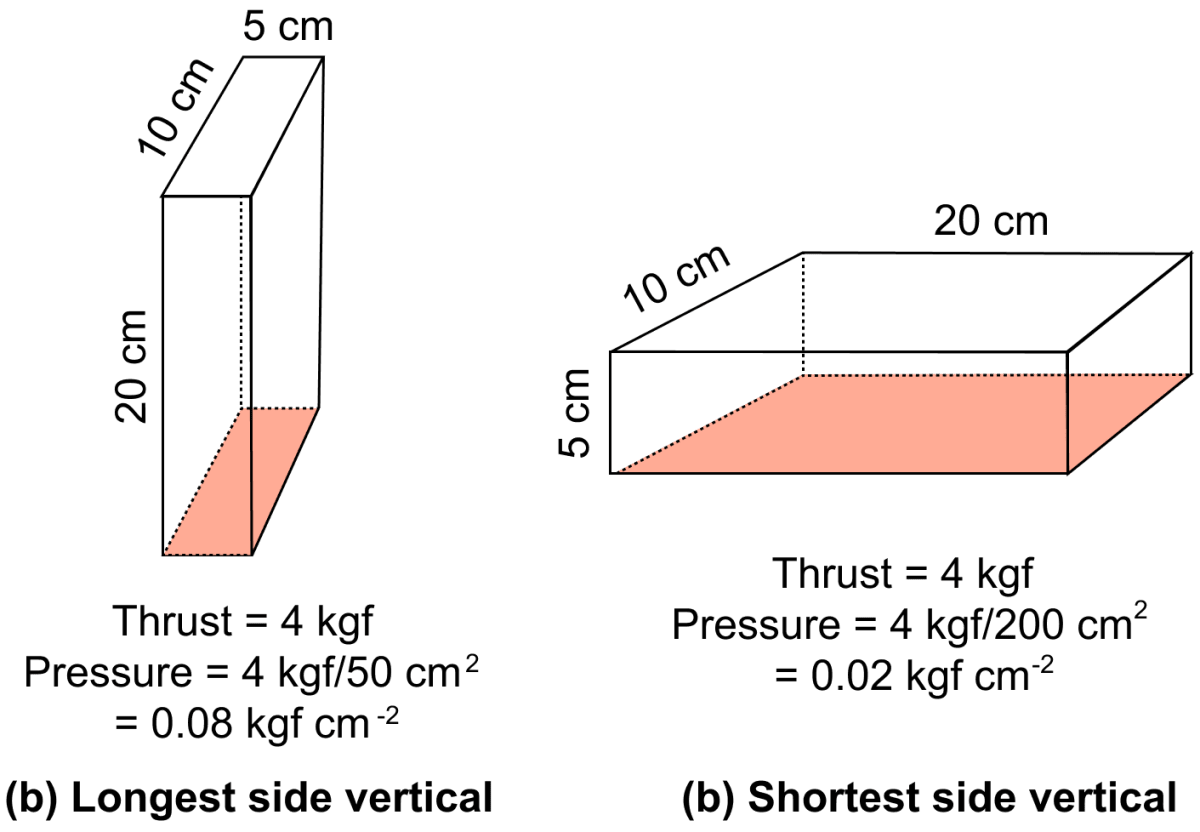
Example — A brick of weight 4 kgf having dimensions 20 cm x 10 cm x 5 cm, exerts maximum pressure on ground when it is placed with it's longest side (20 cm) vertical, as shown in fig below, while it exerts minimum pressure when it is placed with it's shortest side (5 cm) vertical, even though the thrust is same in each case.
Why is the tip of an allpin made sharp?
Answer
The tip of an allpin is made sharp so that large pressure is exerted through the pointed end and that they can be driven into, with less effort.
Explain the following —
(a) It is easier to cut with a sharp knife than with a blunt one.
(b) Sleepers are laid below the rails
Answer
(a) It is easier to cut with a sharp knife than with a blunt knife because in a sharp knife even a small thrust causes a great pressure at the edges and hence, cutting can be done with less effort.
(b) Sleepers are laid below the rails so that the pressure exerted by the iron nails on the ground becomes less.
What do you mean by the term fluid pressure?
Answer
A fluid contained in a vessel exerts pressure at all points and in all directions due to it's weight and this pressure is called fluid pressure.
How does the pressure exerted by a solid and a fluid differ ?
Answer
Both liquids and solids exert pressure due to it's weight, however, pressure exerted by a solid acts only on the surface on which it is placed i.e. at it's bottom, but pressure exerted by a fluid acts on the bottom as well as the walls of the container due to it's tendency to flow.
State three factors on which the pressure at a point in a liquid depends.
Answer
The three factors on which the pressure at a point in a liquid depends are —
depth of the point below the free surface (h),
density of liquid (ρ), and
acceleration due to gravity (g).
Write an expression for the pressure at a point inside a liquid. Explain the meaning of the symbols used.
Answer
The pressure at a point inside a liquid at a depth h
= Atmospheric pressure + pressure due to liquid column
= P0 + hρg
where,
P0 = atmospheric pressure acting on the free surface of liquid
h = depth of the point below the free surface
ρ = the density of the fluid
g = acceleration due to gravity.
How does the pressure at a certain depth in sea water differ from that at the same depth in river water ? Explain your answer.
Answer
The pressure at a certain depth in sea water is more than the same depth in river water because the density of sea water is more than the density of river water.
According to the formula,
Pressure = depth x density of liquid x acceleration due to gravity = hρg
Therefore, when density of a liquid is more then the pressure exerted is also more as density and pressure are directly proportional.
Explain why a gas bubble released at the bottom of a lake grows in size as it rises to the surface of lake.
Answer
It is noticed that as the gas bubble formed at the bottom of the lake rises, it grows in size. The reason is that when the bubble is at the bottom of the lake, total pressure exerted on it is the sum of the atmospheric pressure and the pressure due to the water column above it.
As the gas bubble rises, due to decrease in depth, the pressure due to water column decreases, so the total pressure on the bubble decreases.
According to Boyle's law, the volume of a gas is inversely proportional to the pressure on it. Therefore, the volume of bubble increases due to the decrease in pressure, i.e., the bubble grows in size.
When the bubble reaches the surface of liquid, total pressure exerted on it becomes minimum, just equal to the atmospheric pressure and so the size of bubble when touching the surface becomes maximum.
A dam has broader walls at the bottom than at the top. Explain.
Answer
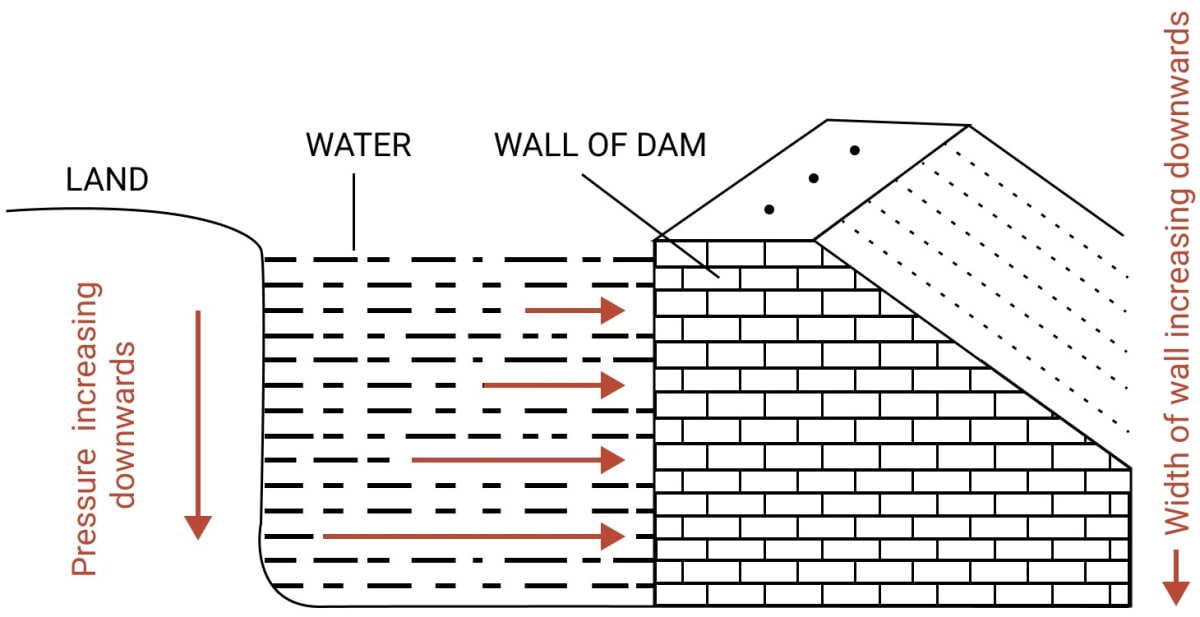
A dam has broader walls at the bottom than at the top as the pressure exerted by the liquid increases with it's depth. Thus, as depth increases, more and more pressure is exerted by water on the walls of the dam.
A thicker wall is required to withstand a greater pressure, therefore, the wall of a dam is made with thickness increasing towards the base.
In the figure given below, the increasing length of arrows in water represents the increasing pressure on the wall of the dam towards the bottom.
Why do sea divers need special protective suit ?
Answer
Sea divers need special protective suit to wear because in deep sea, the total pressure exerted on the diver's body is much more than his blood pressure. To withstand it, they need to wear a special protective suit, made from glass reinforced plastic or cast aluminium. The pressure inside the suit is maintained at one atmosphere.
State the laws of liquid pressure.
Answer
The laws of liquid pressure are —
Inside the liquid, pressure increases with the increase in depth from it's free surface.
In a stationary liquid, pressure is same at all points on a horizontal plane.
Pressure is same in all directions about a point inside the liquid.
Pressure at same depth is different in different liquids. It increases with the increase in density of liquid.
A liquid seeks it's own level.
A tall vertical cylinder filled with water is kept on a horizontal table top. Two small holes A and B are made on the wall of the cylinder, A near the middle and B just below the free surface of water. State and explain your observation.
Answer
We observe that the throw of the liquid from hole A is more than the B i.e., the liquid reaches to a greater distance on the horizontal surface from hole A than hole B. This shows that liquid pressure at a point increases with the increase of depth from it's free surface.
Name and state the principle on which a hydraulic press works. Write one use of the hydraulic press.
Answer
A hydraulic press works on the principle of Pascal's law.
Principle — When a force F1 is applied on the piston A, it exerts a pressure on liquid contained in the cylinder P. According to Pascal's law, this pressure is transmitted through liquid in tube R to the piston B of the other cylinder Q due to which the piston B tends to move upwards.
Since, the area of cross section of cylinder P is less than that of the cylinder Q, therefore by applying a small force on the piston A, we can lift a large weight kept on the piston B.
When no weight is placed on the piston B, it rises up against a fixed roof with a force F2 (F2 > F1). If a bale of cotton is kept on the press plunger B, it gets compressed.
Use of hydraulic press — It is used for pressing cotton bales and goods such as books, quilts etc.
Describe a simple experiment to demonstrate that a liquid enclosed in a vessel exerts pressure in all directions.
Answer
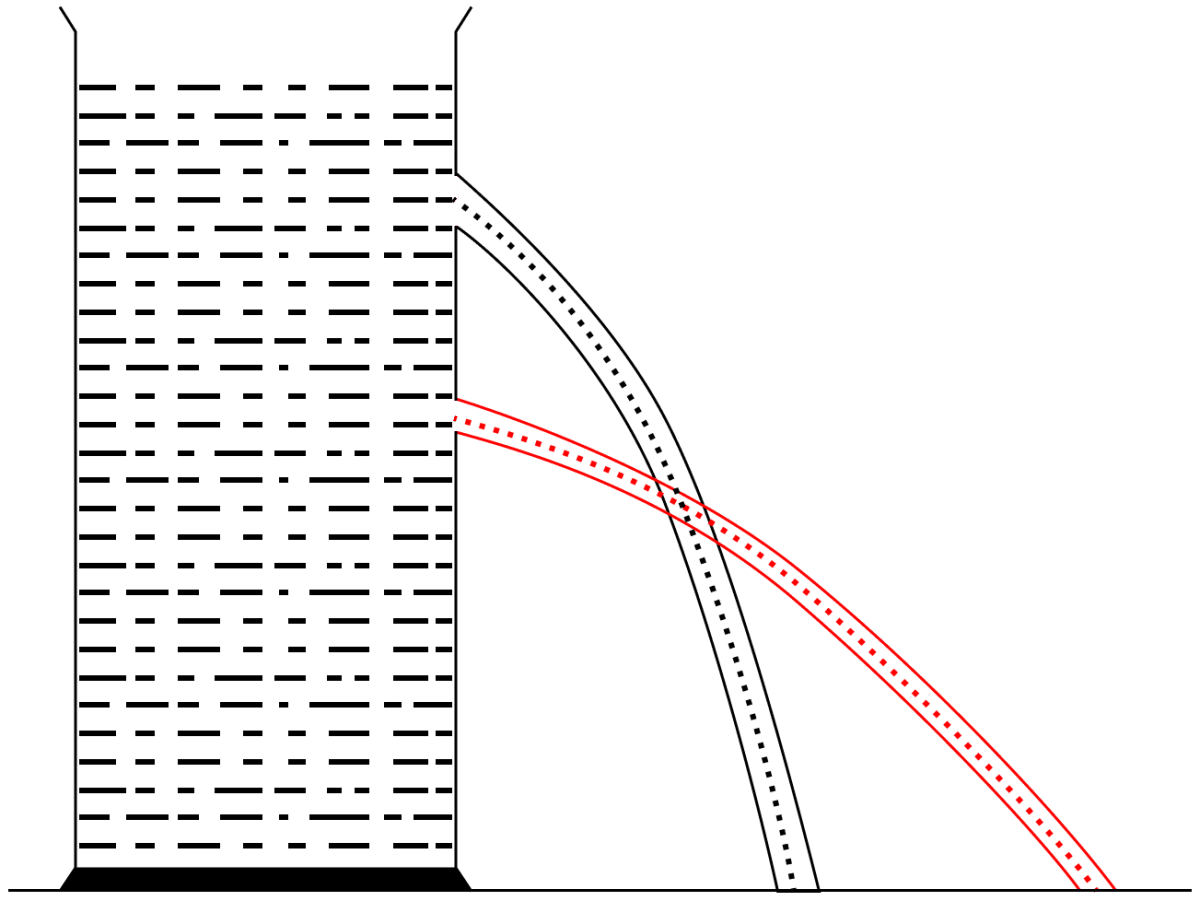
Take a vessel filled with a liquid (say, water). Place it on a horizontal surface. Make several small holes in the wall of the vessel anywhere below the free surface of liquid. It is observed that liquid spurts out through each hole. This shows that the liquid exerts pressure at each point on the wall of the vessel.
Deduce an expression for the pressure at a depth inside a liquid.
Answer
Consider a vessel containing a liquid with density ρ. Let the liquid be stationary. In order to calculate pressure at a depth h, consider a horizontal circular surface PQ with area A at depth h below the free surface XY of the liquid as shown below.
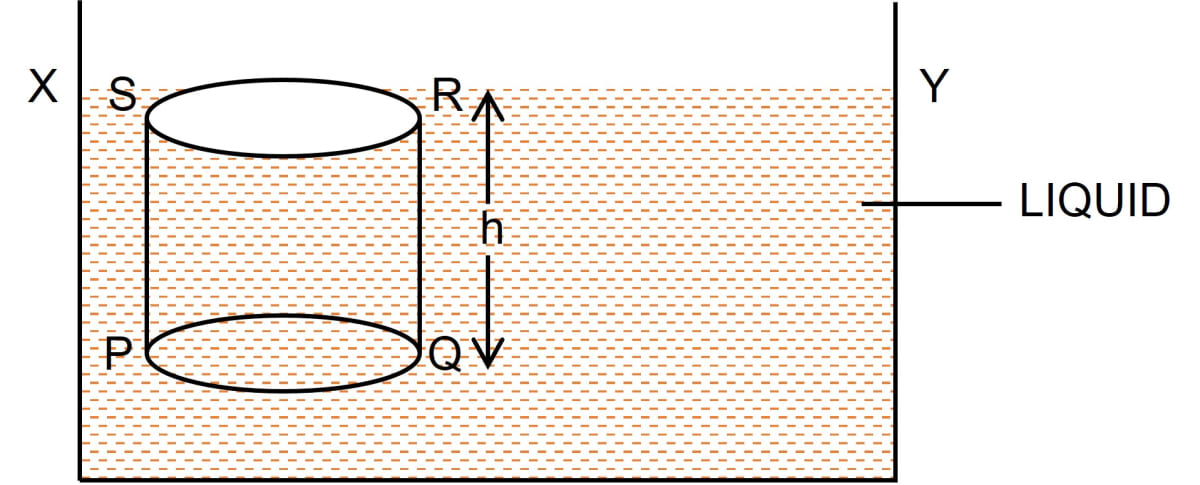
The pressure on surface PQ will be due to the weight of the liquid column above the surface PQ, (i.e., the liquid contained in cylinder PQRS of height h with PQ as it's base and top face RS lying on the free surface XY of the liquid).
Thrust exerted on the surface PQ
= Weight of the liquid column PQRS
= Volume of liquid column PQRS x density x g
= (Area of base PQ x height) x density x g
= (A x h) ρ x g = A h ρ g
This thrust is exerted on the surface PQ of area A. Therefore, pressure
P = =
Hence, Pressure = depth x density of liquid x acceleration due to gravity = hρg
Explain the principle of a hydraulic machine. Name two devices which work on this principle.
Answer
The principle of hydraulic machine is that a small force applied on a smaller piston is transmitted to produce a large force on the bigger piston.
Two devices that work on this principle are —
- Hydraulic brakes
- Hydraulic jack
The diagram in figure below shows a device which makes use of the principle of transmission of pressure.
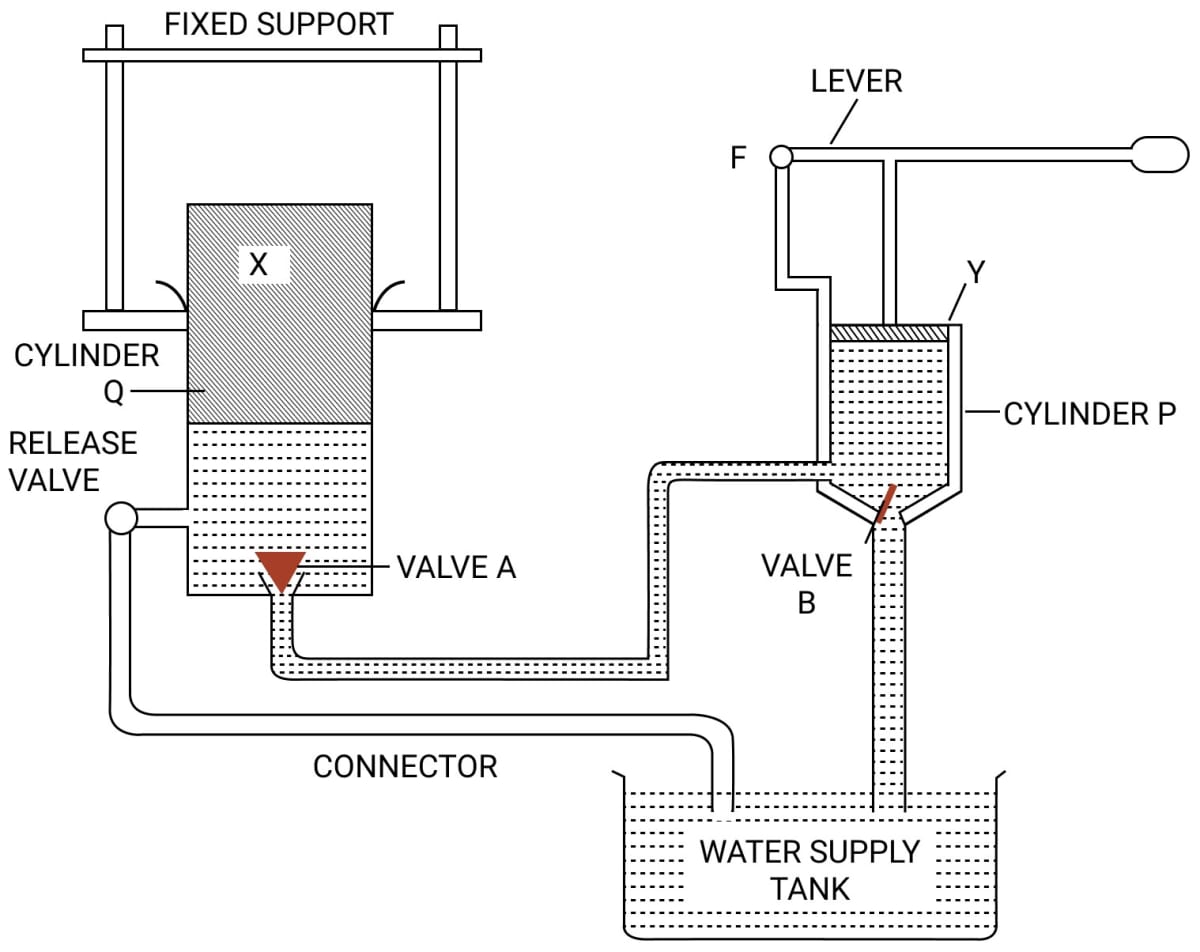
(a) Name the parts labelled by the letters X and Y.
(b) Describe what happens to the valves A and B and to the quantity of water in the two cylinders when the lever arm is moved down.
(c) State one use of the above device.
Answer
(a) The parts are —
X → Press plunger
Y → Pump plunger
(b) When the lever arm is moved down, the valve B closes and the valve A opens, so water from cylinder P is forced into the cylinder Q.
(c) A hydraulic press is used for pressing cotton bales and goods like quilts, books, etc.
Draw a simple diagram of a hydraulic jack and explain its principle.
Answer
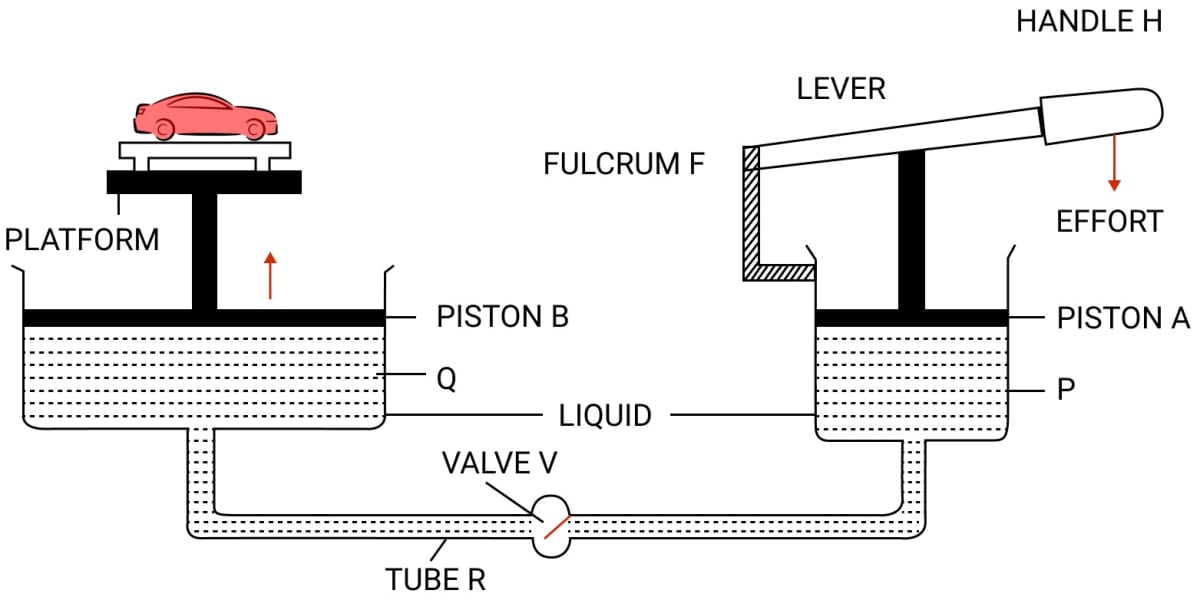
When handle H of lever is pressed down by applying an effort, the valve V opens because of increase in pressure in the cylinder P. The liquid runs out from the cylinder P to the cylinder Q.
As a result, the piston B rises up and it raises the car placed on the platform. When the car reaches the desired height, the handle H of lever is no longer pressed.
The valve V gets closed (since the pressure on either side of the valve becomes same) so that the liquid may not run back from the cylinder Q to the cylinder P.
Explain the principle of a hydraulic brake with a simple labelled diagram.
Answer
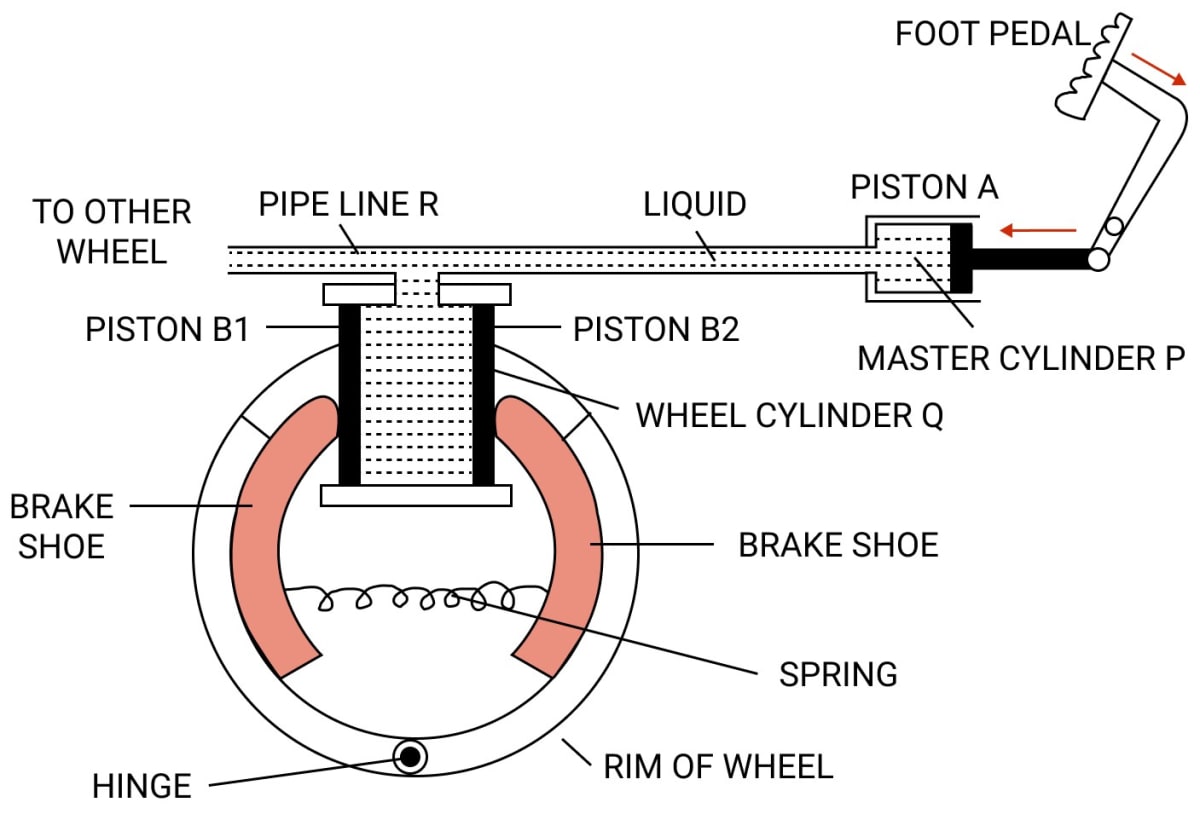
To apply brakes, the foot pedal is pressed due to which pressure is exerted on the liquid in the master cylinder P, so liquid runs out from the master cylinder P to the wheel cylinder Q.
As a result, the pressure is equally transmitted and undiminished through the liquid to the pistons B1 and B2 of the wheel cylinder Q. Therefore, the pistons B1 and B2 gets pushed outwards and brake shoes gets pressed against the rim of the wheel due to which the motion of the wheel retards.
Since, the area of cross section of piston A in the master cylinder P is less than that in the wheel cylinder Q, a small force applied at the foot pedal produces a large force on the pistons B1 and B2 of the wheel cylinder Q.
This is the force responsible for retarding the vehicle. It should be noted that due to transmission of pressure through liquid, equal pressure is exerted on all wheels of the vehicle connected to the pipe line R.
On releasing the pressure on the pedal, the spring pulls the brake shoes to it's original position and forces the piston's B1 and B2 to return back into the wheel cylinder Q. As a result the liquid runs back from the wheel cylinder Q to the master cylinder P and thus the brakes gets released.
A hammer exerts a force of 1.5 N on each of the two nails A and B. The area of cross section of tip of nail A is 2 mm2 while that of nail B is 6 mm2. Calculate pressure on each nail in pascal.
Answer
As we know,
Pressure (P) =
Given,
- F = 1.5 N
- A = 2 mm2
Converting 2 mm2 in metre2
As 1 mm = m
So, 1 mm2 = (1) mm x (1) mm
=
= 1 x 10 -6 m2
Hence,
2 mm2 = 2 x 10⁻⁶ m2
AA = 2 x 10 -6 m2
AB = 6 x 10 -6 m2
Substituting the values in the formula above, we get,
Pressure on A
Hence, pressure on A = 7.5 x 10⁵ Pa
Pressure on B
Hence, pressure on B = 2.5 x 10⁵ Pa
A block of iron of mass 7.5 kg and of dimensions 12 cm x 8 cm x 10 cm is kept on a table top on it's base of side 12 cm x 8 cm. Calculate : (a) thrust and (b) pressure exerted on the table top. Take 1 kgf = 10 N.
Answer
As we know,
(a) Force (F) = mass (m) x acceleration due to gravity (g)
Given,
- m = 7.5 kg
- 1 kgf = 10 N
Substituting the values in the formula above we get,
Hence, F = 75 N
(b) As we know,
Pressure (P) =
Given,
- Area of the base = 12 x 8 = 96 cm2
Converting cm2 into m2
100 cm = 1 m
So, 100 cm x 100 cm = 1 m2
Hence, 96 cm2 =
Therefore, A = 0.0096 m 2
Substituting the values in the formula above, we get,
Hence, pressure = 7812.5 Pa
A vessel contains water up to a height of 1.5 m. Taking the density of water 103 kg m-3, acceleration due to gravity 9.8 m s-2 and area of base vessel 100 cm2, calculate : (a) the pressure and (b) the thrust, at the base of vessel.
Answer
(a) As we know,
Pressure due to water column of height h = h ρ g
Given,
- h = 1.5 m
- ρ = 1000 kg m-3
- g = 9.8 m s2
Substituting the values in the formula above, we get,
Hence, pressure = 1.47 x 10⁴ N m-2
(b) As we know,
Pressure (P) =
Given,
- A = 100 cm2
Converting cm2 into m2
100 cm = 1 m
And, 100 cm x 100 cm = 1 m2
Therefore, 100 cm2 = m2
Hence, A = 10-2 m2
Substituting the values in the formula above, we get,
Hence, thrust = 147 N
The area of base of a cylindrical vessel is 300 cm2. Water (density = 1000 kg m-3) is poured into it up to a depth of 6 cm. Calculate : (a) the pressure and (b) the thrust of water on the base. (g = 10 m s-2).
Answer
(a) As we know,
Pressure due to water column of height h = hρg
Given,
- ρ = 1000 kg m-3
- g = 10 m s-2
- h = 6 cm
Converting cm to m
100 cm = 1 m
So, 6 cm = x 6 = 0.06 m
Hence, h = 0.06 m
Substituting the values in the formula above we get,
P = 0.06 x 1000 x 10
⇒ P = 600 Pa
Hence, pressure = 600 Pa
(b) As we know,
Pressure (P) =
Given,
- A = 300 cm2
Converting cm2 into m2
100 cm = 1 m
And, 100 cm x 100 cm = 1 m2
Therefore, 300 cm2 = m2
Hence, A = 3 x 10⁻² m2
Substituting the values in the formula we get,
Hence, thrust = 18 N
(a) Calculate the height of a water column which will exert on it's base the same pressure as the 70 cm column of mercury. Density of mercury is 13.6 g cm-3.
(b) Will the height of the water column in part (a) change if the cross section of the water column is made wider ?
Answer
(a) As we know,
Pressure due to water column of height h = hρg
and
Pascal's law, states that the pressure exerted anywhere in a confined liquid is transmitted equally and undiminished in all directions throughout the liquid.
Thus,
Pressure due to water column = Pressure due to mercury column
Hence,
hw ρw g = hm ρm g
Given,
- hm = 70 cm
- ρm = 13.6 g cm-3
- ρw = 1 g cm-3
From the above formula, we get,
hw =
Substituting the values, we get,
hw = x 70
⇒ hw = 952 cm
⇒ hw = 9.52 m
Hence, height of a water column = 9.52 m
(b) No, if the cross section of the water column is made wider, the height of the water column will be unaffected.
The pressure of water on the ground floor is 40,000 Pa and on the first floor is 10,000 Pa. Find the height of the first floor.
(Take : density of water = 1000 kg m-3, g = 10 m s-2)
Answer
As we know,
Pressure due to water column of height h = hρg
Given,
- Density of water (ρ) = 1000 kg m-3
- Acceleration due to gravity (g) = 10 m s-2
- Pressure on ground floor (Pg) = 40,000 Pa
- Pressure on first floor (Pf) = 10,000 Pa
In order to know the height of the first floor, let us calculate the difference in pressure
P = Pg - Pf
= 40,000 – 10,000
= 30,000 Pa
Substituting the values in the formula,
P = h ρ g
⇒ 30,000 = 1000 x 10 x h
⇒ h = 3 m
Hence, the height of the first floor is 3 m.
A simple U tube contains mercury to the same level in both of it's arms. If water is poured to a height of 13.6 cm in one arm, how much will be the rise in mercury level in the other arm ?
Given: density of mercury = 13.6 x 10³ kg m-3 and density of water = 103 kg m-3
Answer
Given,
- Density of mercury (ρm) = 13.6 x 10³ kg m-3
- Density of water (ρw) = 103 kg m-3
- Height to which water is poured in one arm (hw) = 13.6 cm
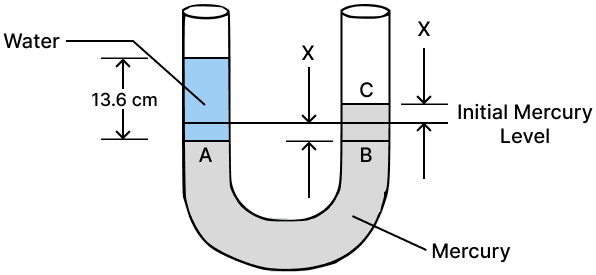
By pouring 13.6 cm of water, the mercury level in the left arm goes down to point A by x cm, while in the right arm, it rises to point C by x cm. Therefore, BC = hm = 2x cm
By Pascal's law,
Pressure in the water column = pressure in the mercury column
Therefore, PA = PB
⇒ hw ρw g = hm ρm g
⇒ 13.6 x 10³ x g = 2𝑥 x 13.6 x 103 x g
⇒ 1 = 2𝑥
⇒ 𝑥 = = 0.5 cm
Hence, the rise in mercury level = 0.5 cm
In a hydraulic machine, a force of 2 N is applied on the piston of area of cross section 10 cm2. What force is obtained on it's piston of area of cross section 100 cm2?
Answer
As we know,
Pressure (P) =
Given,
- A = 10 cm2
Converting cm2 into m2
100 cm = 1 m
And, 100 cm x 100 cm = 1 m2
Therefore, 10 cm2 =
Hence, A = 10-3 m2
F = 2 N at area of cross section 10 cm2
Substituting the values in the formula we get,
P = [Equation 1]
Now when, A = 100 cm2
Converting cm2 into m2
A = 100 cm 2 = = 10-2 m 2
Substituting the value in the formula above we get,
Therefore, P = [Equation 2]
Equating 1 and 2 we get,
Hence, force at 100 cm2 is 20 N.
What should be the ratio of area of cross section of the master cylinder and wheel cylinder of a hydraulic brake so that a force of 15 N can be obtained at each of it's brake shoe by exerting a force of 0.5 N on the pedal ?
Answer
As we know,
Pressure (P) =
Let,
- Area of cross section of the master cylinder = A1
- Area of cross section of the wheel cylinder = A2
- Force applied on pedal = F1 = 0.5 N
- Force applied on brake shoe = F2 = 15 N
By the principle of hydraulic brakes which works on Pascal's law
Pressure on narrow piston = Pressure on broader piston
Thus,
Hence, the ratio of area of cross section = 1 : 30
The areas of pistons in a hydraulic machine are 5 cm2 and 625 cm2. What force on the smaller piston will support a load of 1250 N on the larger piston? State any assumption which you make in your calculation.
Answer
As we know,
Pressure (P) =
and by the principle of hydraulic machine
Pressure on narrow piston = Pressure on broader piston
So,
Given,
- Area of narrow piston (A1) = 5 cm2
- Area of wider piston (A2) = 625 cm2
- Force (F2) = 1250 N
Substituting the values in the formula above we get,
Hence, force acting on the smaller piston = 10 N
Assumption — There is no friction and no leakage of liquid.
(a) The diameter of neck and bottom of a bottle are 2 cm and 10 cm respectively. The bottle is completely filled with oil. If the cork in the neck is pressed in with a force of 1.2 kgf, what force is exerted on the bottom of the bottle ?
(b) Name the law/principle you have used to find the force in part (a)
Answer
(a) As we know,
Pressure (P) =
and by the principle of hydraulic machine
Pressure on neck = pressure on bottom of bottle
So,
Given,
- Diameter of neck (d1) = 2 cm
- Diameter of bottom of bottle (d2) = 10 cm
- Force applied on the cork in the neck (F1) = 1.2 kgf
Then,
A1 = 𝜋 = 𝜋
And
A2 = 𝜋 = 25 𝜋
Substituting the values in the formula above we get,
Hence, force exerted at the bottom of the neck = 30 kgf.
(b) The Pascal's law is applied to solve the part (a) which states that the pressure exerted anywhere in a confined liquid is transmitted equally and undiminished in all directions throughout the liquid.
Hence,
A force of 50 kgf is applied to the smaller piston of a hydraulic machine. Neglecting friction, find the force exerted on the large piston, if the diameters of the pistons are 5 cm and 25 cm respectively.
Answer
As we know, by the principle of hydraulic machine
Pressure on the smaller piston = Pressure on the larger piston
So,
Given,
- Diameter of the smaller piston (d1) = 5 cm
- Diameter of the larger piston (d2) = 25 cm
- Force applied on the smaller piston (F1) = 50 kgf
Then,
A1 = 𝜋 = 6.25𝜋
And
A2 = 𝜋 = 156.25𝜋
Substituting the values in the formula above we get,
Hence, force exerted on the larger piston is 1250 kgf.
Two cylindrical vessels fitted with pistons A and B of area of cross section 8 cm2 and 320 cm2 respectively, are joined at their bottom by a tube and they are completely filled with water. When a mass of 4 kg is placed on piston A, find : (i) the pressure on piston A, (ii) the pressure on piston B, and (iii) the thrust on piston B.
Answer
(i) As we know,
Pressure (P) =
Given,
- Force on the narrow piston A = 4 kg
- Area of cross section on piston A (AA) = 8 cm2
- Area of cross section on piston B (AB) = 320 cm2
Substituting the values in the formula above, we get,
Hence, PA = 0.5 kg cm-2
(ii) As we know, by the principle of hydraulic machine
Pressure on piston A = Pressure on piston B
Hence, PB = 0.5 kg cm-2
(iii) Thrust on piston B is acting in the upward direction, which is given by
Pressure (P) =
Substituting the values, we get,
Hence, thrust on piston B = 160 kgf
What force is applied on a piston of area of cross section 2 cm2 to obtain a force 150 N on the piston of area of cross section 12 cm2 in a hydraulic machine ?
Answer
As we know, by the principle of hydraulic machine
Pressure on piston A = Pressure on piston B
Hence,
Given,
- A1 = 2 cm2
- A2 = 12 cm2
- F2 = 150 N
Converting cm2 into m2
100 cm = 1 m
And, 100 cm x 100 cm = 1 m2
Therefore, 1 cm2 = m2
Hence,
- A1 = 2 x 10⁻⁴ m2
- A2 = 12 x 10-4 m2
Substituting the values in the formula above we get,
Hence, force applied = 25 N
Assertion (A) : A brick exerts maximum pressure on ground when it is placed with its longest side vertical.
Reason (R) : Larger the area on which a given thrust acts, lesser is the pressure exerted by it.
- Both A and R are true and R is the correct explanation of A
- Both A and R are true and R is not the correct explanation of A
- Assertion is false but reason is true
- Assertion is true but reason is false
Answer
Both A and R are true and R is the correct explanation of A
Explanation
Assertion (A) is true because when the brick is placed with its longest side vertical, the contact area with the ground is minimum, and for a given weight (thrust), smaller area means higher pressure as
Reason (R) is true because this is a direct consequence of the formula above — pressure is inversely proportional to area for a constant force, since the Reason clearly explains why the pressure is maximum when area is minimum (i.e., brick standing vertically), it is the correct explanation.
Assertion (A) : The walls of a dam are made thicker at the bottom.
Reason (R) : Pressure is the same in all directions about a point inside the liquid.
- Both A and R are true and R is the correct explanation of A
- Both A and R are true and R is not the correct explanation of A
- Assertion is false but reason is true
- Assertion is true but reason is false
Answer
Both A and R are true and R is not the correct explanation of A
Explanation
Assertion (A) is true because the pressure in a liquid increases with depth and is given by
So, the bottom of the dam experiences the highest pressure, and therefore the walls must be made thicker to withstand this pressure.
Reason (R) is true because this is the statement of Pascal's law which states that at a given point in a liquid at rest, pressure is exerted equally and undiminished in all directions.
But R is not the correct explanation for A because the dam walls are thicker at the bottom due to increase in pressure with depth, not because pressure is the same in all directions.
Assertion (A) : A hydraulic jack is used for squeezing oil out of linseed and cotton seeds.
Reason (R) : It works on the Pascal's principle.
- Both A and R are true and R is the correct explanation of A
- Both A and R are true and R is not the correct explanation of A
- Assertion is false but reason is true
- Assertion is true but reason is false
Answer
Both A and R are true and R is the correct explanation of A
Explanation
Assertion (A) is true because hydraulic jacks are commonly used in oil extraction processes to apply large pressure over a small area to squeeze oil from seeds.
Reason (R) is true because Pascal's principle states that :
“When pressure is applied to a confined fluid, it is transmitted equally in all directions throughout the fluid.”
This principle allows a small force applied on a small piston to produce a large force on a larger piston, making the jack effective for pressing operations like oil extraction, since the hydraulic jack works because of Pascal’s principle, the Reason correctly explains the Assertion.
A hydraulic jack is used in a car workshop to lift a car. The jack consists of two connected pistons A(area = 5 cm2) and B(area = 250 cm2), filled completely with an incompressible hydraulic fluid (such as hydraulic oil). The fluid transmits pressure uniformly throughout the system. A force of 120 N is applied vertically downward on piston A.
Assuming the system to be ideal, answer the following questions:
(a) Calculate the pressure produced in the liquid by piston A.
(b) Determine the force exerted on piston B. Name the law used.
(c) Does this hydraulic jack provide a gain in force or a gain in distance? Justify your answer.
(d) If piston B rises by a height of 2 cm, calculate the distance moved by piston A.
(e) What would happen if a small air bubble enters the liquid of the hydraulic jack?
Answer
Given,
- Area of piston A () = 5 cm2
- Area of piston B () = 250 cm2
- Force applied on piston A () = 120 N
(a) Converting cm2 into m2
100 cm = 1 m
And, 100 cm x 100 cm = 1 m2
Therefore, 1 cm2 = m2
Hence,
- Area of piston A = 5 x 10⁻⁴ m2
- Area of piston B = 250 x 10-4 m2
As pressure on a surface is given by,
Then,
Hence, the pressure produced in the fluid by piston A is 2.4 x 10⁵ Pa.
(b) As Pascal's law states that the pressure exerted anywhere in a confined liquid is transmitted equally and undiminished in all directions throughout the liquid.
Thus,
Pressure on piston A = Pressure on piston B
Now,
Hence, the force exerted on piston B is 6000 N and the law is Pascal's law.
(c) The hydraulic jack provides gain in force. This is because a small force of 120 N applied on the smaller piston produces a much larger force of 6000 N on the larger piston. Since the output force is greater than the input force, the machine acts as a force multiplier. It does not give a gain in distance.
(d) Given,
- Distance moved by piston B = 2 cm
- Area of piston A = 5 cm2
- Area of piston B = 250 cm2
From conservation of volume.
Volume of fluid displaced in piston A = Volume of fluid displaced in piston B
⇒ Area of piston A × Distance moved by piston A = Area of piston B × Distance moved by piston B
⇒ Distance moved by piston A =
Hence, the distance moved by piston A is 100 cm.
(e) If a small air bubble enters the liquid, the hydraulic jack will not work efficiently.
This is because air is compressible, whereas hydraulic fluid is incompressible. When force is applied, some part of it will be used to compress the air bubble instead of being fully transmitted through the liquid.
As a result, the pressure transmitted to piston B will decrease, and the jack may lift the car less effectively or work sluggishly.