
Define or state Boyle's Law
Answer
Temperature remaining constant, the volume of a given mass of dry gas is inversely proportional to it's pressure.
V ∝ [T = constant]
Express Kelvin Zero in °C
Answer
Kelvin zero or absolute zero = -273°C.
A fixed volume of a gas occupies 760 cm3 at 27°C and 70 cm of Hg. What will be it's vol. at s.t.p.
Answer
| Initial Conditions | S.T.P. |
|---|---|
| P1 = 70 cm of Hg | P2 = 76 cm of Hg |
| T1 = 27 + 273 = 300 K | T2 = 273 K |
| V1 = 760 cm3 | V2 = ? |
Using gas laws:
=
Substituting the values:
=
Therefore:
Therefore, the volume occupied by the gas is 637 cm3.
At 0°C and 760 mm Hg pressure, a gas occupies a volume of 100 cm3. The Kelvin temperature (Absolute temperature) of the gas is increased by one-fifth while the pressure is increased one and a half times. Calculate the final volume of the gas.
Answer
Initial conditions [S.T.P.]:
P1 = Initial pressure of the gas = 760 mm Hg
V1 = Initial volume of the gas = 100 cm3
T1 = Initial temperature of the gas = 0°C = 273 K
Final conditions:
P2 (Final pressure) = increased one and a half times of P1
= (1 + ) of 760
= x 760
= 3 x 380
= 1140
V2 (Final volume) = ?
T2 (Final temperature) = increased by one-fifth of 273 K = 1 + of 273
= x 273 =
By Gas Law:
Substituting the values:
Therefore, final volume of the gas = 80 cc
The pressure on one mole of gas at s.t.p. is doubled and the temperature is raised to 546 K. What is the final volume of the gas ? [one mole of a gas occupies a volume of 22.4 litres at stp.]
Answer
Initial conditions [S.T.P.]:
P1 = Initial pressure of the gas = 1 atm
V1 = Initial volume of the gas = 22.4 litres
T1 = Initial temperature of the gas = 273 K
Final conditions:
P2 (Final pressure) = 2 atm
V2 (Final volume) = ?
T2 (Final temperature) = 546 K
By Gas Law:
Substituting the values:
Therefore, final volume of the gas = 22.4 litre
Give a reason — "When stating the volume of a gas the pressure and temperature should also be given".
Answer
The change in any one of the parameters [pressure, volume, temperature] affects the other two parameters. Therefore, when stating the volume of a gas the pressure and temperature should also be given.
Is it possible to change the temperature and pressure of a fixed mass of gas without changing its volume. Explain your answer.
Answer
Yes, it is possible to change the temperature and pressure of a fixed mass of gas without changing its volume. If the gas is kept in a rigid container, its volume remains constant. According to the gas equation:
Since volume is constant,
Hence, pressure and temperature can change proportionately while the volume remains unchanged.
What volume will a gas occupy at 740 mm pressure which at 1480 mm occupies 500 cc? [Temperature being constant]
Answer
V1 = Initial volume of the gas = 500 cc
P1 = Initial pressure of the gas = 1480 mm
P2 = Final pressure of the gas = 740 mm
V2 = Final volume of the gas = ?
By Boyle's Law:
Substituting the values:
Therefore, final volume of the gas = 1000 cc
The volume of a given mass of a gas at 27°C is 100 cc. To what temperature should it be heated at the same pressure so that it will occupy a volume of 150 cc?
Answer
V1 = Initial volume of the gas = 100 cc
T1 = Initial temperature of the gas = 27°C = 27 + 273 = 300 K
V2 = Final volume of the gas = 150 cc
T2 = Final temperature of the gas = ?
By Charles's Law:
Substituting the values:
T2 in °C = 450 - 273 = 177°C
Therefore, final temperature of the gas = 177°C
A fixed mass of a gas has a volume of 750 cc at -23°C and 800 mm pressure. Calculate the pressure for which it's volume will be 720 cc. The temperature being -3°C.
Answer
| Initial Conditions | Final Conditions |
|---|---|
| V1 = Initial volume of the gas = 750 cc | V2 = Final volume of the gas = 720 cc |
| T1 = Initial temperature of the gas = -23°C = -23 + 273 = 250 K | T2 = Final temperature of the gas = -3°C = -3 + 273 = 270 K |
| P1 = Initial pressure of the gas = 800 mm | P2 = Final pressure of the gas = ? |
By Gas Law:
Substituting the values:
Therefore, final pressure of the gas = 900 mm
What temperature would be necessary to double the volume of a gas initially at s.t.p. if the pressure is decreased by 50% ?
Answer
| Initial conditions [S.T.P.] | Final conditions |
|---|---|
| P1 = Initial pressure of the gas = 1 atm | P2 = Final pressure of the gas = 0.5 atm |
| V1 = Initial volume of the gas = V | V2 = Final volume of the gas = 2V |
| T1 = Initial temperature of the gas = 273 K | T2 = Final temperature of the gas = ? |
By Gas Law:
Substituting the values:
Therefore, final temperature of the gas = 273 K = 0 °C
A gas cylinder having a capacity of 20 litres contains a gas at 100 atmos. How many flasks of 200 cm3 capacity can be filled from it at 1 atmos. pressure if the temperature remains constant ?
Answer
V1 = 20 lits.
1 lit. = 1000 cc Therefore, 20 lit = 20,000 cc
P1 (Initial pressure) = 100 atmos.
P2 (Final pressure) = 1 atmos.
V2 = ?
By Boyle's Law:
Substituting the values:
200 cc = capacity of 1 flask
Therefore, number of flasks required for 20,00,000 cc of gas
Therefore, number of flasks that can be filled = 10,000
A certain mass of gas occupied 850 ml at a pressure of 760 mm of Hg. On increasing the pressure it was found that the volume of the gas was 75% of it's initial value. Assuming constant temperature, find the final pressure of the gas?
Answer
V1 = Initial volume of the gas = 850 ml
P1 = Initial pressure of the gas = 760 mm of Hg
V2 (Final volume) = 75% of initial 850 ml = of 850 ml = ml
P2 = Final pressure of the gas =?
By Boyle's Law:
Substituting the values:
Therefore, final pressure of the gas = 1013.33 mm of Hg.
It is required to reduce the volume of a gas by 20% by compressing it at a constant pressure. To do so, the gas has to be cooled. If the gas attains a final temperature of 157°C, find the initial temperature of the gas?
Answer
Initial conditions:
V1 = Initial volume of the gas = V
T1 = Initial temperature of the gas = ?
Final conditions
V2 (Final volume) = reduce by 20%
= V - of V
=
=
T2 = Final temperature of the gas = 157°C = 157 + 273 = 430 K
By Charles Law:
Substituting the values:
Therefore, initial temperature of the gas = 537.5 K - 273 K = 264.5°C
At a given temperature the pressure of a gas reduces to 75% of its initial value and the volume increases by 40% of its initial value. Find this temperature if the initial temperature was -10°C.
Answer
Initial conditions:
P1 = Initial pressure of the gas = P
V1 = Initial volume of the gas = V
T1 = Initial temperature of the gas = -10°C = 273-10 = 263 K
Final conditions:
P2 = Final pressure of the gas = reduces to 75% of P = of P =
V2 = Final volume of the gas = increases by 40% of it's initial value
T2 = Final temperature of the gas = ?
By Gas Law:
Substituting the values:
Therefore, final temperature of the gas = 276.15 K - 273 K = 3.15 °C
State which of the following, represents the correct graphical relationship between the volume of a given mass of dry gas to its absolute temperature at constant pressure.
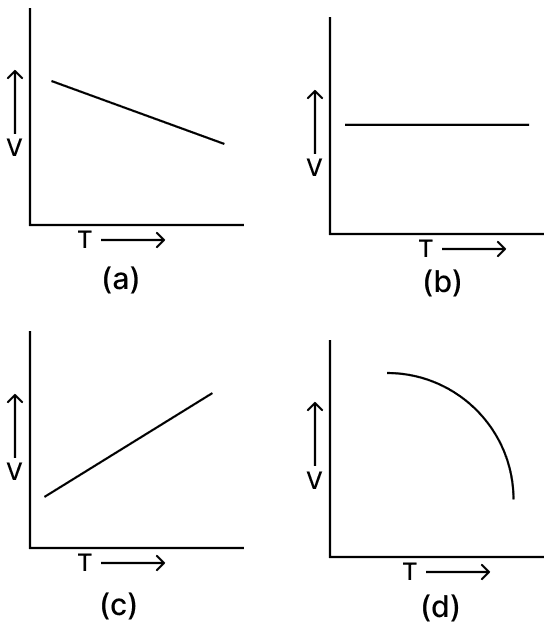
Answer
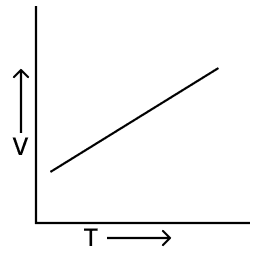
Reason — According to Charles’ Law:
Volume ∝ Temperature.
At constant pressure, the volume of a fixed mass of dry gas is directly proportional to its absolute temperature. So, the graph between volume (V) and absolute temperature (T in Kelvin) is a straight line passing upward, showing direct proportionality.
Match column A with the relevant match in column B.
| Column A | Column B |
|---|---|
| (a) 273 K | (i) Gas equation |
| (b) V = K × | (ii) 27°C |
| (c) 300 K | (iii) 1 atmos. pressure |
| (d) V = K [K constant] | (iv) Boyle's Law |
Answer
The matched columns are shown below:
| Column A | Column B |
|---|---|
| (a) 273K | (iii) 1 atmos. pressure |
| (b) V = K × | (i) Gas equation |
| (c) 300K | (ii) 27°C |
| (d) V = K [K constant] | (iv) Boyles law |
Assertion: Gas laws are rules followed by a gas, on subjecting the gas to a change in temperature, pressure or volume.
Reason: Volume of gases are converted to s.t.p. conditions & then compared easily.
- Both A and R are true and R is the correct explanation of A.
- Both A and R are true but R is not the correct explanation of A.
- A is true and R is false.
- A is false and R is true.
Answer
Both A and R are true but R is not the correct explanation of A.
Reason — The Assertion is true because gas laws describe the behaviour of a fixed mass of gas when any of the three variables — temperature, pressure, or volume — is changed.
The Reason is also true because the volume of a gas depends on temperature and pressure. Therefore, gas volumes are usually converted to s.t.p. conditions before comparison.
However, the Reason does not explain why gas laws are followed by gases. It only states one practical use of gas laws, i.e., comparison of gas volumes under standard conditions.
Therefore, Both A and R are true but R is not the correct explanation of A is the correct option.
Two gases 'A' & 'B' are compared at 273 K & 1 atmos. pressure to determine which has a greater volume. The volume of gas 'A' is 1.20 litre at 27°C & 750 mm Hg & of gas 'B' 1.25 litre at 0°C & 760 mm. Hg. State which gas 'A' or 'B' has a greater volume.
Answer
For Gas A:
VA1 = 1.20 L
TA1 = 27°C = 300 K
PA1 = 750 mm
TA2 = 273 K
PA2 = 760 mm
VA2 =
VA2 =
VA2 = 1.08 L
For Gas B:
VB1 = 1.25 L
TB1 = 0°C = 273 K
PB1 = 760 mm
TB2 = 273 K
PB2 = 760 mm
VB2 =
VB2 =
VB2 = 1.25 L
Therefore, at 273 K and 760 mm Hg, the volume of gas A is 1.08 L and the volume of gas B is 1.25 L. Hence, gas B has the greater volume.
Name or state the following:
- The law which states that pressure remaining constant the volume of a given mass of dry gas is directly proportional to it's absolute [Kelvin] temperature.
- The law which studies the relationship between pressure of a gas and the volume occupied by it at constant temperature.
- An equation used in chemical calculations which gives a simultaneous effect of changes of temperature and pressure on the volume of a given mass of dry gas.
- The standard pressure of a gas in cm. of mercury corresponding to one atmospheric pressure.
- The absolute temperature value corresponding to 35°C.
Answer
- Charles' Law.
- Boyle's Law.
- Gas equation.
- 76 cm.
- 35 + 273 = 308K
Give reasons for the following:
Gases unlike solids and liquids exert pressure in all directions.
Answer
The force of attraction between the molecules is negligible in case of gases. The molecules of a gas move in straight lines, undergo random collisions with other molecules and occupy the complete space available unlike solids and liquids. The impact of gas molecules with high velocity causes pressure to be exerted in all directions.
Give reasons for the following:
Gases have lower densities compared to solids or liquids.
Answer
The inter-molecular distance between the molecules of gases is very large. Hence, the number of molecules per unit volume of a gas is much lower compared to solids and liquids. Gases therefore, have low densities.
Give reasons for the following:
Temperature remaining constant the product of the volume & the pressure, of a given mass of dry gas is a constant.
Answer
Let a particular mass of a gas occupy
Volume = V; Pressure = P; At constant temperature = T
According to Boyle's Law:
Hence, temperature remaining constant, the product of the volume & the pressure, of a given mass of dry gas is a constant.
Give reasons for the following:
All temperatures on the Kelvin scale are in positive figures.
Answer
The lowest temperature on Kelvin scale is 0 K = -273°C. Practically, it is impossible for any gas to go below this temperature, as they solidify or liquify before reaching this temperature. Hence, all temperatures on the Kelvin scale are in positive figures.
Give reasons for the following:
Volumes of gases are converted into s.t.p. conditions and then compared.
Answer
Volumes of gases change with temperature and pressure – hence a standard value of temperature and pressure is chosen to which gas volumes are referred. Hence, volumes of gases are converted into s.t.p. conditions and then compared.
Calculate the temperature to which a gas must be heated, so that the volume triples without any change in pressure. The gas is originally at 57°C and having a volume 150 cc.
Answer
V1 = Initial volume of the gas = 150 cc
T1 = Initial temperature of the gas = 57°C = 57 + 273 = 330 K
V2 = Final volume of the gas = 3 x 150 = 450 cc
T2 = Final temperature of the gas = ?
By Charles's Law:
Substituting the values:
T2 °C = 990 - 273 = 717°C
Therefore, final temperature of the gas = 717°C
A gas 'X' at -33°C is heated to 127°C at constant pressure. Calculate the percentage increase in the volume of the gas.
Answer
V1 = Initial volume of the gas = V cc
T1 = Initial temperature of the gas = -33°C = -33 + 273 = 240 K
T2 = Final temperature of the gas = 127°C = 127 + 273 = 400 K
V2 = Final volume of the gas = ?
By Charles's Law:
Substituting the values:
Increase in vol. = - V =
Percentage increase in vol. = x 100 = x 100 = 66.67%
Therefore, percentage increase in the volume of the gas = 66.67 %
Calculate the volume of a gas A at s.t.p., if at 37°C and 775 mm of mercury pressure, it occupies a volume of litres.
Answer
| Initial conditions | Final conditions [S.T.P.] |
|---|---|
| P1 = Initial pressure of the gas = 775 mm of Hg | P2 = Final pressure of the gas = 760 mm of Hg |
| V1 = Initial volume of the gas = 9.5 lit. | V2 = Final volume of the gas = ? |
| T1 = Initial temperature of the gas = 37°C = 37 + 273 = 310 K | T2 = Final temperature of the gas = 273 K |
By Gas Law:
Substituting the values:
Therefore, final volume of the gas = 8.5312 lit
Calculate the temperature at which a gas A at 20°C having a volume of 500 cc. will occupy a volume of 250 cc.
Answer
V1 = Initial volume of the gas = 500 cc
T1 = Initial temperature of the gas = 20°C = 20 + 273 = 293 K
T2 = Final temperature of the gas = ?
V2 = Final volume of the gas = 250 cc
By Charles's Law:
Substituting the values:
Final temperature in °C = 146.5 - 273 = -126.5°C
A gas X is collected over water at 17°C and 750 mm. pressure. If the volume of the gas collected is 50 cc., calculate the volume of the dry gas at s.t.p. [at 17°C the vapour pressure is 14 mm.]
Answer
| Initial conditions | Final conditions [S.T.P.] |
|---|---|
| P1 = Initial pressure of the gas = 750 mm - 14 mm = 736 mm | P2 = Final pressure of the gas = 760 mm |
| V1 = Initial volume of the gas = 50 cc. | V2 = Final volume of the gas = ? |
| T1 = Initial temperature of the gas = 17°C = 17 + 273 = 290 K | T2 = Final temperature of the gas = 273 K |
By Gas Law:
Substituting the values:
Therefore, final volume of the gas = 45.58 cc
Assuming temperature remaining constant calculate the pressure of the gas:
The pressure of a gas having volume 1000 cc. originally occupying 1500 cc. at 720 mm. pressure.
Answer
V1 = Initial volume of the gas = 1500 cc
P1 = Initial pressure of the gas = 720 mm
V2 (Final volume) = 1000 cc
P2 = Final pressure of the gas = ?
By Boyle's Law:
Substituting the values:
Therefore, final pressure of the gas = 1080 mm.
Assuming temperature remaining constant calculate the pressure of the gas:
The pressure of a gas having volume 100 lits. originally occupying 75 dm3 at 700 mm. pressure.
Answer
V1 = Initial volume of the gas = 75 dm3
As 1 dm3 = 1 lit, hence, 75 dm3 = 75 lit
P1 = Initial pressure of the gas = 700 mm
V2 (Final volume) = 100 lit.
P2 = Final pressure of the gas = ?
By Boyle's Law:
Substituting the values:
Therefore, final pressure of the gas = 525 mm.
Assuming temperature remaining constant calculate the pressure of the gas:
The pressure of a gas having volume 380 lits. originally occupying 800 cm3 at 76 cm. pressure.
Answer
V1 = Initial volume of the gas = 800 cm3
P1 = Initial pressure of the gas = 76 cm
V2 (Final volume) = 380 lit.
As 1 lit. = 1000 cm3, hence, 380 lit. = 3,80,000 cm3
P2 = Final pressure of the gas = ?
By Boyle's Law:
Substituting the values:
Therefore, final pressure of the gas = 0.16 cm.
Assuming temperature remaining constant calculate the pressure of the gas:
The pressure of a gas having volume 1800 ml. originally occupying 300 ml. at 6 atms. pressure.
Answer
V1 = Initial volume of the gas = 300 ml
P1 = Initial pressure of the gas = 6 atmos.
V2 (Final volume) = 1800 ml
P2 = Final pressure of the gas = ?
By Boyle's Law:
Substituting the values:
Therefore, final pressure of the gas = 1 atm.
Assuming temperature remaining constant calculate the pressure of the gas:
The pressure of a gas having volume 1500 cm3 originally occupying 750 cc. at 5 atms. pressure.
Answer
V1 = Initial volume of the gas = 750 cc
P1 = Initial pressure of the gas = 5 atms.
V2 (Final volume) = 1500 cc
P2 = Final pressure of the gas = ?
By Boyle's Law:
Substituting the values:
Therefore, final pressure of the gas = 2.5 atms.
Calculate the following:
The temp, at which 500 cc. of a gas 'X' at temp. 293K occupies half it's original volume [pressure constant].
Answer
V1 = Initial volume of the gas = 500 cc
T1 = Initial temperature of the gas = 293 K
T2 = Final temperature of the gas = ?
V2 = Final volume of the gas = 250 cc
By Charles's Law:
Substituting the values:
Final temperature in °C = 146.5 - 273 = -126.5°C
Calculate the following:
The volume at s.t.p. occupied by a gas 'Y' originally occupying 760 cc. at 300 K and 70 cm. press, of Hg.
Answer
| Initial conditions | Final conditions [S.T.P.] |
|---|---|
| P1 = Initial pressure of the gas = 70 cm. | P2 = Final pressure of the gas = 76 cm |
| V1 = Initial volume of the gas = 760 cc. | V2 = Final volume of the gas = ? |
| T1 = Initial temperature of the gas = 300 K | T2 = Final temperature of the gas = 273 K |
By Gas Law:
Substituting the values:
Therefore, final volume of the gas = 637 cc.
Calculate the following:
The volume at s.t.p. occupied by a gas 'Z' originally occupying 1.57 dm3 at 310.5 K and 75 cm. press. of Hg.
Answer
| Initial conditions | Final conditions [S.T.P.] |
|---|---|
| P1 = Initial pressure of the gas = 75 cm | P2 = Final pressure of the gas = 76 cm |
| V1 = Initial volume of the gas = 1.57 dm3 | V2 = Final volume of the gas = ? |
| T1 = Initial temperature of the gas = 310.5 K | T2 = Final temperature of the gas = 273 K |
By Gas Law:
Substituting the values:
Therefore, final volume of the gas = 1.36 dm3
Calculate the following:
The volume at s.t.p. occupied by a gas 'Q' originally occupying 153.7 cm3 at 287 K and 750 mm. pressure [vapour pressure of gas 'Q' at 287 K is 12 mm of Hg.]
Answer
| Initial conditions | Final conditions [S.T.P.] |
|---|---|
| P1 = Initial pressure of the gas = 750 mm - 12 mm = 738 mm | P2 = Final pressure of the gas = 760 mm |
| V1 = Initial volume of the gas = 153.7 cm3 | V2 = Final volume of the gas = ? |
| T1 = Initial temperature of the gas = 287 K | T2 = Final temperature of the gas = 273 K |
By Gas Law:
Substituting the values:
Therefore, final volume of the gas = 141.970 cm3
Calculate the following:
The temperature to which a gas 'P' has to be heated to triple it's volume, if the gas originally occupied 150 cm3 at 330 K [pressure remaining constant].
Answer
V1 = Initial volume of the gas = 150 cm3
T1 = Initial temperature of the gas = 330 K
T2 = Final temperature of the gas = ?
V2 = Final volume of the gas = 3 x 150 cm3 = 450 cm3
By Charles's Law:
Substituting the values:
Final temperature in °C = 990 - 273 = 717°C
Fill in the blanks with the correct word, from the words in bracket:
- If the temperature of a fixed mass of a gas is kept constant and the pressure is increased, the volume correspondingly .............. [increases/decreases]
- If the pressure of a fixed mass of a gas is kept constant and the temperature is increased, the volume correspondingly .............. [increases/decreases]
- 1 dm3 of a gas is equal to .............. [1 litre / 100 ml. / 100 cc.]
- All the temperatures on the kelvin scale are in .............. figures [negative/positive]
- At -273°C the volume of a gas is theoretically .............. [272 cc. / 0 cc. /274 cc.]
Answer
- If the temperature of a fixed mass of a gas is kept constant and the pressure is increased, the volume correspondingly decreases.
- If the pressure of a fixed mass of a gas is kept constant and the temperature is increased, the volume correspondingly increases.
- 1 dm3 of a gas is equal to 1 litre.
- All the temperatures on the kelvin scale are in positive figures.
- At -273°C the volume of a gas is theoretically 0 cc.