
Mathematics
(1, 5) and (-3, -1) are the co-ordinates of vertices A and C respectively of rhombus ABCD. Find the equations of the diagonals AC and BD.
Straight Line Eq
2 Likes
Answer
Given, A = (1, 5) and C = (-3, -1) of rhombus ABCD.
We know that in a rhombus, diagonals bisect each other at right angle.
So, mid-point of AC = mid-point of BD.
Let’s take O to be the point of intersection of the diagonals AC and BD.
Then, the co-ordinates of O
=
Then, the equation of the line AC is
⇒ y - y1 = m(x - x1)
⇒ y - 5 = (x - 1)
⇒ 2y - 10 = 3x - 3
⇒ 3x - 2y -3 + 10 = 0
⇒ 3x - 2y + 7 = 0.
Now, the line BD is perpendicular to AC.
∴ Slope of BD × Slope of AC = -1
⇒ Slope of BD × = -1
⇒ Slope of BD = .
BD will also pass through O.
By point-slope form,
Equation of the line BD,
⇒ y – y1 = m(x – x1)
⇒ y – 2 = [x - (-1)]
⇒ 3(y – 2) = -2[x + 1]
⇒ 3y - 6 = -2x - 2
⇒ 2x + 3y = -2 + 6
⇒ 2x + 3y = 4.
Hence, equation of line AC is 3x - 2y + 7 = 0 and BD is 2x + 3y = 4.
Answered By
2 Likes
Related Questions
In the given figure, line AB meets y-axis at point A. Line through C(2, 10) and D intersects line AB at right angle at point P. Find :
(i) equation of line AB.
(ii) equation of line CD.
(iii) co-ordinates of point E and D.

Find the equation of the line through the points A(-1, 3) and B(0, 2). Hence, show that the points A, B and C(1, 1) are collinear.
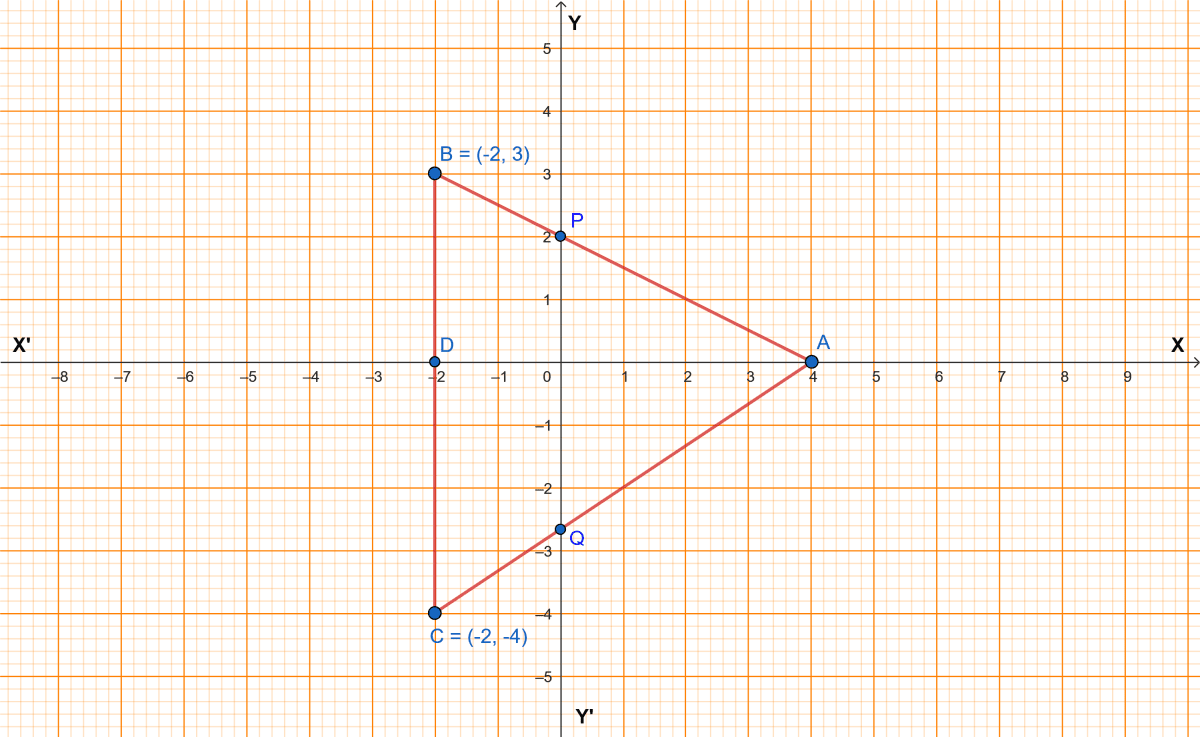
In the figure, given, ABC is a triangle and BC is parallel to the y-axis. AB and AC intersect the y-axis at P and Q respectively.
(i) Write the co-ordinates of A.
(ii) Find the length of AB and AC.
(iii) Find the ratio in which Q divides AC.
(iv) Find the equation of the line AC.
A line AB meets X-axis at A and Y-axis at B. P(4, -1) divides AB in the ratio 1 : 2.
(i) Find the co-ordinates of A and B.
(ii) Find the equation of the line through P and perpendicular to AB.
